Nuro Bets on the ‘Second Mover’ Advantage to Challenge Waymo’s Robotaxi Dominance
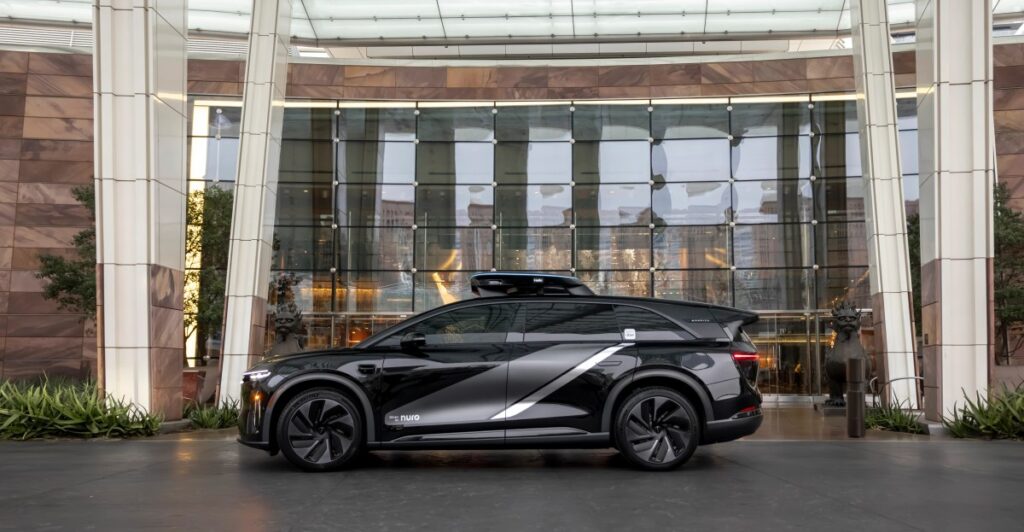
Table of Contents
The Art of the Late Entry
In the high-stakes race for autonomous ride-hailing, Waymo has long been the undisputed frontrunner. With a fleet of over 3,000 driverless cars operating across ten U.S. cities, the Alphabet-owned company has effectively mapped the minefield of urban autonomous transit. For most competitors, being behind feels like a deficit. For Nuro, it’s a strategic asset.
Nuro, founded by former Google self-driving project veterans, is positioning itself not as a trailing competitor, but as a ‘second mover.’ After spending years perfecting small-scale delivery bots, Nuro pivoted toward passenger robotaxis in 2024. The shift is backed by a heavy-hitting alliance with Uber and Lucid, designed to scale a driverless fleet across the U.S. with a level of industrial integration that few other startups have managed.
According to co-founder and co-CEO Dave Ferguson, the value of this timing is the ability to conduct a real-time post-mortem on the industry’s early failures. By observing where Waymo stumbles—whether in complex intersection navigation or operational scaling—Nuro’s engineers can ‘kick the tires’ on their own systems before they ever hit the pavement in a commercial capacity.
A Three-Way Industrial Play
While Waymo largely controls its own vertical stack, Nuro is executing a different blueprint. Their model is a tripartite ecosystem involving a rideshare network, a luxury automaker, and an AI startup. Nuro provides the sensing and compute stack, which is integrated directly into the Lucid Gravity SUV on the production line.
This means the vehicles leave the factory as Level 4 autonomous machines, bypassing the clunky retrofitting process that has plagued other AV efforts. These vehicles are then sold to Uber, which handles the heavy lifting of fleet management, depot operations, and the consumer-facing app interface. It is a lean approach that allows Nuro to focus on the software intelligence while Uber manages the logistical nightmare of urban fleet operations.
Redefining the Operational Launch
The company is currently eyeing San Francisco for its initial rollout later this year, having already secured the first of several necessary permits. However, Ferguson is pushing back against the ‘incremental’ playbook. Many AV companies launch with highly restricted operational design domains (ODDs)—limiting cars to specific neighborhoods or avoiding unprotected left turns—and slowly expanding over years.
Nuro intends to launch with a broader utility from day one. While certain high-complexity environments like freeways may follow later, the goal is to provide a service that feels useful to the average commuter immediately, rather than a glorified tech demo restricted to a few city blocks.
The Remote Assistance Debate
As Nuro prepares for launch, it is stepping into a regulatory storm regarding ‘remote assistance.’ Recent congressional scrutiny has targeted Waymo and other operators over their use of offsite workers to oversee driverless fleets, with critics suggesting these cars are being ‘driven’ via remote control.
Ferguson is quick to clarify the distinction. He argues that remote assistance isn’t about playing a video game with a car in a different city, but rather providing high-level prompts to help a vehicle resolve a ‘confusion’—such as a construction worker waving traffic into a lane the AI doesn’t trust. By clarifying this role, Nuro hopes to avoid the public perception that their AI is a facade for a hidden human driver.
Blending Legacy and End-to-End AI
The technical backbone of Nuro’s approach is a hybrid of the old and the new. The company is transitioning toward end-to-end learning models—where the AI learns driving behavior from data rather than hard-coded rules—which results in a more natural, human-like driving style. However, they are keeping their older, rules-based machine learning systems as a ‘sanity check.’
This duality allows Nuro to iterate quickly while maintaining a safety floor. By blending these methodologies, Nuro believes it can achieve a level of reliability that exceeds the first-generation efforts of its predecessors, turning its late arrival into a competitive edge.


