Navigating the Bashi Channel: How Indigenous Taiwanese are Using Ancient Astronomy to Reclaim the Great Pacific Migration
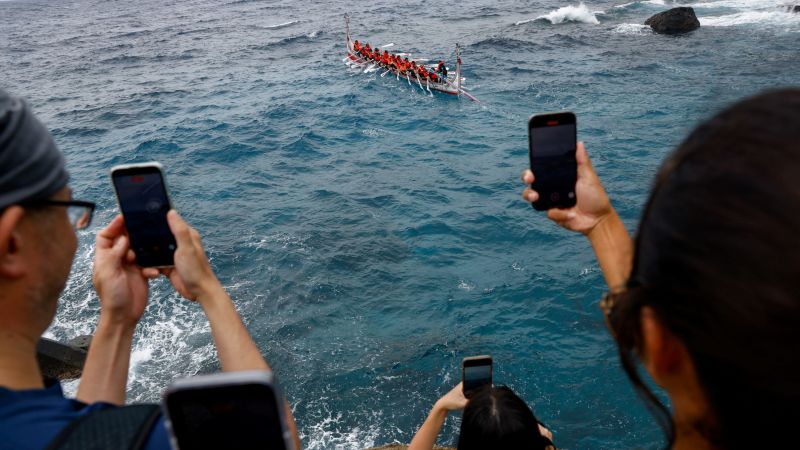
Table of Contents
The Return of the Ovayan: A 111-Mile Leap Into the Past
In a daring fusion of ancestral knowledge and physical endurance, 60 indigenous seafarers from Taiwan’s Orchid Island recently crossed the Bashi Channel, paddling a traditional wooden canoe 111 miles to Batan Island in the northern Philippines. This was not a leisure cruise or a modern sporting event; it was a calculated attempt to replicate the Great Pacific Migration, a movement of people that fundamentally reshaped the human geography of the Pacific and Indian Oceans over 4,000 years ago.
- The Vessel: The Ovayan (Golden Friendship), built without nails using traditional binding methods.
- The Route: From Orchid Island, Taiwan, across the Bashi Channel to Batan Island, Philippines.
- Navigation: Purely celestial; using star patterns and ocean currents rather than GPS or modern charts.
- The Goal: To validate the linguistic and genetic links between Taiwan’s indigenous peoples and the wider Austronesian diaspora.
The voyage serves as a living laboratory for ancient maritime technology. By eschewing modern electronics, the crew—primarily from the Tao community—demonstrated that the perceived “impossibility” of such a journey in antiquity was a myth. The success of the trip underscores the sophistication of early human navigation and the resilience of indigenous knowledge systems that have survived despite centuries of marginalization.
The Technicality of the ‘Out of Taiwan’ Theory
To understand why this voyage is significant, one must look at the Out of Taiwan theory. In archaeology and linguistics, this hypothesis posits that Taiwan is the primary urheimat (homeland) of the Austronesian-speaking peoples. According to this model, ancestors of today’s Filipinos, Malaysians, Indonesians, and eventually Polynesians and Madagascan peoples originated on the island of Taiwan approximately 5,000 years ago.
Emeritus Professor Peter Bellwood of the Australian National University, a leading authority on Southeast Asian prehistory, asserts that the archaeological and DNA evidence is “absolutely certain.” The migration wasn’t a single event but a staggered expansion. These early voyagers didn’t just drift; they carried a “transported landscape” with them. This included taro, yams, and livestock—essential biological technology that allowed them to colonize previously uninhabited islands across the Pacific.
Linguistic Evidence: The ‘Lima’ Connection
The most compelling evidence for this migration is found not in the soil, but in speech. Victoria Chen, a senior lecturer at Victoria University of Wellington, points to the shared lexicon across thousands of miles of ocean. A primary example is the word for the number five:
| Language | Region | Word for ‘Five’ |
|---|---|---|
| Bahasa Indonesia | Southeast Asia | Lima |
| Māori | New Zealand | Rima |
| Hawaiian | Central Pacific | ʻelima |
The high degree of linguistic diversity found specifically within Taiwan suggests it is the root of the tree. In linguistics, the area with the greatest internal diversity in a language family is typically the point of origin, as the languages had more time to diverge there than in the colonies they later established.
Engineering the Ovayan: Maritime Tech Without Nails
The construction of the Ovayan, or “Golden Friendship,” was a feat of community engineering involving over 200 people from six tribal communities. The vessel was built using traditional methods, avoiding nails and screws in favor of precise wood-cutting and organic binding. This isn’t just a cultural preference; it’s a functional design choice.
Hsieh Chen-Hsiung, a master shipbuilder involved in the project, noted that the seamless nature of the hull is critical. In a high-friction environment like the Bashi Channel, any uneven surface or protrusion creates drag, increasing the physical toll on the paddlers. By crafting a smooth, organically bound hull, the builders minimized resistance, allowing the canoe to glide more efficiently through strong currents.
This design allows the vessel to be flexible. Unlike a rigid, nailed hull that might crack under the torsion of heavy Pacific swells, a bound hull can “flex” with the water, a technical adaptation that likely allowed ancient Austronesians to survive journeys to Easter Island and Madagascar.
The Science of Star Navigation
The most impressive aspect of the 111-mile journey was the reliance on celestial navigation. While modern ships rely on the Global Positioning System (GPS), the crew of the Ovayan used a mental map of the stars, known as a star compass.
Celestial navigation involves tracking the rising and setting points of specific stars on the horizon. By aligning the canoe with these stellar markers, navigators can maintain a consistent bearing over open water where no land is visible. This is combined with the observation of swell patterns—the way the ocean ripples after hitting a distant landmass—and the behavior of migratory birds, which often signal the proximity of an island.
For the Tao people, this knowledge is more than a skill; it is a reclamation of identity. The Tao are one of Taiwan’s smallest indigenous groups (approximately 5,120 people), and their maritime culture was nearly erased by modernization and shifting political borders. Relearning these navigation techniques is an act of cultural survival.
Geopolitical Friction and the ‘Out of Taiwan’ Narrative
While the science overwhelmingly supports the Taiwan origin point, the theory has recently become a flashpoint for geopolitical tension. Some academics in mainland China have challenged the “Out of Taiwan” model, suggesting instead that the Austronesian peoples originated in southern China.
Analysts suggest this is less about archaeology and more about territorial claims. By shifting the ancestral origin point to the mainland, Beijing can create a historical narrative that reinforces its assertions over Taiwan. However, the genetic markers and linguistic depth found on the island strongly contradict the southern China theory, making the Ovayan’s voyage a political statement as much as a cultural one.
What This Means for Modernity
The success of this journey challenges our modern definition of “primitive.” We often equate the absence of silicon and steel with a lack of sophistication. However, the ability to navigate thousands of miles of open ocean using only the stars and the wind requires a level of cognitive mapping and environmental integration that exceeds the capabilities of the average modern human. It proves that sustainable, low-impact technology can achieve global-scale results.
Frequently Asked Questions
Who are the Tao people?
The Tao (also known as the Yami) are an indigenous group residing primarily on Lanyu (Orchid Island) off the coast of Taiwan. They are renowned for their traditional boat-building skills and a culture deeply tied to the sea.
What is the Bashi Channel?
The Bashi Channel is a body of water in the Pacific Ocean that separates Taiwan from the Philippines. It is known for strong currents and unpredictable weather, making it a challenging route for small, non-motorized vessels.
Why is the ‘Out of Taiwan’ theory important?
It explains how a massive area of the globe—from Madagascar in Africa to Hawaii in the Pacific—was populated by people speaking related languages. It establishes Taiwan as a critical hub of human migration and cultural dispersion.
Did they really use no maps?
Yes, the crew relied on traditional navigation techniques. This includes “dead reckoning” (calculating position based on speed and direction) and celestial observation, rather than paper charts or electronic GPS.
How long did the journey take?
The 111-mile voyage was completed in roughly 24 to 48 hours, depending on the currents and the rotation of the paddlers, arriving at Batan Island the day after departure.
As the Ovayan arrived at Batan Island to the sound of drums and traditional dance, the voyage concluded not just as a physical achievement, but as a bridge across time. By proving that a traditional canoe can still conquer the Bashi Channel, the Tao people have reminded the world that the Great Pacific Migration was not a fluke of history, but a triumph of human intelligence and daring.