Mark Carney Signals Strategic Pivot as Canada Navigates US Trade Rupture and Critical Mineral Race
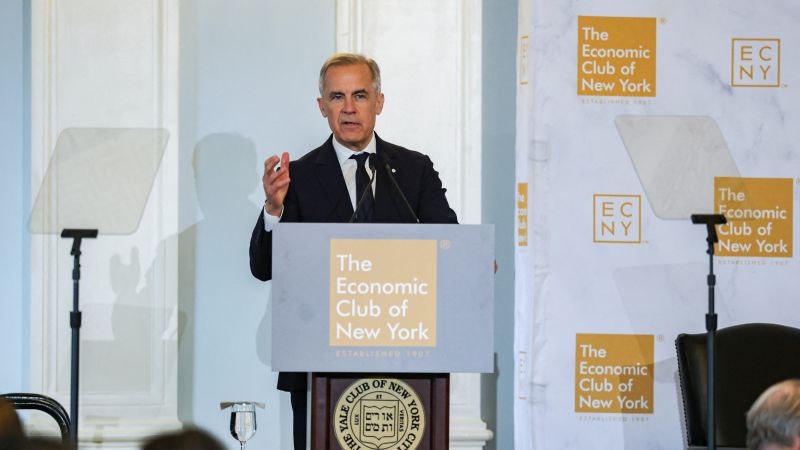
Table of Contents
A Precarious Balancing Act in New York
Speaking before the Economic Club of New York on Thursday, Canadian Prime Minister Mark Carney articulated a vision for a “new partnership” with the United States, framed not as a plea for leniency, but as a strategic necessity for North American industrial resilience. The appearance comes at a moment of profound friction, as Canada grapples with a global “rupture” characterized by a fundamental shift in how the U.S. manages its commercial borders.
Carney’s rhetoric highlighted the tension currently defining Ottawa’s foreign policy: the need to remain the United States’ most reliable partner while simultaneously insulating the Canadian economy from the volatility of American protectionism. This “dual-track” approach is a direct response to a trade environment where tariffs have surged to levels reminiscent of the Great Depression, and where the stability of the US-Mexico-Canada Agreement (USMCA) is under active review.
The Leverage of Critical Minerals and Automotive Tech
The core of Carney’s pitch to the U.S. rests on the intersection of energy security and emerging technology. While political rhetoric in Washington has fluctuated—ranging from trade threats to President Donald Trump’s provocative suggestions regarding the annexation of Canada—Carney focused on the hard assets that make Canada indispensable.
He specifically pointed to aluminum, automobiles, and critical minerals—the bedrock of the transition to green energy and advanced semiconductor manufacturing. By positioning Canada as the primary provider of reliable power and the raw materials necessary for American growth, Carney is attempting to pivot the conversation from a zero-sum trade dispute to a joint security imperative. In the current geopolitical climate, the ability to secure a non-adversarial supply of lithium, cobalt, and nickel is a strategic priority for the U.S. Department of Defense and the Department of Energy, giving Canada significant leverage in negotiations.
Diversification as a Defense Mechanism
Despite the conciliatory tone in New York, where Carney praised the U.S. as the most “dynamic and inventive” country in history, the Canadian government is quietly building an exit ramp from over-reliance on the American market. Carney revealed a concerted effort to double Canadian exports to non-U.S. markets over the next decade, a goal supported by more than 20 economic and security deals signed in the past year alone.
This shift toward strategic autonomy was evidenced earlier this week when Canada announced the acquisition of a fleet of military aircraft from Sweden. The move represents a departure from the historical precedent of relying almost exclusively on American aerospace manufacturers, signaling that Canada is willing to diversify its security infrastructure if the political cost of American partnership becomes too high.
The Beijing Reset and Global Financial Stability
The complexity of Canada’s position was further underscored by Carney’s comments on his recent diplomatic engagement with China. Following a period of severely strained relations under the administration of Justin Trudeau, Carney described his January meeting with President Xi Jinping as a “basic reset.”
However, the reset comes with conditions. Carney disclosed that he privately pressed the Chinese leadership to accept greater responsibility within the global monetary and financial system. By urging China to move its currency and financial mechanisms “away from the margins,” Carney is pushing for a more transparent, rules-based system that reduces the vulnerability of middle powers to the whims of any single superpower.
As U.S. trade officials continue talks in Mexico City regarding the overhaul of the USMCA—notably excluding Canada from the current round of discussions—Carney’s remarks suggest a leader who is hedging his bets. By framing a more independent Canada as a “better ally,” Carney is attempting to redefine the North American relationship for an era where interdependence is no longer seen as an inherent virtue, but as a vulnerability to be managed.