Lenovo Doubles Down on Modular Hardware and Foldable Gaming at MWC 2026
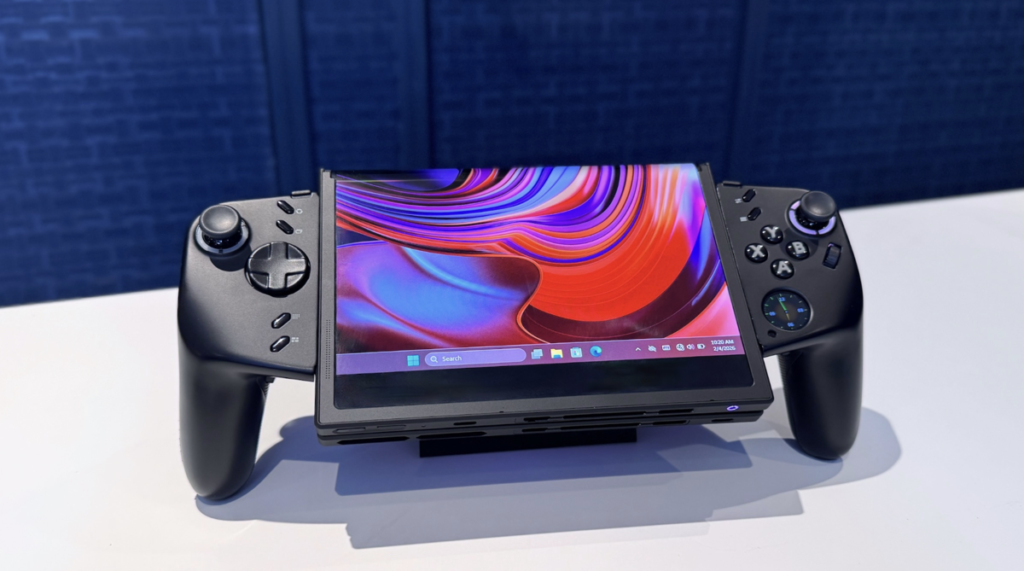
Table of Contents
A Shift Toward Adaptability
Coming off a dominant showing at CES, Lenovo has arrived at Mobile World Congress 2026 not just with a refreshed product catalog, but with a clear strategic pivot toward hardware modularity and form-factor experimentation. While the company continues to ship high volumes of traditional clamshells, the showcase in Barcelona reveals an obsession with devices that can change their identity based on the user’s immediate needs.
The centerpiece of this ambition is the Legion Go Fold Concept. This device attempts to bridge the gap between a handheld gaming console and a full productivity machine. It features a 7.7-inch POLED display that unfolds into a substantial 11.6-inch canvas. Unlike previous foldable attempts in the space, Lenovo is pairing this with a detachable wireless keyboard and a controller that doubles as a vertical mouse, effectively turning the handheld into a compact Windows laptop. The inclusion of an Intel Lunar Lake chip and 32GB of RAM suggests that this isn’t just a visual demo, but a prototype designed for actual performance.
The Fight Against Planned Obsolescence
Perhaps more significant than the foldables is Lenovo’s apparent embrace of the “Right to Repair” movement. The ThinkBook Modular AI PC Concept is a direct challenge to the industry standard of soldered components. Drawing a clear parallel to the philosophy of Framework, this concept allows users to swap ports and peripherals on the fly. The system utilizes pogo-pin connectors for data and power transfer, allowing for a detachable secondary display and interchangeable keyboard modules.
This modularity isn’t limited to the concept stage. Lenovo is extending these repairability wins into its commercial lineup. The T-Series models for 2026 have been redesigned for easier internal access, a trend that started with the Space Frame design seen in the ThinkPad X1 Carbon Gen 14 Aura Edition. For the enterprise sector, this shift reduces the total cost of ownership and extends the lifecycle of fleet deployments, a move that aligns with growing European regulatory pressure regarding electronic waste.
Mainstream Hardware and AI Integration
While the concepts grab the headlines, the Yoga 9i 2-in-1 Aura Edition serves as the flagship for the consumer market. Priced at $1,949 and launching in May, the updated 2-in-1 returns the headphone jack—a nod to user feedback—and integrates an Intel Core Ultra Series 3 chip. The addition of a magnetic Yoga Pen Gen 2 enabling a dedicated ‘Canvas mode’ suggests Lenovo is still targeting the creative professional who needs a tactile bridge between a tablet and a laptop.
The Ambient AI Desk
Lenovo is also attempting to move AI off the screen and into the physical environment. Two new tabletop prototypes, the AI Work Companion and the AI Workmate, represent the company’s vision for ‘ambient computing.’ The former acts as a discrete secretary, managing schedules via a ‘Thought Bubble’ interface and monitoring screen time to prevent burnout. The latter, the AI Workmate, is a more assertive, anthropomorphic device capable of scanning physical documents and projecting content onto nearby surfaces using local, on-device AI processing.
Across the board, the integration of the Qira personal AI agent is the glue holding these devices together. Lenovo confirmed that Qira will roll out to more than 20 devices in the coming weeks, signaling a transition from AI as a software feature to AI as a system-level operating layer.


