June 2026 Celestial Calendar: Planetary Alignments and Narrow Dark-Sky Windows for Astrophotographers
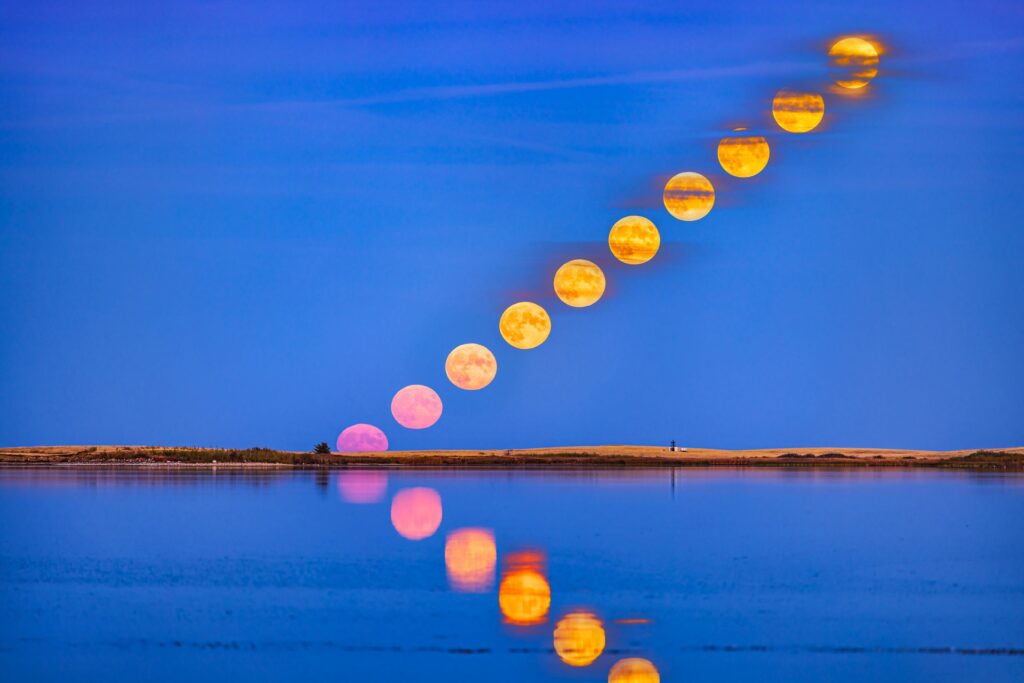
Table of Contents
The Twilight Parade: Venus and Jupiter Take Center Stage
For those tracking the 2026 celestial calendar, June opens with a high-contrast planetary display that favors the west-northwest horizon. The primary draw is a tight conjunction between Venus and Jupiter, which serves as a textbook opportunity for wide-angle landscape compositions. While Venus reaches its highest point relative to the horizon around June 5, the tightest proximity occurs on June 9, with the two planets separated by just over 1.5 degrees.
From a technical standpoint, the most photogenic window arrives on June 11, when Venus aligns almost directly above Jupiter. Mercury will also be visible, though its low altitude makes it a challenging target, appearing briefly before the horizon swallows it. To maximize the visual impact of this grouping, photographers should employ a short telephoto lens. This compresses the distance between the planetary bodies and the terrestrial foreground, creating a more dramatic sense of proximity than a standard wide-angle lens can achieve.
Navigating the Solstice: The Race for Dark Skies
Deep-sky imaging in June is always a race against the clock, particularly in mid-northern latitudes where the June solstice introduces lingering twilight. The critical window for high-contrast imaging opens following the last quarter moon on June 8. This leads into a period of genuine darkness as the moon wanes toward the new moon phase on June 14 and 15.
This gap, extending roughly until June 19, is the only viable time for capturing faint nebulae and star clusters without significant lunar interference. Targets such as the Great Globular Cluster in Hercules (M13) and the Lagoon Nebula in Sagittarius are prime candidates during this interval. Because the nights are at their shortest, the margin for error in timing is slim; any delay in setup can result in the loss of several hours of usable darkness.
Precision Targets: The Pleiades and the Beehive Cluster
Beyond the broad planetary alignments, June offers several precision-based targets that require a more disciplined approach to timing. In the pre-dawn hours, a waning crescent moon—illuminated at only 5%—will rise in the east-northeast, appearing adjacent to the Pleiades open cluster (M45). Mars will be positioned just to the right of this pairing, providing a rare triple-entity composition. This scene is fleeting, requiring a telephoto setup and a steady tripod to capture the faint glow of the Seven Sisters before the morning twilight washes out the frame.
Later in the month, the focus shifts back to the western sky. On June 17, a waxing crescent moon will sit between Jupiter and Mercury, though the remaining twilight brightness may hinder long-exposure work. A more significant event occurs on June 18, as a 12%-illuminated moon passes across the Beehive Cluster (M44). Capturing a cluster of over 100 stars with the moon in the frame requires careful exposure balancing to ensure the lunar surface isn’t blown out while the stars remain visible.
The Full Moon and the Role of Computational Astronomy
June’s full moon peaks at 7:57 p.m. EDT, providing a prime opportunity for atmospheric photography. The classic ‘moonrise’ effect—where the moon appears larger and shifts toward an orange hue due to Rayleigh scattering—is best captured by aligning the moon with specific architectural or natural landmarks. Tools like PhotoPills and TPE (The Photographer’s Ephemeris) remain essential for calculating the exact azimuth and altitude of the moon relative to the terrain.
While traditional 200mm to 600mm lenses remain the standard for lunar detail, there is a growing shift toward the use of smart telescopes. These devices integrate automated star-tracking and internal image processing, lowering the barrier to entry for those who lack the manual tracking expertise required for deep-space objects. By automating the alignment and stacking process, these tools are increasingly capable of delivering gallery-quality lunar and planetary images that previously required a dedicated equatorial mount and hours of post-processing.