HoverAir Aqua: The Rare Case of a Drone You’re Actually Encouraged to Sink
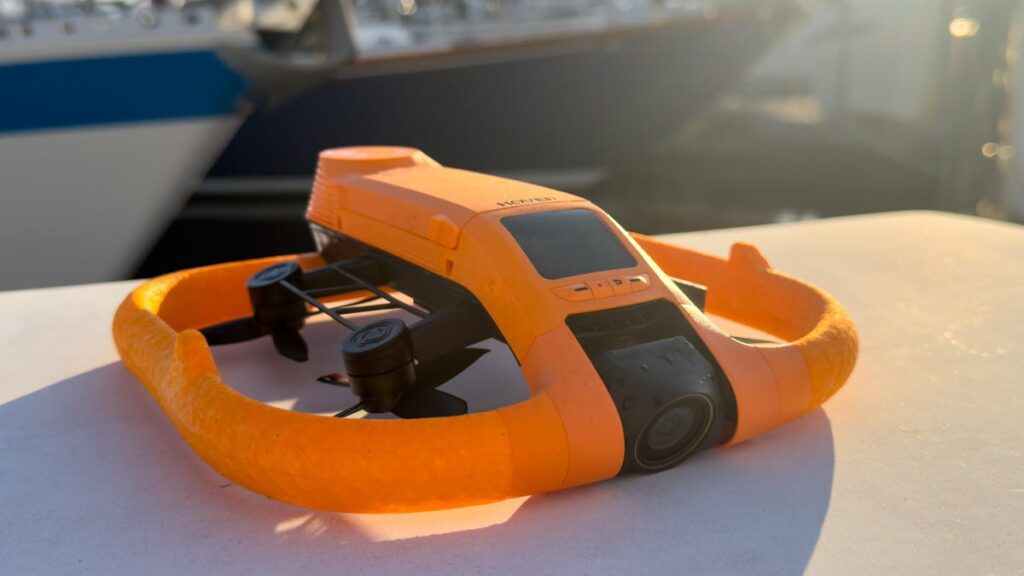
Table of Contents
Overcoming the ‘Water Panic’
Every drone pilot knows the specific, visceral spike of anxiety that occurs when a quadcopter drifts too close to a shoreline or a lake surface. For most, the water is a binary outcome: either the drone flies perfectly, or it becomes an expensive piece of artificial reef. The HoverAir Aqua is designed specifically to eliminate that tension, treating the water not as a hazard, but as a launchpad.
Unlike traditional drones that require a dry, flat surface for takeoff, the Aqua is built for a life of saturation. It doesn’t just resist splashes; it is designed to be tossed overboard. During initial testing in the choppy waters of a Seattle marina, the transition from ‘floating object’ to ‘aerial camera’ happens with a loud, sputtery burst of rotors cutting through surface tension—a chaotic but effective sequence that signals the start of its flight.
The Hardware: Buoyancy and Beacons
The system is a two-part ecosystem consisting of the 249g quadcopter and a specialized wearable transmitter called the Lighthouse. By keeping the weight under 250g, HoverAir is clearly targeting the regulatory sweet spot to avoid cumbersome registration processes in many jurisdictions, though the drone’s current availability remains a point of contention. Despite its global rollout to 50 countries, the Aqua is currently unavailable in the US, citing “administrative and regulatory complexities”—a frustrating hurdle for the North American market.
The drone itself is ruggedized with an IP67 rating, featuring foam guards that provide essential buoyancy and a 1.6-inch AMOLED screen for on-device configuration. The real intelligence, however, resides in the Lighthouse. This chunky orange beacon is strapped to the user’s arm or leg, acting as the primary anchor for the drone’s tracking algorithms. Rather than relying solely on visual computer vision, which can struggle with the reflective, shimmering surfaces of moving water, the Lighthouse provides a hardware-level lock that ensures the drone knows exactly who to follow.
Autonomous Tracking in the Surf
The Aqua is less a ‘drone’ in the traditional sense and more of a flying tripod. While it can be operated via a smartphone app for manual control, its primary value proposition is its autonomous modes. Using the Lighthouse, users can trigger launches and recalls with a single button, allowing athletes to focus on their sport rather than a controller screen.
In practical application, ‘Kayak mode’ proves highly effective, maintaining a consistent distance while trailing the user from behind. For those looking for more cinematic flair, the drone offers Orbit Follow and Spiral modes, which blend altitude changes with circular movement to create professional-looking b-roll without the need for a dedicated pilot. The device is rated for speeds up to 34 mph (55 km/h), making it viable for faster activities like windsurfing or foil-boarding.
The ‘Turtle Flip’ and Surface Intelligence
One of the most pragmatic additions to the Aqua is the ‘Turtle Flip’ feature. In a real-world water environment—especially in surf—a lightweight drone is prone to being flipped upside down by a wave or a clumsy landing. Instead of requiring a manual rescue mission, the Aqua can automatically right itself from a submerged, inverted position.
Interestingly, the camera’s ability to rotate 90 degrees transforms the drone into a surface-level probe. Before takeoff, the Aqua can record footage of what is happening beneath the surface while bobbing on the water, bridging the gap between a GoPro-style underwater camera and a traditional aerial drone.
With a price tag of $1,299, the HoverAir Aqua isn’t just selling flight; it’s selling the confidence to fail. By removing the fear of the crash, it opens up a new angle of cinematography for water sports that was previously too risky for high-end gear.


