Europol Takedown of ‘First VPN’ Exposes Thousands of Cybercriminals Who Thought They Were Invisible
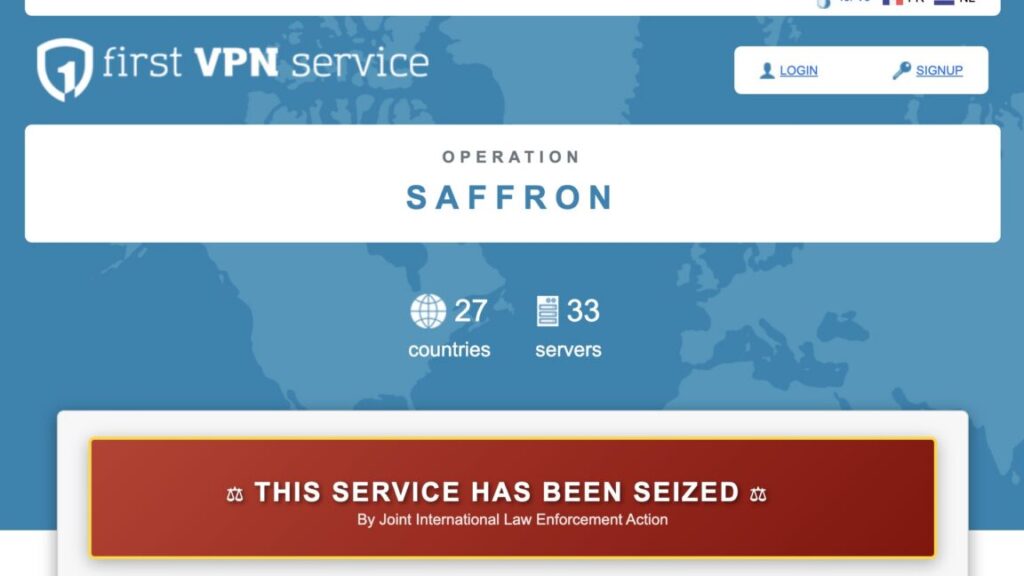
Table of Contents
The Illusion of Anonymity
For nearly a decade, First VPN marketed itself as the ultimate sanctuary for the digital underworld. Promoted heavily across Russian-speaking cybercrime forums, the service promised a world where “Big Brother” could not watch—a jurisdiction-free zone where encrypted communications and anonymous payments guaranteed total invisibility. In reality, that invisibility was a facade. Europol recently announced the complete dismantlement of the service, revealing that law enforcement had been inside the network for years, monitoring the very criminals who believed they were safe.
The operation, led by authorities in France and the Netherlands with critical support from Europol and Eurojust, culminated in the seizure of multiple domains and the arrest of the service’s administrator in Ukraine. For the users of First VPN, the wake-up call was blunt: a seizure notice now occupies the domains once used to sell the dream of total privacy.
A Long-Game Intelligence Operation
This wasn’t a sudden raid, but a calculated, multi-year infiltration. The investigation began in December 2021, but police didn’t immediately pull the plug. Instead, they played the long game. By gaining access to the service’s internal infrastructure and user databases, investigators were able to map the connections between VPN traffic and specific cybercriminal activities.
The Dutch National Police Corps noted that for a significant period, authorities had direct access to the traffic of users who operated under the mistaken belief that their identities were shielded. This period of observation turned the VPN into a massive intelligence-gathering tool for the state. By the time the servers were physically dismantled on May 19 and 20, law enforcement had already harvested a wealth of data.
According to Europol, the operation yielded 83 “intelligence packages” and the identification of 506 specific users whose data has since been shared internationally. The fallout is already feeding into 21 different Europol-supported investigations, turning a single service provider into a roadmap for dozens of unrelated criminal cases.
Infrastructure for the Ransomware Ecosystem
First VPN was not a general-purpose privacy tool. According to the FBI, the service was specifically engineered for the cybercrime ecosystem, utilizing 32 exit node servers across 27 countries to facilitate network reconnaissance and intrusions. The FBI’s intelligence alert suggests the infrastructure was a favorite for at least 25 different ransomware groups, including Avaddon.
The service’s utility for these groups went beyond simple masking. FBI analysts observed that First VPN IP addresses were consistently used for “password spraying” and brute-force attacks against exposed services like SSH and RDP, as well as scanning for open ports to identify vulnerable network configurations. Essentially, First VPN provided the cloaking device necessary for ransomware operators to probe corporate networks without triggering immediate geography-based red flags.
The ‘No-Logs’ Paradox
The First VPN case highlights a recurring tension in the digital privacy market: the “no-logs” promise. Like many commercial VPNs, First VPN claimed it stored no records of user activity. However, the reality of the First VPN takedown proves that when a service specifically targets criminals, the likelihood of internal logging—or the susceptibility of the provider to law enforcement infiltration—increases exponentially.
While the Dutch police emphasized that this specific service was uniquely criminal in its targeting, the event serves as a reminder of the inherent risk in trusting any single point of failure for anonymity. By promising that it was “not subject to any jurisdiction,” First VPN created a false sense of security that ultimately led its users directly into a law enforcement trap.
The operation concluded with the seizure of domains including 1vpns.com, 1vpns.net, and 1vpns.org, along with several associated .onion sites. In a final, psychological blow to the user base, Europol confirmed that users of the service have been notified that the system is shut down and, more importantly, that they have been identified.