Cloudflare’s Turnstile is Quietly Locking Out Privacy-Focused Browsers via WebGL Fingerprinting
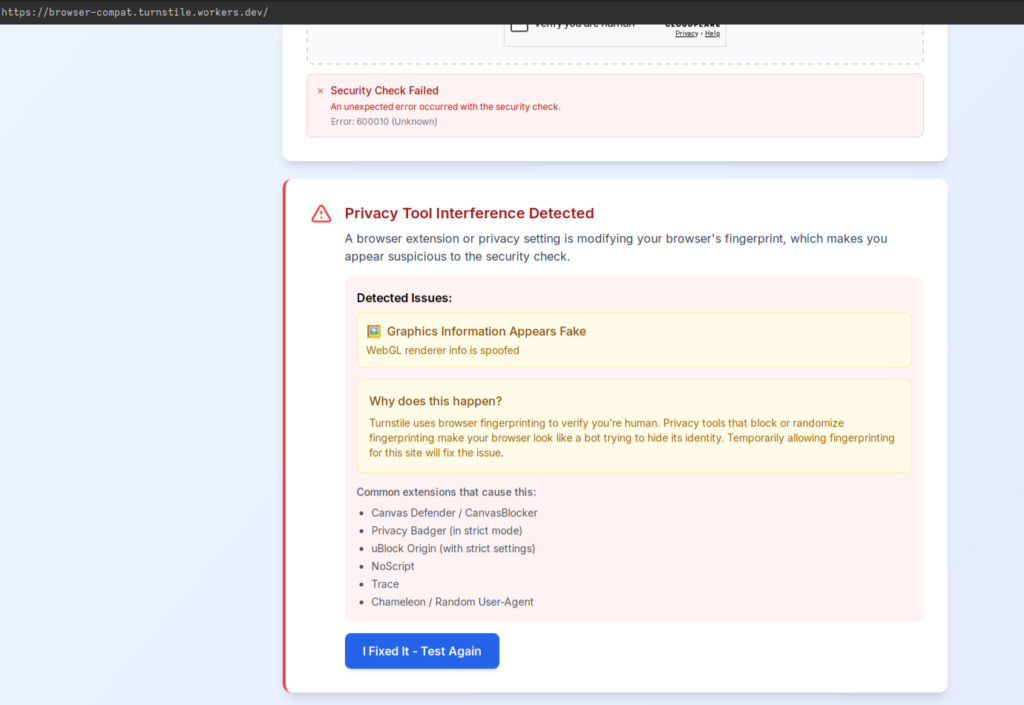
Table of Contents
The ‘Infinite Loop’ of Human Verification
For users of niche, privacy-centric browsers, the internet is becoming a series of impenetrable walls. A growing number of reports indicate that Cloudflare Turnstile—the company’s “non-interactive” replacement for traditional CAPTCHAs—has begun triggering infinite verification loops for users on WebKitGTK-based browsers and those utilizing aggressive anti-fingerprinting tools.
The issue manifests as a relentless cycle: the user clicks the “Verify you are human” checkbox, the page refreshes or spins, and the prompt reappears indefinitely. While Cloudflare markets Turnstile as a frictionless experience, for a specific subset of the web, it has become a hard lockout.
The WebGL Fingerprinting Requirement
The root of the conflict lies in how Cloudflare determines “humanness.” According to technical analysis from the privacy community, Turnstile has increasingly relied on WebGL (Web Graphics Library) fingerprinting to validate device identity. WebGL allows a website to query the specific hardware characteristics of a user’s graphics card and driver version, creating a unique digital signature—a fingerprint—that can track users across the web even without cookies.
Cloudflare’s official stance on this mechanism is blunt: the company asserts that privacy tools which block or randomize fingerprinting make a browser appear like a bot attempting to hide its identity. By their logic, if a browser refuses to provide a hardware fingerprint, it is inherently suspicious.
However, this creates a fundamental clash with the design philosophy of WebKitGTK and other hardened browser environments. WebKit, the engine powering Safari, has long maintained strict defaults against certain types of fingerprinting to protect user anonymity. Because WebKitGTK implements these protections by default, Cloudflare’s verification system views these browsers as “bots” by definition, effectively banning a significant portion of the Linux-based privacy community from accessing thousands of websites protected by the service.
The Safari Exception and the Mozilla Gap
There is a glaring inconsistency in this enforcement. While WebKitGTK users are locked out, Apple’s Safari—which uses the same underlying WebKit engine—generally passes Turnstile verification. This suggests that Cloudflare has implemented a whitelist for Safari, essentially deciding that Apple’s ecosystem is “trusted” while the open-source implementation of the same engine is not.
The situation is further complicated by emerging vulnerabilities in other major browsers. Recent reports and Bugzilla filings (notably Bugzilla#1916271) suggest that Mozilla Firefox has struggled with its own WebGL fingerprinting protections. Documentation indicates that Gecko, Firefox’s engine, has occasionally revealed sanitized GPU characteristics that should have been hidden, failing to match the hardcoded strings used by Blink or WebKit to mask identity.
Furthermore, some users have noted that the privacy.resistfingerprinting flag in Firefox is not always active even when “Strict” Enhanced Tracking Protection is selected. This gap in implementation means that while some Firefox users are currently slipping through Cloudflare’s net, they may face similar lockouts as Cloudflare tightens its hardware-verification requirements.
The Trade-off Between Security and Anonymity
This development highlights a growing trend in the “bot war” of the 2020s. As AI-driven automation becomes more sophisticated, security firms like Cloudflare are moving away from behavioral analysis (how you move your mouse) toward hardware analysis (what your GPU is).
The implication is a narrowing definition of a “standard browser.” If the only way to prove you are human is to allow a corporation to fingerprint your hardware, then anonymity is no longer a viable state for the general web user. For those using WebKitGTK, the current solution is a frustrating compromise: either disable the very privacy protections that led them to use the browser in the first place, or remain locked out of the modern web.