Beyond the Black Box: The Rise of ‘Bimbo Tech’ and the Feminine Cyberdeck Movement
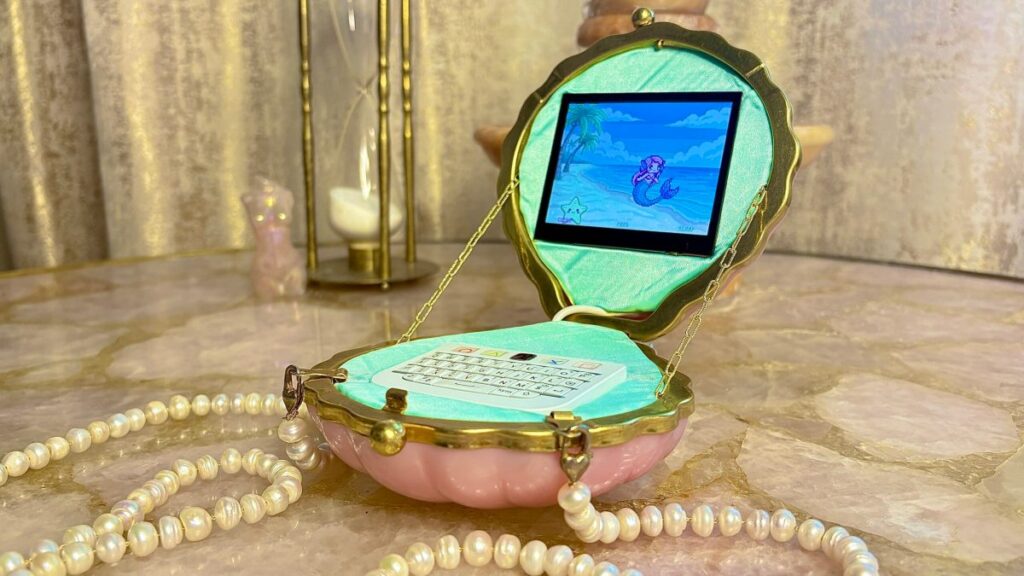
Table of Contents
The Aesthetic of Resistance
For decades, the “pro” aesthetic of consumer electronics has been defined by a specific, sterile palette: space gray, matte black, and brushed aluminum. In the world of high-performance computing, utility has almost always been synonymous with a lack of ornamentation. But a growing community of makers is currently dismantling that narrative, replacing the sleek minimalism of Silicon Valley with glitter, faux fur, and pink acrylics.
At the center of this movement is the ‘cyberdeck’—a term coined by William Gibson in his 1984 novel Neuromancer to describe a portable, often ruggedized computer. While the traditional cyberdeck community has long been a bastion of military-grade chassis and mechanical keyboards, a new wave of creators is pivoting toward what some call “Bimbo Tech.” This approach blends hyper-feminine aesthetics with deep technical curiosity, turning everything from seashell purses to Barbie dollhouses into functional workstations.
CC, a prominent voice in the movement and founder of the blog Bimbo Tech, describes her latest project as a seashell-themed cyberdeck that functions as an e-reader and a portal to her home servers. “It’s networked to my vault and my servers, so it has access to all of my server data, which has all my PDFs, books, and notes,” she explains. For CC, the project isn’t just about the visual appeal; it is about accessibility. By documenting her builds for women who may not yet know the intricacies of RAM or GPIO pins, she is lowering the barrier to entry for hardware hacking.
Decoupling Utility from Aesthetics
The rise of the feminine cyberdeck is more than a visual trend; it is a critique of the “black box” nature of modern tech. Most contemporary devices, from the iPhone to the latest Pixel, are designed to be opaque. Attempting to modify the hardware or jailbreak the software often voids warranties and alienates the user from the machine they technically own.
“I love seeing people taking the power back into their hands,” CC says. “It obviously always means creativity when people are given the means to go outside of the black box.” This sentiment is echoed by creators like Sarahbelle Kim, who advocates for the use of thrifted components and eBay finds to build devices that evade the surveillance-heavy ecosystems of big tech. By building a custom machine, the user controls the OS, the data flow, and the physical form, creating a level of digital sovereignty that a mass-market tablet cannot provide.
The Weaving of History and Hardware
While some projects focus on the surreal, others, like those of blockchain developer Maro Vandanyan, draw a direct line back to the origins of computing. Vandanyan describes her work as “crocheting with computers,” creating wearable tech such as Raspberry Pi corsets and macrame motherboards.
This isn’t merely a fashion statement; it is a historical reclamation. Before the era of silicon processors, the Apollo Guidance Computer that powered the moon landing relied on magnetic-core memory. This memory was created by women textile workers who meticulously hand-wove copper wires into complex patterns to encode binary data. The very foundation of modern computing was built on labor often dismissed as “domestic” or “feminine.”
“The original processor was handwoven by seamstresses, not by engineers,” Vandanyan notes. “I feel like the hand weaving, and even the fashion-meets-technology… it’s so full circle.” By integrating conductive thread and acrylic shells to protect her Raspberry Pi builds, Vandanyan merges the ancient art of weaving with the modern art of the circuit board.
Pushback and the Cult of Optimization
The movement has not been without friction. The cyberdeck community, often rooted in a culture of extreme optimization and technical purity, has occasionally met these projects with condescension. On platforms like Reddit and X, creators have faced criticism for “wasting” hardware during chip shortages or questioning the practicality of a computer housed in a purse.
However, the insistence on impracticality is precisely the point. In an era of peak efficiency and algorithmic optimization, building a computer that is intentionally cumbersome or “frivolous” is a radical act. It prioritizes the joy of creation and the intimacy of the build over the cold metrics of productivity. For the creators of Bimbo Tech, the goal isn’t to build a better laptop—it’s to build a more human relationship with the machines that define their lives.


