Asus Goes All-In on Excess: The ROG Edition 20 Lineup is a 3,000W Love Letter to Overkill
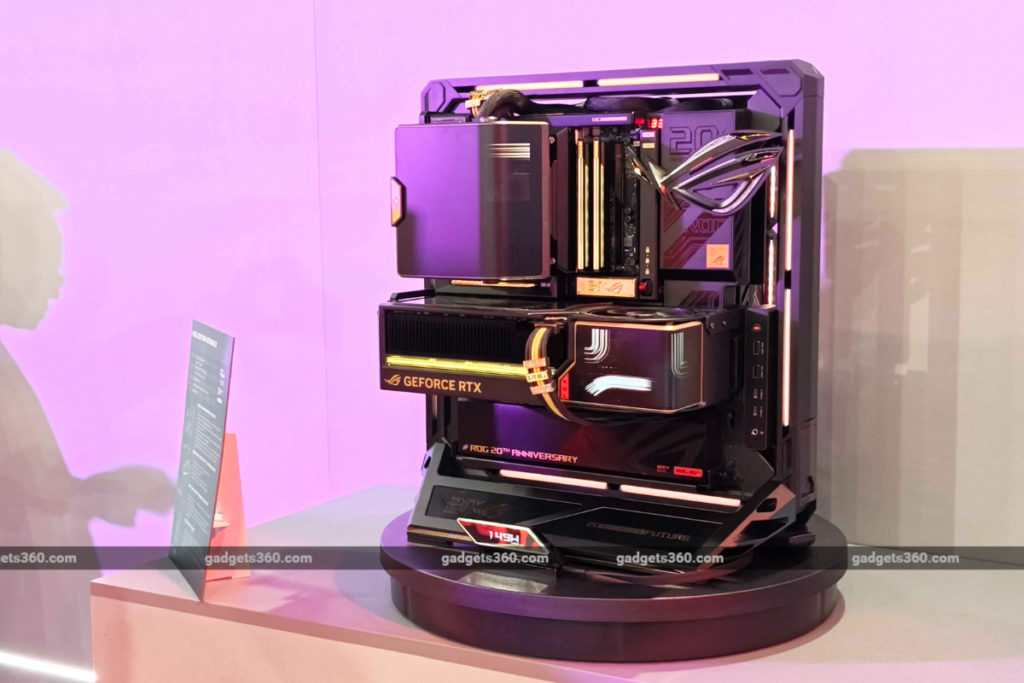
Table of Contents
A Celebration of Hardware Extremism
Asus isn’t just marking a milestone; it’s attempting to redefine the ceiling of consumer gaming hardware. Ahead of Computex 2026, the Taiwan-based giant held a pre-event showcase in Taipei to unveil the ‘ROG Edition 20’ lineup. The series commemorates two decades since the 2006 launch of the Republic of Gamers (ROG) brand, and the hardware reflects a company that has spent twenty years learning how to push power limits to the breaking point.
The visual identity of the collection is a departure from the neon-heavy aesthetics of recent years. The Edition 20 series adopts a sophisticated “ROG Black” colorway, accented with Radiant Gold and Crystal Lens elements. It’s a design language that leans more toward luxury automotive styling than typical RGB-laden gaming gear, signaling a shift toward a more “prestige” segment of the enthusiast market.
The Motherboard: Integration Over Modularity
At the heart of the lineup is the ROG Crosshair X870E Edition 20. While high-end motherboards usually serve as the foundation for third-party cooling, Asus has opted for an integrated approach. The board features a built-in AIO cooling architecture, merging the ROG Ryujin Edition 20 solution with a full-width thermal deck designed to aggressively manage CPU and VRM temperatures.
Under the hood, Asus has partnered with Asetek to implement the EMMA Gen10 V3Rx pump, targeting high-pressure efficiency. The most striking addition, however, is the Swivel Dual 6.67-inch LCD screen setup. Rather than a static display, these screens can be adjusted, allowing builders to customize their telemetry or aesthetics based on the viewing angle of the chassis.
The Power Problem: 3,000 Watts of GaN
Perhaps the most audacious piece of hardware in the showcase is the ROG Thor 3000W Titanium III Edition 20. In an era where 1,000W is considered ample for most high-end rigs, a 3,000W unit seems purely theoretical—until you look at the target use case. Asus is explicitly designing this PSU to power configurations running up to four Nvidia GeForce RTX 5090 GPUs simultaneously.
To achieve this without the unit becoming a space heater, Asus has utilized server-grade GaN (Gallium Nitride) MOSFETs. These components allow for higher efficiency and better thermal management in a smaller footprint, bridging the gap between enterprise-grade data center power and consumer gaming desktops.
The GPU and Chassis: Airflow and Aesthetics
The graphics centerpiece is the ROG Astral GeForce RTX 5090 Edition 20. While the Blackwell architecture is already known for its thermal demands, Asus has countered this with a quad-fan array. According to the company, this configuration increases airflow and static pressure by 20% over previous flagship designs, likely a necessity given the power draw of the 50-series silicon.
Housing this hardware is the ROG GR20 Edition 20 modular PC case. It follows the same “ROG Black” and gold aesthetic, but its primary value is its modularity. The case is designed to accommodate the massive footprint of the Astral GPU and the integrated cooling of the X870E motherboard without compromising the internal cable management.
Small Form Factor, Massive Power
For those not interested in a full-tower behemoth, Asus introduced the ROG NUC 16 Edition 20. This desktop leverages a semi-transparent black chassis with gold hues, packing an RTX 5090 that supports DLSS 4.5. The engineering challenge here was thermal dissipation; Asus claims a combined CPU and GPU heat dissipation of up to 300 watts via the QuietFlow cooling solution. This allows the NUC to drive up to five 4K monitors, effectively turning a small-form-factor PC into a professional-grade workstation.
The ROG Edition 20 lineup arrives at a time when the line between “gaming PC” and “AI workstation” is blurring. By offering 3,000W power supplies and quad-GPU support, Asus isn’t just targeting the gamer who wants a high frame rate—they are courting the local AI developer and the extreme enthusiast who views power efficiency as a secondary concern to absolute performance.


