Apple’s watchOS 27 Cutoff Hits 2022 Hardware, Signaling a New Era of AI-Driven Obsolescence
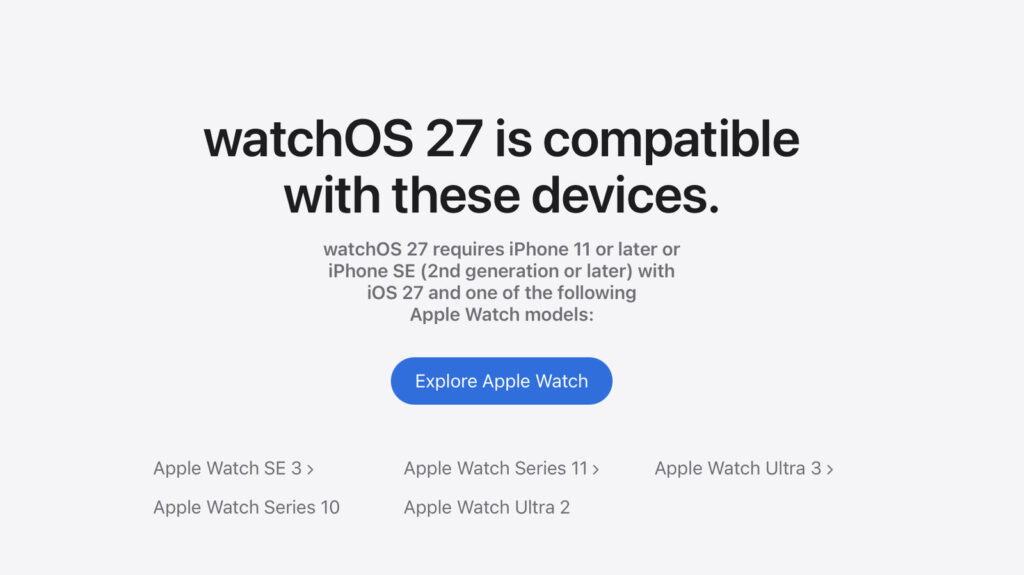
Table of Contents
A Sharper Cutoff for Wearables
While the fanfare of WWDC typically focuses on the expansive capabilities of new software, the more critical story for existing users is often the ‘cutoff line’—the invisible boundary where hardware becomes obsolete. With the announcement of watchOS 27, Apple has drawn that line significantly deeper into its recent catalog than many users expected. Specifically, two mainstay devices from 2022 are being left behind.
The compatibility list for watchOS 27 is surprisingly lean. Official documentation indicates the update will target the Apple Watch SE 3, Apple Watch Series 10, Apple Watch Series 11, Apple Watch Ultra 2, and Apple Watch Ultra 3. This leaves the original Apple Watch Ultra and the Apple Watch SE 2—both flagship-tier or high-volume entries from just a few years ago—without a path to the latest operating system.
The Hardware Gap and the AI Tax
The decision to drop 2022 hardware is a departure from Apple’s historical approach to iOS. For comparison, iOS 27 is expected to maintain support for devices as old as the iPhone 11, extending the software lifecycle of the smartphone far beyond that of the wearable. This discrepancy suggests that the bottleneck isn’t simply a matter of OS bloat, but a fundamental requirement for new silicon capabilities.
Central to this year’s keynote was the complete overhaul of Siri, now powered by deeper integration with Apple Intelligence. These on-device generative AI features require significant Neural Engine (NPU) throughput and memory bandwidth. It appears the S-series chips powering the 2022 models simply cannot meet the minimum compute requirements to run the new AI-driven Siri and its accompanying contextual awareness features without compromising battery life or system stability.
Correcting the Series 9 Confusion
The rollout of the compatibility list was not without its friction. Early documentation appeared to omit the Apple Watch Series 9, a device released in 2023. Such an omission would have been an unprecedented move, as Apple rarely drops a device only one generation old. After initial reports of the omission, Apple confirmed to Engadget that the Series 9 will, in fact, be supported.
This correction highlights the tension between Apple’s desire to push the ‘AI-first’ narrative and the reality of its hardware fragmentation. While the Series 9 survives, the exclusion of the original Ultra is particularly stinging for enthusiasts. The Ultra was marketed as the ‘ultimate’ watch, designed for longevity and ruggedness; seeing it phased out of software support only four years after its inception challenges the narrative of the Ultra as a long-term investment.
The New Lifecycle Standard
This shift suggests that Apple is moving toward a tiered support model based on AI capability rather than chronological age. If the NPU is the new primary metric for compatibility, we may see more aggressive deprecation cycles across the entire ecosystem. Users who bought the SE 2 as a budget-friendly entry point are now finding that ‘budget’ comes with a shorter shelf life in the age of generative AI.
For now, those on the original Ultra and SE 2 will continue to receive security updates, but they will miss out on the transformative AI features that define watchOS 27. As Apple continues to tighten the integration between its LLMs and its hardware, the gap between ‘supported’ and ‘obsolete’ is likely to shrink.