Amazon’s Bee Wearable is a Productivity Powerhouse That Feels Like a Privacy Nightmare
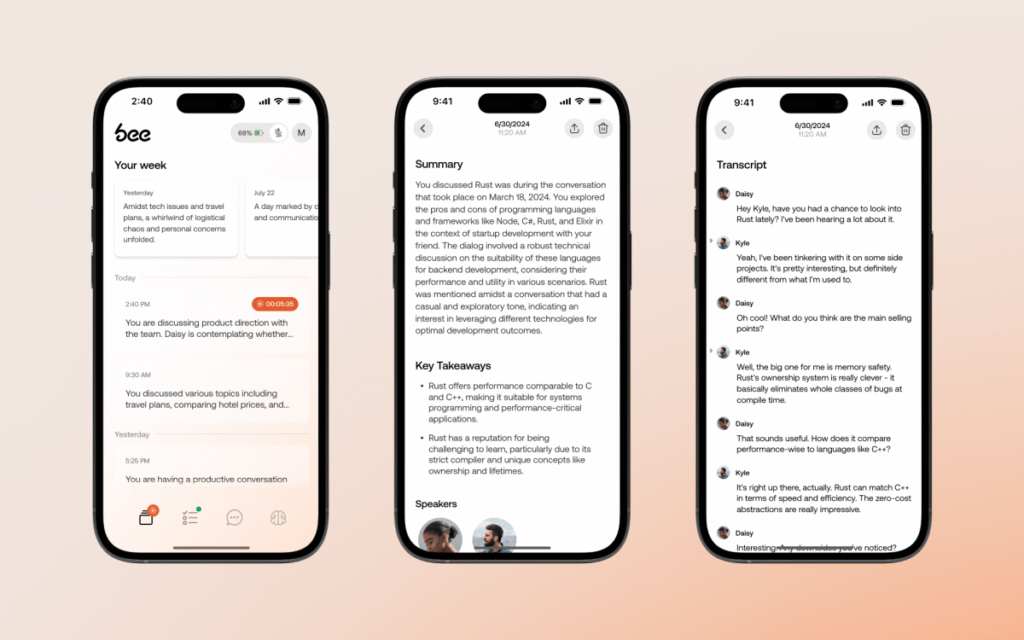
Table of Contents
The Always-On Assistant
The premise of the Bee wearable is simple: total cognitive offloading. Acquired by Amazon last year and recently updated with a suite of refined AI features, Bee isn’t trying to replace your phone. Instead, it acts as a persistent, wrist-mounted scribe designed to record, transcribe, and summarize the friction of daily life.
Setting up the device is straightforward. After syncing it with the Bee mobile app and inputting basic personal details, the hardware functions primarily through a single physical button. A flashing green light indicates the device is actively recording; when the light goes dark, the microphones are off. Once a session concludes, the app processes the audio into an automated summary and a full text transcription.
In a professional setting, the utility is immediate. During a recent business-related call—conducted with the other party’s consent—Bee proved to be a remarkably competent administrative assistant. The resulting summary didn’t just regurgitate the conversation; it segmented the talk into logical blocks, allowing for a quick review of key decisions without the need to scrub through a twenty-minute audio file. While this functionality mirrors software like Otter or Granola, the form factor of a wearable removes the friction of opening an app and hitting ‘record’ on a laptop.
The Friction of Privacy
However, the transition from a professional tool to a personal companion is where the experience becomes unsettling. For anyone with a baseline concern for digital surveillance, the prospect of wearing an eavesdropping device 24/7 is a difficult pill to swallow. The device essentially creates a searchable database of your spoken life, a concept that feels more like a Black Mirror episode than a productivity hack.
This discomfort extends beyond the microphones. To function at its peak, Bee requires an expansive set of mobile permissions. It asks for access to your location, photos, contacts, calendar, and notifications. There is even an option to integrate health data, meaning Amazon could potentially correlate your resting heart rate or sleep patterns with the specific conversations you were having during the day.
During a casual test run at a movie night with friends, the AI’s contextual awareness was surprisingly sharp. While watching Reservoir Dogs, the device didn’t mistake the cinematic violence for a real-world emergency. Instead, it correctly identified the environment and labeled the subsequent discussion as “Tarantino Film Scene Analysis.” It is an impressive feat of Natural Language Processing (NLP), but it also serves as a reminder of just how much the device is interpreting from your surroundings.
The Cloud Problem
The most significant hurdle for the Bee wearable remains its reliance on the cloud. All collected data is stored on Amazon’s servers, which creates a centralized point of failure and a massive honeypot of personal information. While Amazon maintains that it uses encryption for data both at rest and in transit, and points to rigorous third-party security audits, the company’s sprawling footprint in the global cloud environment means that no system is entirely immune to breaches.
There is a glimmer of hope for the privacy-conscious. In a previous interaction with tech YouTuber Becca Farsace, Bee reportedly showcased a demo of the device running entirely locally. Local processing would fundamentally change the value proposition, moving the device from a surveillance tool to a secure personal vault. However, Amazon has yet to provide a timeline or a formal announcement regarding a local-only version of the hardware.
Currently, Bee sits in a strange middle ground. It is a highly effective tool for the corporate power-user who needs to manage a dozen meetings a day, but it feels overly invasive as a general-purpose consumer gadget. Until the data processing moves off the cloud and onto the wrist, it remains a curious piece of tech that asks for a level of trust that many users simply aren’t willing to give.


