Amazon’s Bee AI Wearable Promises Total Recall, But at a Steep Privacy Cost
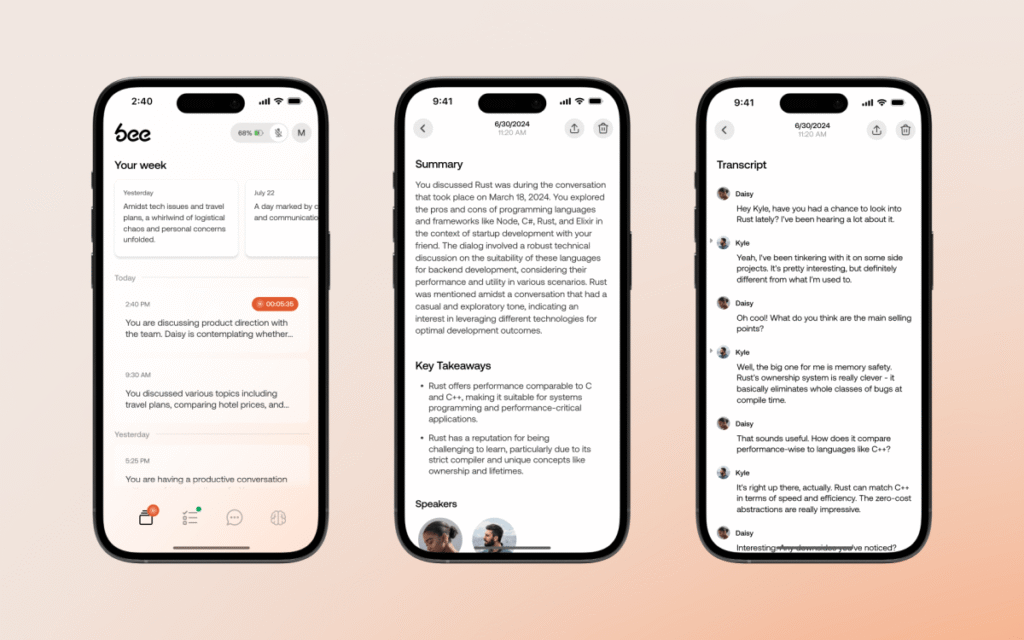
Table of Contents
The Quest for the Perfect Memory
The promise of the AI wearable has remained stubbornly elusive: a device that blends into the background of your life while quietly organizing the chaos of your daily interactions. Amazon’s latest foray into this space, the Bee wearable, attempts to bridge that gap. After spending a week with the device—which Amazon acquired last year and has since iterated upon—the experience is a jarring mix of genuine utility and a lingering sense of digital intrusion.
At its core, Bee is a discreet wrist-mounted gadget designed to act as a perpetual personal assistant. It doesn’t try to replace your phone; instead, it functions as an ambient recorder and synthesizer. By syncing the hardware with a dedicated mobile app and providing access to your calendar, Bee creates a chronological map of your day, transcribing conversations and distilling them into digestible summaries.
The physical interface is intentionally minimalist. A single button toggles the recording state, indicated by a flashing green LED. When active, the device captures audio and pushes it to the cloud, where Amazon’s LLMs process the speech into text and then into a summary. For those who struggle with meeting notes or forget the specifics of a casual agreement made in a hallway, the value proposition is clear.
Performance in the Professional Trenches
Where Bee actually shines is in a structured professional environment. During a series of business-related calls and meetings, the device proved to be a competent secretary. Once the recording was stopped, the app generated a summary that broke the conversation into thematic segments, allowing for a quick review of key action items without the need to scrub through an hour of audio.
However, it isn’t a magic bullet. While the summaries are impressive, the raw transcripts are often erratic. The device frequently struggles with speaker diarization—the ability to distinguish who is talking—requiring users to manually label participants in the app. In several instances, the AI omitted minor but relevant sections of the dialogue, suggesting that while the ‘gist’ is usually correct, the Bee shouldn’t be trusted as a legal record of conversation.
Interestingly, the device handled unstructured social environments with surprising nuance. During a movie night featuring the chaotic dialogue of Reservoir Dogs, the AI didn’t trigger any false alarms regarding the onscreen violence. Instead, it correctly contextualized the audio, labeling the subsequent summary as a “Tarantino Film Scene Analysis,” demonstrating a level of situational awareness that exceeds basic voice-to-text tools.
The Data Trade-off
The utility of Bee is inextricably linked to its hunger for data. To function as intended, the app requires an expansive set of permissions: location tracking, access to photos, contacts, calendar entries, and mobile notifications. There is even an option to integrate health data, such as sleep patterns and heart rate, which feels like a step toward a total biometric surveillance package.
For a privacy-conscious user, this is the breaking point. The device effectively transforms the wearer into a walking microphone, capturing not only their own words but those of everyone around them. While Amazon asserts that data is encrypted both at rest and in transit—and claims to undergo rigorous third-party audits—the reality is that this data lives in the cloud. The company’s track record with large-scale data management is well-documented, and the prospect of a permanent, cloud-stored record of one’s offline life is a heavy ask.
There have been whispers of a fully local version of the device—one that processes audio on the hardware itself without pinging a server—which was reportedly demoed for tech reviewers. Such a pivot would fundamentally change the device’s appeal, shifting it from a corporate data-harvesting tool to a genuine productivity gadget. Until Amazon provides a concrete timeline for local processing, Bee remains a precarious balance of convenience and vulnerability.
Ultimately, Bee is an intriguing piece of hardware that manages to be both helpful and haunting. It offers a glimpse into a future where we no longer need to take notes, provided we are willing to hand over the keys to our digital and physical privacy.