Xiaomi Disrupts Indian TV Market with FX Mini LED Series: High-End Contrast for Under ₹30,000
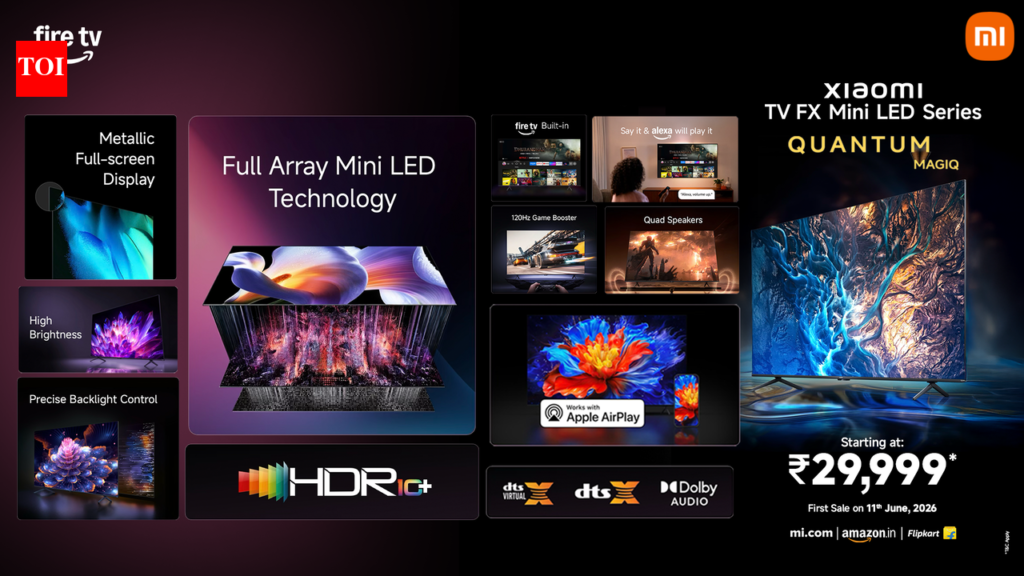
Table of Contents
A New Baseline for Budget Contrast
Xiaomi has officially expanded its display portfolio in India with the launch of the Xiaomi TV FX Mini LED Series. Starting at a disruptive price point of ₹29,999, the series aims to bridge the gap between standard direct-lit LEDs and the premium, expensive world of OLEDs. For the average Indian consumer, the transition to Mini LED has previously been gated by high costs, but Xiaomi’s new entry suggests a shift toward democratizing high-contrast cinema experiences.
- Aggressive Pricing: Starts at ₹29,999, making Mini LED technology accessible to budget-conscious buyers.
- Contrast Boost: Utilizes smaller LEDs for better backlight control and reduced blooming compared to standard LEDs.
- Smart Ecosystem: Runs on the latest Google TV iteration, ensuring deep integration with smart home devices.
- Market Strategy: Directly challenges the dominance of mid-range LED TVs from Samsung and LG in the Indian sub-₹40k segment.
Decoding the Mini LED Advantage
To understand why the Xiaomi TV FX Mini LED Series matters, one must first understand the technical leap from standard LED-LCDs. In a traditional LED TV, the backlight consists of relatively large LEDs. This often results in “blooming”—where light leaks from a bright object into a dark area of the screen.
Mini LED technology replaces these large diodes with thousands of microscopic LEDs. By shrinking the light source, Xiaomi can implement more precise local dimming zones. In practical terms, this means the TV can turn off specific clusters of LEDs to achieve true blacks while maintaining high peak brightness in other areas of the frame. This is the closest a budget TV can get to the per-pixel control of an OLED without the risk of permanent burn-in or the steep price hike.
The Technical Breakdown: Specifications and Performance
While Xiaomi has kept some specific zone counts proprietary for each screen size, the FX series emphasizes a high-nit peak brightness designed to combat glare in brightly lit Indian living rooms. The panels feature 4K UHD resolution with HDR10+ and Dolby Vision support, ensuring that high-dynamic-range content is rendered with accurate highlights and shadow detail.
| Feature | Xiaomi TV FX Mini LED | Standard 4K LED |
|---|---|---|
| Backlighting | Mini LED Array | Direct/Edge LED |
| Contrast | High (Deep Blacks) | Moderate (Greyish Blacks) |
| Brightness | High Peak Luminance | Standard Luminance |
| Starting Price | ₹29,999 | ₹15,000 – ₹35,000 |
What This Means for the Indian Consumer
The launch of the FX series is not just about a new product; it is a market repositioning. For years, the “budget” segment in India has been dominated by basic 4K TVs that look great on paper but suffer from poor contrast in dark rooms. By bringing Mini LED down to the ₹30k mark, Xiaomi is effectively forcing competitors to either lower their prices or upgrade their panel technology.
For the user, this means the “cinema at home” experience—once reserved for those spending ₹1 Lakh+ on OLEDs—is now attainable. Gamers, in particular, will benefit from the improved contrast when playing titles with atmospheric lighting, such as Cyberpunk 2077 or Elden Ring, where the distinction between light and shadow is critical to the visual storytelling.
Integrating the Ecosystem: Google TV and Beyond
Hardware is only half the battle. The Xiaomi TV FX Mini LED Series leverages Google TV, which has become the gold standard for UI fluidity and app availability. Integration with the Google Assistant allows for seamless voice control, while Chromecast built-in simplifies the process of streaming content from mobile devices.
From a software perspective, Xiaomi’s PatchWall continues to play a significant role, providing a curated content layer that aggregates shows and movies from various streaming platforms into a single interface. This reduces the “app-hopping” fatigue that many users experience on traditional smart TVs.
Potential Trade-offs: The Cost of Value
Journalistic integrity requires acknowledging that no TV at this price point is without compromise. While Mini LED is a massive step up from standard LED, it is not a perfect OLED replacement. Some users may still notice slight “halo’ effects around bright subtitles on a black background. Additionally, while the peak brightness is impressive, the color accuracy out-of-the-box may require some calibration to reach professional standards.
Comparative Analysis: Mini LED vs. The Competition
When compared to similar offerings from brands like Samsung (QLED) or LG (NanoCell), Xiaomi’s approach focuses on the luminance-to-price ratio. While a Samsung QLED might offer superior color volume, the Mini LED array in the FX series provides a superior “black level” experience, which is generally more noticeable to the human eye than slight shifts in color saturation.
“The democratization of Mini LED is the most significant shift in the entry-level TV market since the transition from 1080p to 4K. By slashing the price barrier, Xiaomi is changing the expectation of what a budget TV should look like.” — Industry Analyst Perspective
Addressing User Concerns: Frequently Asked Questions
Will the Mini LED panel cause burn-in?
No. Unlike OLED, which uses organic compounds that degrade over time, Mini LED uses inorganic gallium nitride. This means the Xiaomi TV FX Mini LED Series is immune to permanent image retention or burn-in, making it a safer choice for users who leave news channels or static dashboards on for long hours.
Is this TV suitable for PS5 or Xbox Series X gaming?
Yes, it is a highly capable display for next-gen consoles. While it may not feature the 120Hz native panels found in ultra-premium models, the 4K resolution and HDR10+ support ensure that the visual fidelity of modern games is well-preserved.
How does it handle glare in bright rooms?
One of the primary benefits of Mini LED is the ability to push higher peak brightness. This allows the TV to “punch through” ambient light more effectively than budget OLEDs, making it ideal for living rooms with multiple windows.
Does it support all major streaming apps?
Because it runs Google TV, it has native access to the Google Play Store, meaning Netflix, Prime Video, Disney+ Hotstar, and YouTube are all supported and optimized for the hardware.
What is the warranty and after-sales support in India?
Xiaomi typically offers a standard one-year manufacturer warranty. Given Xiaomi’s extensive service network across Tier 1 and Tier 2 cities in India, after-sales support is generally more accessible than for smaller, white-label budget brands.
Final Market Verdict
The Xiaomi TV FX Mini LED Series is a calculated strike against the mid-range TV market. By offering a panel technology that was previously a luxury, Xiaomi is not just selling a television; they are shifting the industry’s value proposition. For anyone looking to upgrade their home entertainment setup without breaking the bank, the FX series represents the current sweet spot where cutting-edge tech meets consumer affordability.