DJI Osmo Pocket 4 Review: Does the 1-Inch Sensor Finally Solve Vlogging’s Low-Light Struggle?
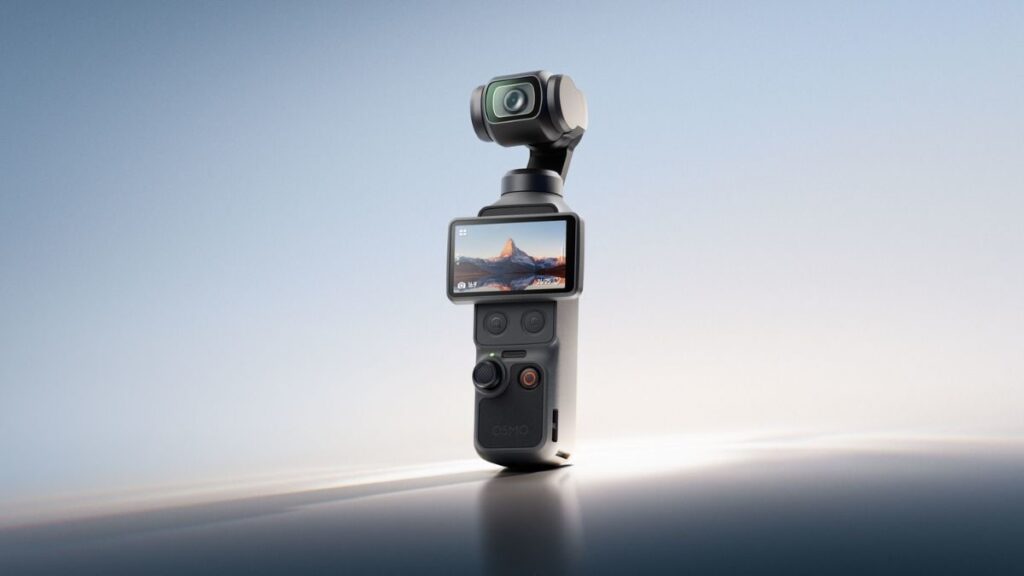
Table of Contents
The Pivot to Large-Format Sensors in Compact Form
DJI has officially released the DJI Osmo Pocket 4, a device that represents a critical shift in how we think about ‘pocketable’ cinematography. For years, the trade-off in handheld vlogging has been simple: you either take a bulky mirrorless setup for image quality or a tiny gimbal camera that struggles the moment the sun goes down. With the introduction of a 1-inch CMOS sensor, DJI is attempting to erase that boundary.
The Osmo Pocket 4 isn’t just a spec bump; it’s a targeted response to the growing demand for professional-grade B-roll and cinematic vlogs that don’t require a full production crew. By integrating a larger sensor into the existing mechanical gimbal architecture, DJI is challenging the dominance of smartphones in the ‘quick-capture’ market.
- Sensor Leap: The transition to a 1-inch CMOS sensor significantly improves dynamic range and low-light performance.
- Pricing: Starts at €499 for the Standard Combo and €619 for the Creator Combo.
- AI Integration: New advanced tracking algorithms reduce ‘lost’ subjects during rapid movement.
- Audio Ecosystem: The Creator Combo now integrates the DJI Mic 3 Transmitter for seamless wireless audio.
Technical Breakdown: Why the 1-Inch Sensor Matters
To understand why the DJI Osmo Pocket 4 is a significant upgrade, we have to look at the physics of light. In previous iterations, smaller sensors struggled with ‘noise’ in the shadows, often resulting in a grainy image when filming indoors or at night. A 1-inch sensor provides a substantially larger surface area to capture photons, which translates directly to cleaner images and a more natural bokeh (background blur) without needing software-simulated portraits.
For creators, this means the ‘golden hour’ window is wider. You can now push the ISO higher without the image falling apart, allowing for more flexibility in color grading during post-production. When compared to the 1/1.3-inch sensors found in many high-end smartphones, the Pocket 4 offers a perceptible jump in depth and textural detail, particularly in high-contrast environments.
Gimbal Stabilization and Mechanical Precision
While electronic image stabilization (EIS) has improved in iPhones and Pixels, it often introduces ‘warping’ or ‘jello’ effects during fast pans. The Osmo Pocket 4 continues to rely on a 3-axis mechanical gimbal, but DJI has refined the motors to be quieter and more responsive. The result is a level of smoothness that software alone cannot replicate, specifically when walking or running—the dreaded ‘walking bob’ is almost entirely neutralized here.
The Creator Combo: An Ecosystem Play
DJI is no longer just selling a camera; they are selling a production kit. The Creator Combo, priced at €619, is designed to eliminate the ‘accessory hunt’ that usually follows a camera purchase. The inclusion of the DJI Mic 3 Transmitter is the standout addition. Audio is often the weakest link in vlogging, and by integrating a professional-grade wireless mic directly into the bundle, DJI ensures the audio quality matches the 1-inch sensor’s visual fidelity.
| Feature | Standard Combo | Creator Combo |
|---|---|---|
| Price | €499 | €619 |
| Camera Unit | Included | Included |
| Audio | Internal Mic | DJI Mic 3 Transmitter |
| Lighting | N/A | Fill Light |
| Lens/Tripod | N/A | Wide-angle Lens & Mini Tripod |
What This Means for the Market
The arrival of the Osmo Pocket 4 puts significant pressure on the ‘Pro’ smartphone market. For a long time, the selling point of an iPhone Pro Max was its ‘cinematic’ capability. However, when a dedicated device like the Pocket 4 can provide genuine mechanical stabilization and a larger sensor for a similar price point to a high-end tablet, the value proposition shifts. For professional YouTubers and TikTokers, this is less about replacing a main camera and more about replacing the ‘run-and-gun’ B-roll camera.
Furthermore, the AI-powered tracking tools mean that solo creators can now achieve shots that previously required a camera operator. The ability for the gimbal to intelligently track a subject through a crowded environment reduces the amount of footage that needs to be discarded due to framing errors.
Practical Considerations: The Trade-offs
Despite the upgrades, the Osmo Pocket 4 isn’t without its compromises. The 1-inch sensor generates more heat than its predecessors. In 4K/60fps high-bitrate modes, users may experience thermal throttling during extended outdoor shoots in direct sunlight. Additionally, while the gimbal is incredibly stable, it remains more fragile than a sealed action camera like the GoPro Hero 13. This is a tool for cinematography, not for extreme sports.
Comparing the Pocket 4 to the Competition
When placed next to the Insta360 X4 or the GoPro line, the Pocket 4 occupies a different niche. While those devices excel in durability and 360-degree capture, the Pocket 4 wins on image quality and ease of framing. It is the ‘prestige’ choice for those who value a cinematic look over ruggedness.
Frequently Asked Questions
Is the DJI Osmo Pocket 4 waterproof?
No, the Osmo Pocket 4 is not natively waterproof. Unlike the GoPro series, the gimbal mechanism is exposed. For underwater shots, you will need a dedicated third-party waterproof housing.
How does the battery life compare to the Pocket 3?
The larger sensor and more powerful AI processing increase power draw. While DJI has optimized the battery, users should expect slightly shorter recording times in high-resolution modes compared to the previous generation. Carrying a portable power bank is recommended for full-day shoots.
Can the Osmo Pocket 4 be used as a webcam?
Yes, the device can be connected to a computer via USB-C to function as a high-quality webcam, utilizing its AI tracking to keep the speaker centered in the frame.
What is the maximum resolution and frame rate?
The Osmo Pocket 4 supports 4K recording at up to 60fps for standard cinematic shots, with higher frame rate options available in cropped modes for slow-motion capture.
Does it support vertical video for TikTok and Instagram?
Yes, the device is designed with a rotating screen and software optimization that allows for seamless switching between horizontal and vertical orientations, making it ideal for social media creators.
Final Verdict on the Hardware Leap
The DJI Osmo Pocket 4 is a refined instrument. It doesn’t reinvent the wheel, but it makes the wheel significantly more efficient. By focusing on the 1-inch sensor, DJI has addressed the primary complaint of the vlogging community: poor low-light performance. While the price jump for the Creator Combo might be steep for some, the integration of the Mic 3 and the improved gimbal makes it a turnkey solution for anyone serious about digital storytelling in 2025.