Samsung Debuts AI Soccer Mode: A Deep Dive into the New Sports-Centric TV Lineup and Bundled Offers
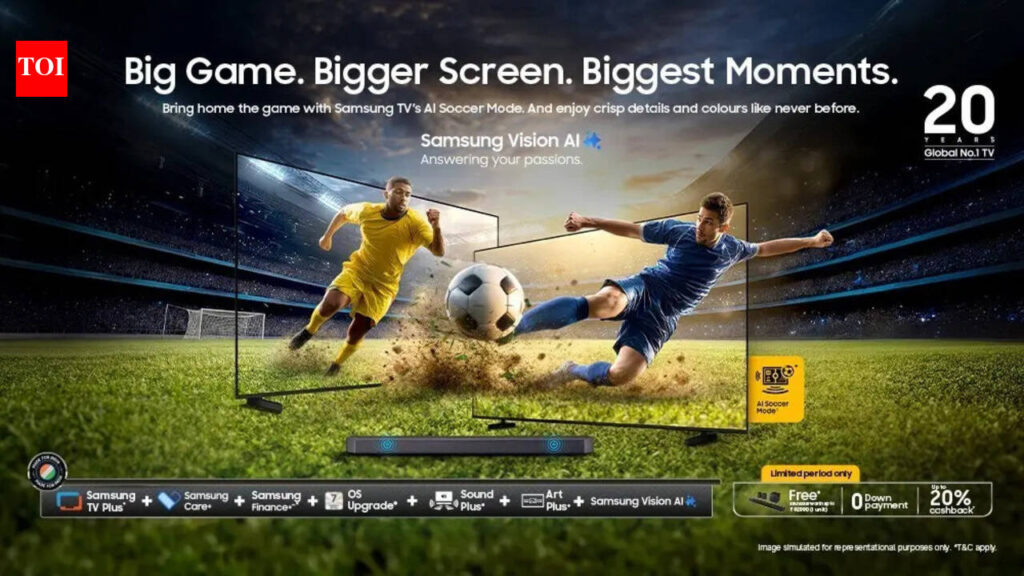
Table of Contents
The New Standard for the Living Room Stadium
Samsung has officially unveiled its 2026 sports-centric television initiative, headlined by the introduction of AI Soccer Mode. This isn’t just a preset brightness or contrast adjustment; it is a fundamental shift in how the display handles high-motion content. By utilizing the latest iteration of the Neural Quantum Processor, Samsung is attempting to solve the age-old problem of ‘motion blur’ and ‘ball trailing’ that often plagues fast-paced football matches broadcast in varying bitrates.
- AI Soccer Mode uses real-time object recognition to sharpen the ball and players during high-speed motion.
- Aggressive Bundling: Selected Neo QLED and OLED models now ship with free compatible soundbars to enhance the stadium atmosphere.
- Financial Incentives: Strategic cashback offers are being rolled out globally to clear 2025 inventory while pushing the AI-enabled 2026 models.
- Technical Focus: Integration of AI-driven motion interpolation to reduce judder in 50Hz/60Hz broadcasts.
For the average viewer, a “Sports Mode” usually means oversaturated greens and a loud, tinny audio profile. However, according to Samsung’s technical documentation, AI Soccer Mode operates on a deeper level. The system employs a neural network trained on thousands of hours of football footage to distinguish the ball from the pitch, ensuring that the object maintaining the fastest velocity remains crisp, regardless of the camera pan speed.
Technical Breakdown: How AI Soccer Mode Actually Works
At the heart of this feature is the Neural Quantum Processor. Unlike traditional motion smoothing (which often creates the dreaded “soap opera effect”), AI Soccer Mode uses a predictive algorithm to analyze frame-by-frame data. When the AI detects a soccer ball, it applies a localized sharpening filter specifically to that object and the immediate surrounding players.
This process involves three primary stages: Object Detection, Motion Vector Analysis, and Dynamic Contrast Adjustment. By analyzing the motion vectors, the TV can predict where the ball will be in the next frame and pre-render the edge clarity. This significantly reduces the ghosting effect seen in lower-end LED panels when the ball moves rapidly across a green background.
Comparing AI Soccer Mode to Standard Motion Processing
| Feature | Standard Sports Mode | AI Soccer Mode |
|---|---|---|
| Processing | Global Contrast/Color Boost | Neural Object Recognition |
| Motion Handling | Fixed Interpolation (Frame Doubling) | Adaptive Motion Vector Analysis |
| Edge Clarity | Consistent Blur at High Speeds | Localized Ball/Player Sharpening |
The Hardware Ecosystem: Soundbars and Synergy
Samsung is recognizing a critical truth in home cinema: a great picture is wasted with mediocre audio. To combat the “flat” sound of integrated TV speakers, Samsung is bundling high-end soundbars with its AI Soccer Mode compatible TVs. This is a strategic move to lock users into the Q-Symphony ecosystem, where the TV speakers and the soundbar operate in unison rather than the TV speakers being disabled.
The inclusion of a free soundbar isn’t just a gift; it’s a demonstration of the AI Acoustic capabilities. The soundbar uses the TV’s AI to detect the direction of the action on the pitch and shifts the audio focus accordingly. If the ball is played to the left wing, the audio spatialization emphasizes that side, creating a more immersive, stadium-like auditory experience.
Market Strategy: Cashback and Consumer Psychology
The launch of AI Soccer Mode coincides with an aggressive cashback campaign. In a market where TV sales have plateaued, Samsung is using a “Value-Add” strategy. By offering cashback and free hardware, they are lowering the barrier to entry for the high-margin Neo QLED and OLED series.
Industry analysts suggest this move is timed to capture the early demand for the next major global football tournament cycle. By placing AI-enhanced screens in homes now, Samsung establishes a benchmark for sports viewing that makes older, non-AI sets look obsolete. The cashback deals effectively act as a subsidy for users to upgrade their entire home entertainment hub, from the screen to the audio system.
What This Means for the Consumer
For the sports enthusiast, this means a noticeable reduction in visual artifacts during live broadcasts. You are less likely to see the ball “jump” or blur during a long-distance strike. Practically, it means you get a professional-grade sports viewing experience without needing to manually tweak settings every time a match starts. For the budget-conscious, the bundled soundbars represent a significant saving—often ranging from $300 to $800 depending on the model—making the upgrade to a 2026 AI model more financially viable.
Critical Analysis: Is It Just Marketing?
It is important to distinguish between Neural Processing and Marketing Hyperbole. While AI Soccer Mode provides a genuine improvement in object clarity, it cannot “fix” a low-quality stream. If you are watching a 720p broadcast over a congested 4G connection, no amount of AI upscaling can recreate detail that isn’t there. The AI creates a perceptual improvement by guessing where the pixels should be, which is impressive but not a replacement for true 4K native content.
Furthermore, the “free soundbar” offer often applies only to the highest-tier models. Users purchasing entry-level Crystal UHD sets will likely find that the AI Soccer Mode is a scaled-down version with less processing power, leading to a varied experience across the product line.
Frequently Asked Questions
Does AI Soccer Mode work on all Samsung TVs?
No. This feature is exclusively available on 2026 models equipped with the Neural Quantum Processor, primarily within the Neo QLED and OLED ranges. Some high-end 2025 models may receive a limited software update, but the full hardware-accelerated version is reserved for the new lineup.
How do I activate AI Soccer Mode?
Once you have a compatible TV, the mode can be toggled via the Picture Settings > Expert Settings > AI Sports Mode. It can also be set to auto-detect when a sports broadcast is recognized via the AI’s scene analysis.
What is the benefit of the free soundbar bundle?
The bundled soundbars support Q-Symphony, allowing the TV and soundbar to work together for a fuller soundstage. This is specifically tuned for the AI Soccer Mode to synchronize audio cues with the AI-enhanced visual movement on screen.
Are the cashback deals available globally?
Cashback offers vary by region and retailer. Most are tied to specific promotional windows and may require registration through the Samsung Members app or a third-party retail portal.
Will this mode affect the input lag for gaming?
Since AI Soccer Mode is designed for broadcast content, it operates differently than Game Mode. When switching to a console, the TV typically disables the AI Sports processing to prioritize the lowest possible input lag.
Closing the Gap Between Broadcast and Reality
Samsung’s pivot toward AI-driven sports optimization reflects a broader trend in the industry: the shift from static image quality to adaptive intelligence. By focusing on the specific pain points of sports fans—motion blur and thin audio—Samsung is moving beyond the spec-sheet war of nits and contrast ratios and into the realm of user experience.
Whether the AI Soccer Mode is a revolutionary leap or an incremental refinement, the combined pressure of free hardware and cashback makes this a compelling moment for consumers to upgrade. As broadcast technology slowly catches up to 4K standards, having a display that can intelligently “fill the gaps” is becoming a necessity for the modern living room.