Google’s Gemma 4 12B Cuts the Middleman: Encoder-Free Architecture Brings Native Audio to Laptops
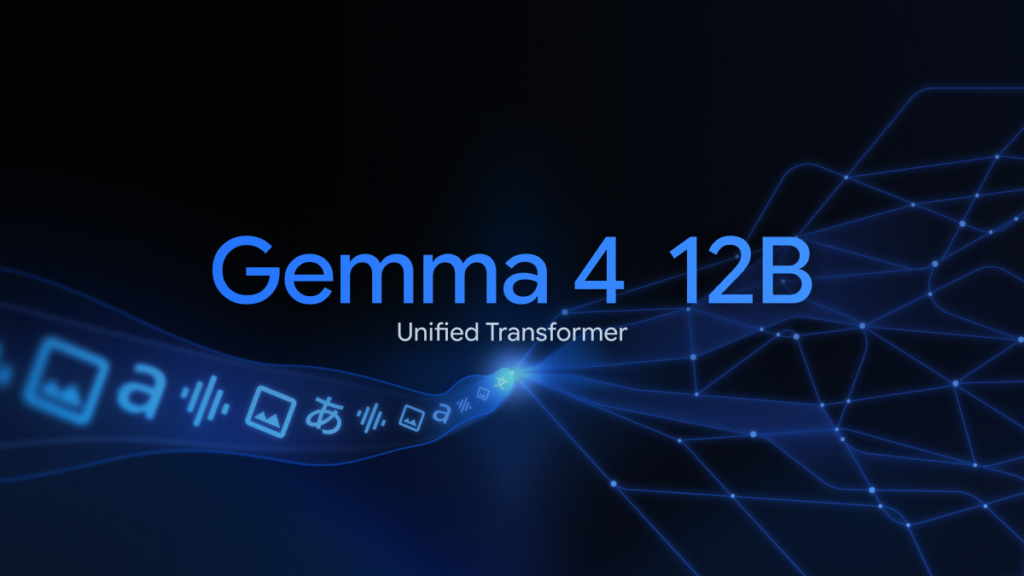
Table of Contents
Moving Beyond the Encoder
Google is attempting to solve one of the most persistent bottlenecks in on-device AI: the architectural ‘tax’ of multimodal processing. With the release of Gemma 4 12B, the company is introducing a mid-sized model that departs from the industry standard of using separate encoders for different types of data. Instead, Gemma 4 12B utilizes an encoder-free architecture, allowing it to ingest audio and visual inputs natively.
In traditional multimodal systems, an image or audio clip must first pass through a dedicated encoder—effectively a translator—that converts the raw signal into a language the Large Language Model (LLM) can understand. This process doesn’t just add latency; it consumes precious VRAM, often making high-performance multimodal AI too bloated for standard consumer hardware. By removing these separate layers, Google has managed to shrink the memory footprint while maintaining a level of reasoning that rivals its larger 26B Mixture of Experts (MoE) sibling.
The 16GB RAM Threshold
The strategic positioning of the 12B model is clear. While the E4B model targets the extreme edge and the 26B MoE targets high-compute environments, the 12B variant is designed specifically for the modern laptop. Google claims the model can run locally on machines with 16GB of RAM, a specification common in mid-range MacBooks and Windows laptops.
This move is less about raw power and more about ‘agentic’ utility. By bringing native audio and vision processing to the local device, developers can build AI agents that react to a user’s environment in real-time without the round-trip latency of a cloud API. For a developer building a voice-activated assistant or a visual accessibility tool, the ability to process audio inputs without a separate transcription layer represents a significant leap in responsiveness.
Bridging the Performance Gap
On paper, the 12B model is designed to punch above its weight class. According to Google, the model achieves performance benchmarks that approach the 26B MoE model despite having less than half the memory overhead. This efficiency is a direct result of the unified architecture, which allows for a more fluid exchange of information between different modalities.
The impact of this approach is most evident in audio processing. While previous Gemma iterations relied on external tools to handle sound, the 12B model treats audio as a primary input. This opens the door for more nuanced understanding of tone, inflection, and ambient noise—elements often lost when audio is first converted to text via a separate Speech-to-Text (STT) engine.
A Growing Ecosystem
The launch comes as the Gemma family reaches a milestone of 150 million downloads. The developer community has already pivoted from simple chatbots to complex integrations, including wearable robotic arms and specialized AI security frameworks for enterprises. By filling the gap between the ‘tiny’ and ‘large’ models, Google is providing a more versatile toolkit for developers who need more than basic logic but cannot afford the hardware requirements of a massive MoE system.
As AI shifts from cloud-based chat interfaces to locally resident agents, the battle will be won by whoever can provide the most intelligence per gigabyte of RAM. With Gemma 4 12B, Google is betting that a streamlined, encoder-free path is the most viable route to that goal.