POCO Pad C1 Debuts as a Budget-Friendly 4G Slate Targeting the Mid-Range Gap
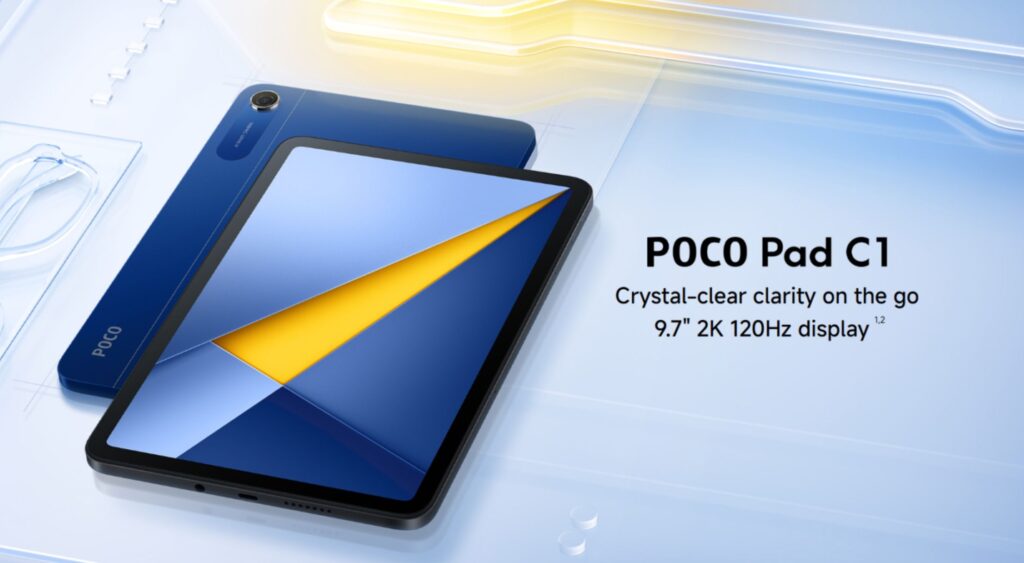
Table of Contents
A Strategic Pivot Toward the Entry-Level Tablet Market
Xiaomi has officially expanded its POCO ecosystem with the global debut of the POCO Pad C1. While POCO has traditionally carved out a niche in the “flagship killer” smartphone market, the Pad C1 signals a clear intent to capture the budget-conscious consumer who needs a dedicated media consumption device without the premium price tag of an iPad or a high-end Samsung Galaxy Tab.
The device arrives at a precarious time for budget tablets. With the lines blurring between large-screen foldable phones and tablets, Xiaomi is betting that a slim, metal-bodied slate with basic 4G connectivity will appeal to students and casual users who prioritize screen real estate over raw processing power.
Display Specs and Build Quality
The standout feature of the POCO Pad C1 is undoubtedly its screen. Xiaomi has equipped the device with a 9.7-inch IPS display boasting a 2K resolution. More importantly, the panel supports a 120Hz refresh rate, a feature that has traditionally been reserved for more expensive hardware. This makes scrolling through documents and navigating the UI significantly smoother than the 60Hz panels found in most entry-level competitors.
In terms of brightness, the C1 hits 500 nits typically, peaking at 600 nits when used outdoors. To appeal to the “bedtime browsing” demographic, the display carries TUV Rheinland certification for low blue light and flicker reduction, suggesting a focus on eye health during prolonged use.
Physically, the tablet avoids the plastic feel often associated with budget devices. It features a slim metal chassis measuring just 7.4 mm in thickness and weighing 406 grams, making it portable enough for a backpack without feeling overly fragile.
The Performance Trade-off: Snapdragon 6s 4G
Under the hood, the POCO Pad C1 is powered by the Qualcomm Snapdragon 6s 4G Gen 2. While the name suggests a modern iteration, the 4G limitation is a significant detail. In an era where 5G is becoming the baseline for mid-range devices, the C1 is explicitly positioned as a budget utility tool.
With 6 GB of RAM and 128 GB of internal storage, the hardware is sufficient for everyday multitasking—think PDF annotation, web browsing, and streaming. For those requiring more space for offline movies or large files, the inclusion of a microSD slot allowing for expansion up to 2 TB is a welcome, if necessary, addition.
The software experience is driven by HyperOS 3.0. Interestingly, Xiaomi is integrating AI-driven features into this budget tier, including Circle to Search and Google Gemini integration. This move suggests that AI capability is no longer a luxury feature but a core part of the user experience, even on hardware that isn’t designed for heavy local processing.
Battery Life and Connectivity
To power the 2K display, the Pad C1 utilizes a 7,600 mAh battery. While the 18W charging speed is modest by today’s standards—likely taking several hours to reach a full charge—the efficiency of the Snapdragon 6s chip allows for respectable endurance. Xiaomi claims up to 15 hours of continuous video playback and nearly two days of moderate use.
In a move that will please audio enthusiasts and those using wired peripherals, the POCO Pad C1 retains the 3.5 mm audio jack, complementing its dual-speaker setup. The camera array is minimal—an 8 MP rear sensor and a 5 MP front-facing camera—confirming that this device is intended for media consumption and occasional video calls rather than content creation.
Market Positioning and Pricing
While finalized regional pricing varies, industry data indicates the POCO Pad C1 will sit comfortably below the $300 mark. By undercutting the premium tablet market, POCO is targeting the “secondary device” market—users who already own a powerful smartphone but want a larger screen for reading and streaming without spending several hundred dollars.