HoverAir Aqua: The Drone That Treats the Ocean Like a Runway
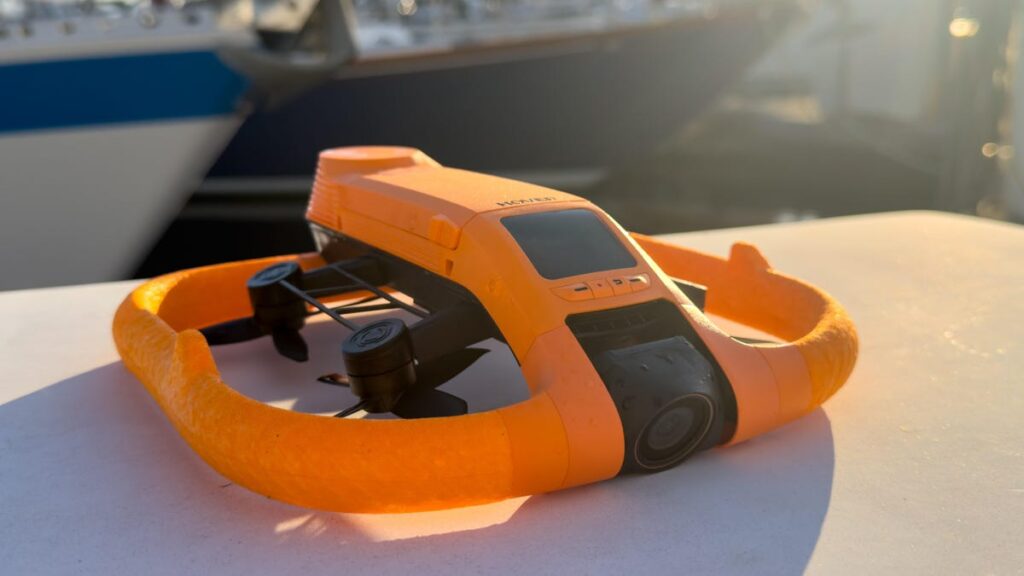
Table of Contents
A New Approach to Aquatic Videography
For most drone pilots, water is the ultimate enemy. Even with the most advanced obstacle avoidance systems, the sight of a high-end quadcopter descending toward a lake or ocean surface usually triggers an immediate panic response. The HoverAir Aqua attempts to eliminate that anxiety by treating the water not as a hazard, but as a launchpad.
The Aqua is designed specifically for the ‘active’ crowd—surfers, kayakers, and paddleboarders who want cinematic close-ups without needing a dedicated camera operator or a handheld controller. Rather than relying on a traditional remote, the system utilizes a symbiotic relationship between the aircraft and a wearable transmitter.
The Ecosystem: Drone and Lighthouse
The hardware is split into two distinct components. The first is the quadcopter itself, a lightweight 249g device that stays under the FAA registration threshold. It features prominent foam guards on each side, which serve as buoyancy aids, and a 1.6-inch AMOLED screen for on-device setting adjustments.
The second, and more critical, piece of hardware is the ‘Lighthouse.’ This is a chunky, orange transmitter worn on the arm or leg. The Lighthouse acts as the primary targeting beacon; once the wireless link is established, the user can launch the drone or recall it to their position with a single press. It also includes four directional buttons for basic flight adjustments, allowing the user to nudge the drone’s altitude or rotation without ever touching a smartphone.
Both the aircraft and the beacon carry an IP67 rating. While this provides significant peace of mind, it isn’t a ‘set it and forget it’ system. Users must ensure the silicon plug on the bottom charging port is seated and the battery is securely latched to maintain the waterproof seal.
Putting the Aqua to the Test
Testing the device in the marinas of Seattle reveals a surprising amount of utility in its autonomous logic. The launch process is visceral; the drone is loud and sputtery as its rotors cut through the water to achieve lift-off. A chipper female voice provides a three-second countdown, warning the user if they are standing too close to the takeoff point.
One of the most impressive technical implementations is the ‘Turtle Flip.’ In the event that the drone is tossed upside-down by a wave or a clumsy landing, the onboard software automatically flips the device back over. This removes the need for the athlete to stop their activity to rescue the hardware from the surface.
The Flight Modes
The Aqua operates primarily in OmniTerrain mode for aquatic environments. During kayak testing, the ‘Kayak mode’ proved effective, maintaining a consistent frame from behind the paddler. The software allows users to toggle between close, medium, and far distances, with a top rated speed of 34 mph (55 km/h).
Beyond simple following, the device offers a suite of cinematic presets:
- Orbit Follow: The drone flies in lazy circles around the subject.
- Spiral: A combined maneuver that backs away while orbiting.
- Dolly Track: A linear movement pattern common in professional cinematography.
Interestingly, the camera can rotate 90 degrees to face downward. This allows the Aqua to act as a surface-level observer, recording underwater activity while the drone bobs on the surface before taking flight.
The Regulatory Hurdle
Despite the technical capabilities, there is a significant catch for North American enthusiasts. HoverAir has confirmed that the Aqua is not yet available in the US due to ‘administrative and regulatory complexities.’ While it can be shipped to 50 other countries at a price point of $1,299, US consumers will have to wait for the company to clear local hurdles.
For those in supported regions, the package is comprehensive, including three batteries and dry-bag waterproof pouches. While the standalone charger remains a non-waterproof USB-C unit, the overall kit suggests a product designed for the rigors of salt and spray.


