Lenovo Doubles Down on Rollables at CES 2026 With New ThinkPad and Legion Concepts
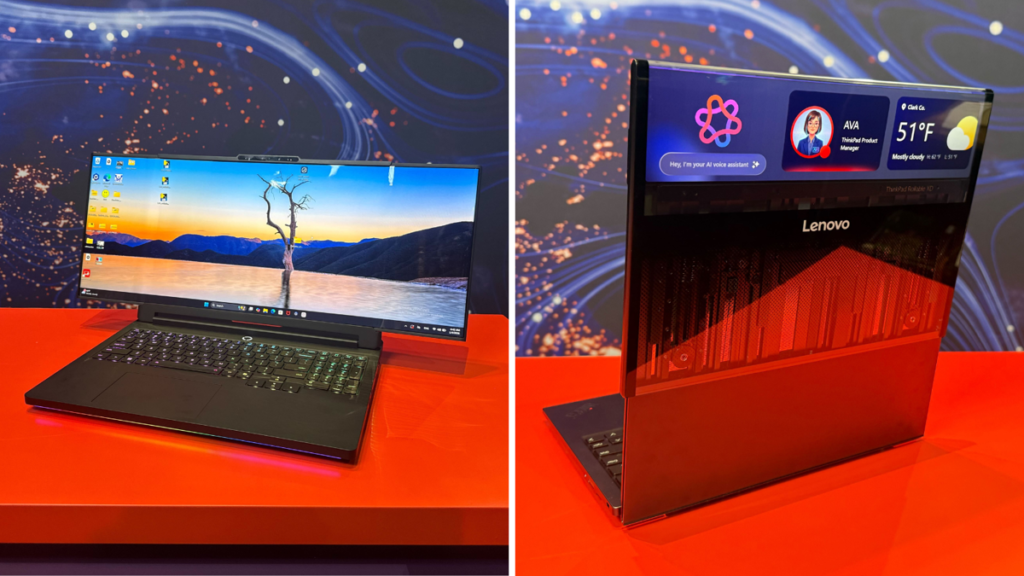
Table of Contents
Beyond the Fold: Lenovo’s Bet on Expanding Glass
While the industry has spent the last few years attempting to perfect the foldable screen—often battling creases and durability concerns—Lenovo is leaning into a different mechanical philosophy: the roll. At CES 2026, the company unveiled two new prototypes that move beyond the simple ‘fold’ to offer screens that physically expand and retract, signaling a shift in how the company envisions the future of mobile productivity and high-end gaming.
The first of these, the ThinkPad Rollable XD Concept, is a clear evolution of the ThinkBook Plus Gen 6. Rather than expanding horizontally, the XD focuses on vertical real estate. The device begins as a compact 13.3-inch laptop but can be extended to nearly 16 inches in height, effectively increasing the screen area by 50 percent. This allows for a level of vertical multitasking—such as viewing long documents or complex spreadsheets—that traditional laptops cannot achieve without sacrificing portability.
What makes the XD particularly striking is its hardware transparency. In a partnership with Corning, Lenovo has implemented a transparent glass cover that wraps 180 degrees over the top edge of the lid. This creates a ‘world-facing’ display on the back, but more importantly, it allows users to see the fiber cables and motors driving the rolling mechanism. It is a deliberate engineering ‘flex,’ turning the internal machinery into a design feature.
A Gaming Rig That Unfurls
If the ThinkPad is about utility, the Legion Pro Rollable Concept is about sheer presence. Designed for the competitive gaming crowd, this device moves away from the vertical growth of the ThinkPad in favor of a wide, cinematic expansion. The laptop operates in three distinct modes: ‘Focus Mode’ (a standard 16-inch display), ‘Tactical Mode’ (extending to 21.5 inches), and the massive ‘Arena Mode,’ which pushes the screen out to a full two feet.
For gamers, this effectively replaces the need for an external monitor in mobile setups, offering a wider field of view than the dual-screen configurations seen in competitors like the Asus ROG Zephyrus Duo. The panel is a 240Hz OLED, ensuring that the fluid movement of the screen is matched by the fluid movement of the frame rate.
Under the hood, the Legion Pro Rollable is essentially a chassis-swap of the Legion Pro 7i. It is powered by a high-end Intel Core processor and an Nvidia GeForce RTX 5090 GPU. However, this power comes with a cost. During hands-on demonstrations, the device emitted significant heat even while idling, and the chassis is considerably bulkier than a standard 16-inch laptop to accommodate the rolling motors and cooling systems.
The Engineering Hurdle
Despite the polish, these remain prototypes. A close inspection of the Legion Pro’s screen reveals slight creasing where the OLED panel retreats into its housing, and some superficial marks were visible upon unfurling. Lenovo has rated the mechanism for 25,000 roll cycles, but translating this from a controlled showroom to a coffee shop or a gaming tournament is a massive leap in durability testing.
The control schemes also reflect the conceptual nature of the project. While the ThinkPad XD utilizes a mix of physical buttons and edge-swiping on its touchscreen lid, it lacks the voice and gesture controls seen in earlier iterations. This suggests Lenovo is still iterating on the most intuitive way to interact with an expanding interface.
The path from concept to consumer is long, but Lenovo has a track record of delivery here. The original rollable concept took two years to reach the market as the ThinkBook Plus Gen 6. Given that the previous model commanded a premium price tag of $3,499.99, anyone hoping to own a piece of this expanding hardware should expect a significant financial investment when these eventually move from the private showroom to the retail shelf.


