Navantia Unveils LASV75: The 1,000-Tonne Drone Warship Aiming for a ‘Hybrid Navy’
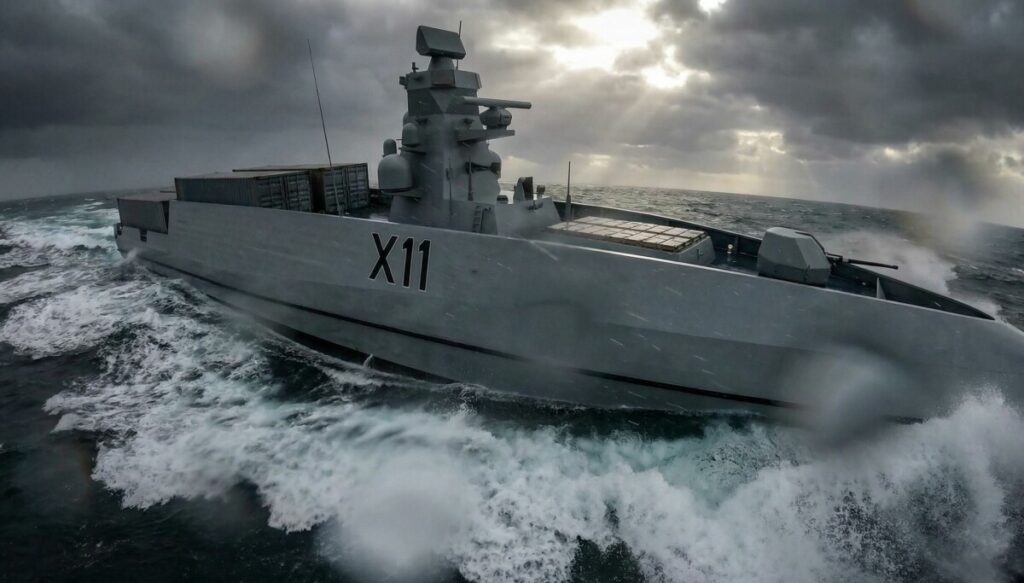
Table of Contents
A Ship Without a Bridge
In the traditional world of naval architecture, the bridge is the heart of the vessel. It is where the captain stands and where critical decisions are made in the heat of engagement. But Navantia’s latest design is conspicuously missing one. The Large Autonomous Surface Vessel, or LASV75, is a 75-meter, 1,000-tonne seagoing drone that replaces human crews with sensors, modular payloads, and remote operational logic.
Developed by the UK arm of the Spanish shipbuilding giant, the LASV75 isn’t just a small remote boat; it is a significant piece of naval hardware. At roughly half the length of a Royal Navy Type 45 destroyer and comparable in size to a River-class patrol vessel, it occupies a middle ground between small tactical drones and full-scale frigates. The goal is to create a “hybrid navy”—a fleet where traditional crewed warships act as command hubs for a swarm of autonomous escorts and ancillary ships.
Modular Warfare and Electric Propulsion
One of the most striking aspects of the LASV75 is its commitment to modularity. The deck is designed to accommodate shipping containers, a trend increasingly adopted by modern navies to swap out capabilities quickly. Whether the mission requires electronic warfare suites, specialized sonar arrays, or weapon systems, the ship can be reconfigured without needing a complete dry-dock overhaul.
Engineers also opted for an Integrated Full Electric Power and Propulsion (IFEP) system. This means the vessel utilizes diesel generators to feed electric motors, providing a cleaner, more efficient power distribution network for the heavy sensor loads required for autonomous navigation. Interestingly, the design lacks the traditional towering funnels associated with combustion engines, utilizing waterline exhausts instead—a choice that likely reduces the vessel’s thermal and visual signature.
The ‘Atlantic Bastion’ Strategy
While the LASV75 is a general-purpose design, it seems specifically tailored for the Royal Navy’s strategic anxieties in the North Atlantic. The UK has long emphasized the need to protect its “Atlantic Bastion”—the critical undersea infrastructure, including fiber-optic cables and energy pipelines, that keeps the nation connected and powered.
Currently, the grueling task of patrolling these cold, volatile waters for Russian submarines falls to the Type 23 frigate and the upcoming Type 26. However, maintaining a constant human presence in the North Atlantic is both expensive and exhausting for crews. The LASV75 could fill the role of the theorized “Type 92 sloop,” acting as a persistent, uncrewed sentinel capable of tracking subsurface threats over long durations without the logistical burden of feeding and housing a crew of hundreds.
“Autonomous vessels are fundamental to the future of sovereign defence capabilities,” says Derek Jones, Navantia UK’s chief commercial and business development officer. “Naval capabilities of the future will comprise a hybrid mixture of crewed warships with uncrewed escorts and ancillary ships.”
The Cost of Autonomy
Navantia claims that the absence of crew quarters, galleys, and life-support systems allows for a faster construction cycle and a significantly lower price point than traditional warships. While the company hasn’t released specific figures, the removal of “hotel services” (the infrastructure required to keep humans alive and sane at sea) typically represents a massive portion of a ship’s internal volume and cost.
However, the transition to a hybrid fleet isn’t without friction. The LASV75 is essentially a bet on the reliability of AI and remote teleoperation in some of the harshest environments on Earth. For now, Navantia is positioning the vessel as a force multiplier—not a replacement for the human sailor, but a way to push the boundaries of where a navy can operate without risking lives in the “grey zone” of modern maritime conflict.