Zhiyun’s Fiveray M60 Ultra Challenges the Logic of Portable Studio Lighting
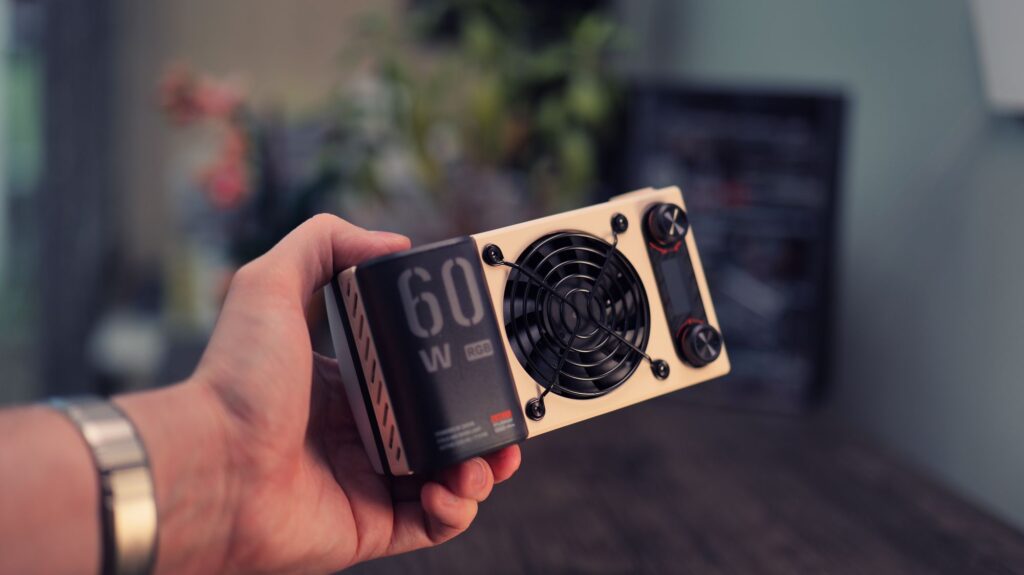
Table of Contents
The paradox of a 60W pocket light
In the world of portable cinematography, there has always been a stubborn trade-off: you either carry a light that fits in your pocket but barely illuminates a tabletop, or you lug around a powerhouse that requires a dedicated road case and a wall outlet. The Zhiyun Fiveray M60 Ultra attempts to collapse that divide, positioning itself as a ‘miniature Arri SkyPanel X’ for the modern creator.
At first glance, the M60 Ultra is an anomaly. It is roughly the size of a modern smartphone, though significantly thicker—akin to stacking three iPhones. Yet, it claims a staggering 60W output. For context, most ‘pocket’ lights in this category struggle to hit 20W without overheating or draining their batteries in minutes. Zhiyun isn’t just pushing the wattage; they are rethinking the form factor of the portable key light.
Industrial design meets thermal reality
Zhiyun has avoided the typical ‘anonymous black box’ aesthetic of professional gear. The M60 Ultra sports a rugged, beige-and-cream housing with striking orange accents, evoking a utilitarian, retro-futuristic vibe that feels more like something from a sci-fi set than a standard electronics accessory. However, the aesthetics are secondary to the engineering. Pushing 60W of light through a chassis this small generates immense heat.
To combat this, the device is essentially a series of vents. From the large central fan on the rear panel to the strategically placed airflow cutouts, the light is designed to breathe. Internally, heat sinks occupy most of the remaining volume. While this means the unit lacks any form of water resistance, it ensures that the LEDs can maintain high brightness levels without triggering a thermal shutdown.
Tactile controls and the ZY Vega ecosystem
One of the most refreshing aspects of the M60 Ultra is the commitment to on-device control. While many contemporary manufacturers hide essential settings behind a mandatory app, Zhiyun provides two physical control knobs and a compact color screen on the rear. There is a learning curve to the menu system, but the ability to dial in settings without reaching for a phone is a significant productivity win in a fast-paced shoot.
When a smartphone is needed, the ZY Vega app (currently Android-only, with iOS pending) offers sophisticated tools. The most impressive feature is the color-matching capability; by pointing your phone’s camera at a light source, the app can approximate that hue on the M60 Ultra. The latency is nearly nonexistent, making it a viable tool for matching ambient light in real-time.
Performance in the field: From product shots to key lighting
In practical testing, the output is surprising. For tight product photography, the M60 Ultra often only needs to be set to 10% power to avoid blowing out highlights. The beam is more focused than one would expect from a panel, a characteristic that can be further refined using the included magnetic honeycomb grid.
When transitioned to a ‘talking head’ setup, the supplied plastic domed diffuser transforms the harsh point source into a softer, more flattering key light. While it cannot replace a large softbox for full-body shots, its ability to provide a primary light source in a compact footprint is undeniable. The inclusion of a built-in battery removes the tether to a power bank, though the 18W USB-C PD charging means you’ll want a high-quality brick handy to minimize downtime.
Market positioning
At an MSRP of $129, the Fiveray M60 Ultra enters a crowded market, but it occupies a specific niche. Competitors like the Amaran Pano 60C offer similar power and RGB functionality but often lack an integrated battery and carry a larger footprint and higher price point. Zhiyun isn’t just competing on specs; they are competing on the convenience of deployment.


