What Happened at YouTube Brandcast 2026? Biggest Updates Explained
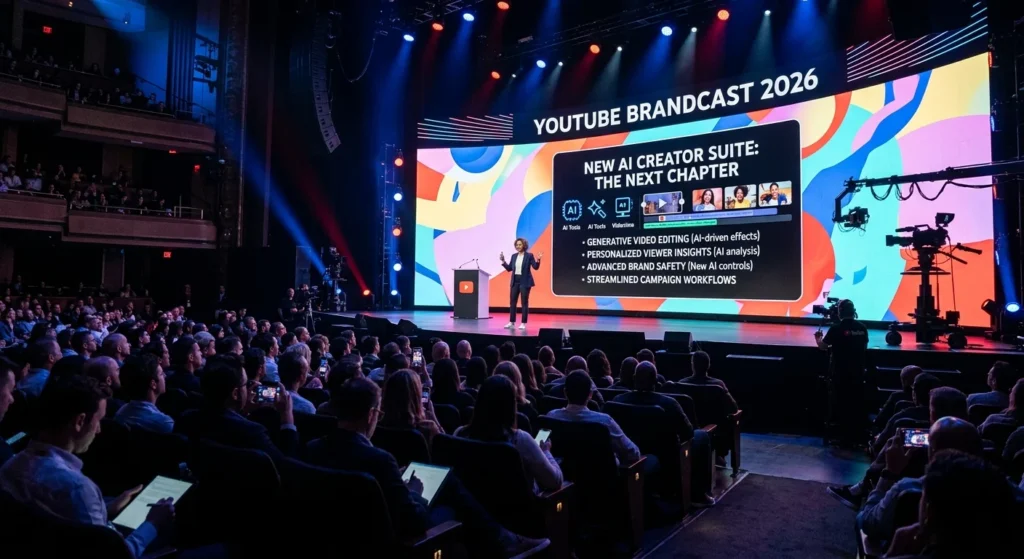
Table of Contents
YouTube Brandcast 2026 was not just another annual event; it was a signal that the online video industry has officially entered a new era. Held on May 13, 2026, at the iconic David Geffen Hall in Lincoln Center, New York City, this year’s Brandcast delivered a sweeping set of announcements that touched every corner of the creator economy: exclusive creator-led shows, AI-powered advertising tools, connected TV commerce features, and a bold message from YouTube CEO Neal Mohan that “the modern marketing playbook has been rewritten.”
For brands, advertisers, and digital creators, YouTube Brandcast 2026 was the clearest statement yet that YouTube is no longer competing with traditional television, it is becoming the better version of it. The platform is positioning itself as the single destination for brand building, content discovery, and direct commerce, all powered by Google’s advanced AI infrastructure.
Whether you are a marketer looking to understand the latest YouTube advertising updates, a creator curious about new monetization paths, or simply someone following the evolving online video industry, this guide breaks down every major announcement and what it means going forward.
What Happened at YouTube Brandcast 2026?
YouTube Brandcast is the platform’s annual “upfront” event — its answer to the traditional TV industry’s annual pitch to advertisers. In 2026, the event was held on May 13 at David Geffen Hall, Lincoln Center, New York City.
The evening was hosted by Trevor Noah and featured performances by Chappell Roan and Zara Larsson. Executives leading the presentation included YouTube CEO Neal Mohan, Chief Business Officer Mary Ellen Coe, and Google President of Americas and Global Partners Sean Downey. High-profile guests included athletes Draymond Green, Dwyane Wade, and JuJu Watkins, alongside top creators Alex Cooper, Kareem Rahma, Jesser, and Quenlin Blackwell.
The event’s central thesis: creators are now “the new Hollywood,” and YouTube is the infrastructure powering their rise. Four major announcements defined the evening:
1. Exclusive Creator Shows
YouTube unveiled a new slate of structured, season-based creator programming that brands can sponsor. Highlights include Kareem Rahma’s Keep the Meter Running, Alex Cooper’s upcoming Met Gala docuseries Before the Steps, and multiple new series under Cooper’s Unwell brand. These moves YouTube firmly into upfront-style programming territory.
2. AI-Powered Ad Tools
YouTube introduced several AI-driven advertising innovations. Custom Sponsorships uses AI to dynamically match a brand’s messaging to contextually relevant videos. Multimodal Video Creation lets advertisers generate full ad creative using Google’s latest AI models — Gemini, Veo, and Nano Banana, from just a few text prompts. The platform also expanded Demand Gen, a campaign tool designed to shorten the path from content discovery to purchase.
3. Shoppable Connected TV (CTV)
In one of the most talked-about product announcements, YouTube revealed “Buy with Google Pay,” a feature that lets viewers watching YouTube on their TV purchase products directly on-screen in just two clicks, using payment information stored in their Google account. CTV conversions on YouTube grew more than 200% year over year in Q1 2026.
4. Affiliate Partnerships Boost
YouTube also introduced tools that allow brands to boost organic creator content that already features their products, enabling affiliate-linked content to drive incremental sales and increase creator earnings directly through YouTube Shopping commission.
Why Is This Trending?
YouTube Brandcast 2026 is generating significant buzz across the digital marketing and online video industry for several interconnected reasons.
First, the timing is critical. The traditional TV upfront season is losing momentum as audiences continue to migrate to streaming and online platforms. YouTube’s Brandcast is the most prominent counter-event in the industry, and in 2026 it made its most aggressive pitch yet for brand budgets that have historically gone to linear television.
Second, the creator economy is at an inflection point. Brands have long debated whether to treat creator partnerships as niche experiments or core media strategy. YouTube Brandcast 2026 effectively ended that debate, by packaging creator content into season-based series with structured sponsorship opportunities, the platform gave advertisers the brand-safe, predictable inventory they have long demanded.
Social media reactions were strong. Marketing professionals on LinkedIn described the event as “the death of the old upfronts” and praised the platform for making the case that creator trust, AI targeting, and full-funnel commerce can now coexist in a single buy. Advertising trade publications highlighted the CTV shopping feature as a potential game-changer for direct-response TV budgets, noting that YouTube streaming strategy is increasingly indistinguishable from traditional broadcast planning, but with the performance data to back it up.
The integration of Google’s AI stack, particularly Gemini and Veo, into the ad creation workflow also generated excitement among digital creators and smaller brands, who can now produce high-quality YouTube advertising without expensive production infrastructure.
Background and History
YouTube Brandcast began as a relatively modest annual event and has grown into one of the most closely watched moments in the digital advertising calendar.
The event was first established as YouTube’s version of the TV industry’s “upfronts” — presentations where networks pitch their coming season’s programming to advertisers ahead of the buying cycle. In its early years, Brandcast focused primarily on showcasing YouTube’s reach statistics and creator talent. Over time, it evolved to include major product announcements and deeper engagement with the advertising community.
In 2022 and 2023, YouTube’s Brandcast emphasized the growth of YouTube on connected TVs, a trend that proved prescient, the platform now reaches massive audiences on the living room screen. In 2024, the event leaned into the creator-brand partnership model. By 2025, YouTube began framing creators explicitly as “the new studios,” a narrative that culminated fully at Brandcast 2026.
Key figures who have shaped Brandcast’s evolution include CEO Neal Mohan, who took over from Susan Wojcicki and has consistently pushed YouTube toward premium content positioning, and CBo Mary Ellen Coe, whose background in Google’s ads business has driven the platform’s deeper integration of commerce and AI into its advertising products.
The broader context is a media industry under pressure. Traditional television viewership has declined for years. Netflix, Disney+, and Amazon Prime Video are fighting for subscriber attention, while TikTok and Instagram have reshaped short-form content consumption. YouTube has carved out a uniquely powerful middle ground: long-form creator content with TV-scale reach and digital-scale targeting.
Key Facts and Important Details
Here are the most important data points and announcements from YouTube Brandcast 2026:
- Event date: May 13, 2026, at David Geffen Hall, Lincoln Center, New York City
- Hosted by: Trevor Noah; performances by Chappell Roan and Zara Larsson
- YouTube’s US reach: The platform reached more than 244 million people age 18 and older across devices in November 2025, representing approximately 91% of the US adult population
- Entertainment preference: 83% of US viewers say YouTube is the video platform they find most entertaining (Google/Kantar survey)
- Gen Z data: 73% of surveyed Gen Z viewers (ages 18–28) in the US engage with YouTube regularly
- Creator trust effect: When creators discuss a product on YouTube, viewers are 13 times more likely to search for the brand and 5 times more likely to make a purchase
- Demand Gen improvement: Upgrades introduced in H2 2025 drove a 30% increase in conversions or conversion value for advertisers in internal experiments
- CTV conversion growth: Conversions from CTV ads on YouTube grew more than 200% year over year in Q1 2026
- Creator shows announced: Keep the Meter Running (Kareem Rahma), Before the Steps (Alex Cooper’s Met Gala docuseries), plus multiple new series under Cooper’s Unwell umbrella
- New AI tools: Custom Sponsorships, Multimodal Video Creation (Gemini, Veo, Nano Banana), expanded Demand Gen
- New commerce features: Buy with Google Pay for CTV, Affiliate Partnerships Boost for in-platform creator content
- New data integrations: Brands will be able to integrate shopper data from Costco and Dollar General to better measure ad impact
Brand case studies presented at the event:
- Coach saw a 60% jump in Gen Z brand awareness, a sixfold increase in consideration, and accelerated Gen Z acquisition through a creator-led YouTube campaign
- General Motors blended NFL placements with Demand Gen campaigns to secure more than 3x ROI across its portfolio
- Walmart used AI-powered shoppable formats to achieve a 44% increase in ROAS, an eightfold increase in purchase intent, and a 175% surge in searches for its Express Delivery service
Public and Industry Reactions
The advertising and marketing industry responded to YouTube Brandcast 2026 with a mix of enthusiasm and strategic recalibration.
Trade press coverage was extensive. Adweek described the event as YouTube’s attempt to show that “creator media, premium video, AI optimization and commerce do not need to live in separate plans.” Campaign US framed the evening as YouTube “doubling down on the creator economy and AI-powered ad formats,” noting the platform’s effort to merge brand-building and performance marketing under one roof.
Expert commentary highlighted the structural significance of the creator show slate. Industry analysts noted that by selling season-based sponsorships around named creator properties — rather than individual videos — YouTube is giving advertisers the same planning consistency they get from traditional network television, combined with the audience precision of digital.
The CTV shopping feature generated particular attention. Marketing strategists pointed out that “Buy with Google Pay” fundamentally changes how brands should think about TV creative on YouTube. Rather than purely cinematic storytelling, TV ads now need to be designed for immediate action — clear product framing, readable overlays, and fast value communication become as important as production quality.
Creator community reactions were broadly positive, particularly around Affiliate Partnerships Boost. For creators who already organically feature products in their content, the ability to have brands amplify that content — and earn additional commission from resulting sales — represents a meaningful new revenue stream that does not require a separate paid partnership deal.
Some caution was also expressed. A few analysts noted that the integration of AI into ad creative, while promising for efficiency, raises questions about the role of human creative agencies and whether AI-generated ads can match the authenticity of creator-led content. The tension between efficiency and trust is one the platform will need to manage carefully.
What Happens Next?
YouTube Brandcast 2026 laid out a clear roadmap, and several developments are expected to follow in the coming months.
Creator shows are already in production. Alex Cooper’s Before the Steps and Kareem Rahma’s Keep the Meter Running are expected to launch on the platform with accompanying brand sponsorship packages. More creator-led series are anticipated to be announced throughout the year as YouTube builds out its structured programming slate.
Buy with Google Pay for connected TV is rolling out as a new feature. As more brands begin designing CTV creative with commerce in mind, expect a new wave of TV-first, action-oriented ad formats to emerge on the platform.
AI ad tools including Multimodal Video Creation (Gemini, Veo, Nano Banana) will be made available to a broader set of advertisers. Initially, access may be limited to larger brands, but the expectation is a gradual rollout that eventually reaches mid-market advertisers and independent creators.
Retail data integrations with Costco and Dollar General are on the horizon, enabling brands to close the loop between YouTube ad exposure and in-store or e-commerce purchases. More retail data partners are likely to be added as the program expands.
For the creator economy broadly, Brandcast 2026 signals a shift toward “format as asset” thinking. Creators who can package their content into repeatable, structured series — rather than one-off videos — will be better positioned to attract brand investment and take advantage of YouTube’s new sponsorship infrastructure.
For advertisers, the practical next step is mapping the new tools to specific business objectives. Brands focused on cultural moments and awareness should explore Custom Sponsorships and the expanded Masthead. Commerce-led brands with direct-to-consumer products should prioritize the Buy with Google Pay feature and shoppable CTV formats. Creator-heavy strategies should incorporate Affiliate Partnerships Boost into future campaign planning.
Conclusion
YouTube Brandcast 2026 made one thing unmistakably clear: the online video industry has a new center of gravity, and YouTube intends to be it. By combining exclusive creator-led programming, AI-powered advertising tools, and a direct pathway from content to commerce via shoppable CTV, the platform is no longer asking brands to choose between brand building and performance marketing — it is arguing that YouTube delivers both, simultaneously, at scale.
The announcements around creator shows signal the end of the “wild west” era of influencer marketing and the beginning of a structured, season-based approach that resembles traditional media buying while retaining the authenticity and trust that make digital creators so effective. The AI tools reduce barriers for advertisers of all sizes. The CTV commerce features push YouTube into territory that no platform has fully occupied before — actionable, measurable, direct-response television.
For brands and digital creators alike, Brandcast 2026 is not just a recap of new features — it is a strategic roadmap. The platforms and advertisers that move quickly to integrate creator shows, AI ad creation, and shoppable CTV into their planning will be better positioned as the online video industry continues its rapid evolution.
Frequently Asked Questions (FAQs)
1. Why is YouTube Brandcast 2026 important?
YouTube Brandcast 2026 is important because it represents the platform’s most comprehensive argument yet that it can serve as a brand’s primary media partner — replacing or supplementing traditional TV, social platforms, and performance channels simultaneously. The announcements around creator shows, AI ad tools, and shoppable CTV mark a significant evolution in YouTube’s advertising strategy.
2. What does YouTube Brandcast 2026 mean for brands?
For brands, Brandcast 2026 means that YouTube advertising now spans the entire marketing funnel — from broad awareness through creator content to direct purchase via CTV checkout — within a single platform. The new tools reduce the need to stitch together separate strategies for branding and performance.
3. What does it mean for the creator economy?
The creator economy gets a significant upgrade in infrastructure. Creators can now participate in structured brand sponsorship programs, earn from affiliate-linked content through YouTube Shopping, and see their organic content amplified through brand partnership boosts — all within the platform.
4. Where can I watch or read about YouTube Brandcast 2026?
The YouTube Blog has published the official event highlights at blog.youtube. Coverage is also available from Adweek, Campaign US, Social Media Today, and Google’s Think with Google research hub.
5. Who are the key people involved?
YouTube CEO Neal Mohan and Chief Business Officer Mary Ellen Coe led the executive presentation. Creators featured include Alex Cooper, Kareem Rahma, Trevor Noah (host), Quenlin Blackwell, and Jesser. Athletes Draymond Green, Dwyane Wade, and JuJu Watkins also appeared. Chappell Roan and Zara Larsson performed.
6. When did YouTube Brandcast 2026 take place?
YouTube Brandcast 2026 was held on Wednesday, May 13, 2026, at David Geffen Hall in Lincoln Center, New York City.
7. What is the difference between Brandcast and the traditional TV upfronts?
Traditional TV upfronts are presentations where television networks pitch their upcoming programming season to advertisers to secure advance commitments. YouTube Brandcast serves the same purpose but for the digital era — showcasing creator-led content, AI tools, and performance ad products alongside programming. The key difference is that YouTube backs its pitch with digital-scale audience targeting and measurable performance data.