Voigtlander’s f/0.9 Glass Hits a New Low: The Nokton 35mm Now Discounted for Fuji X-Mount Users
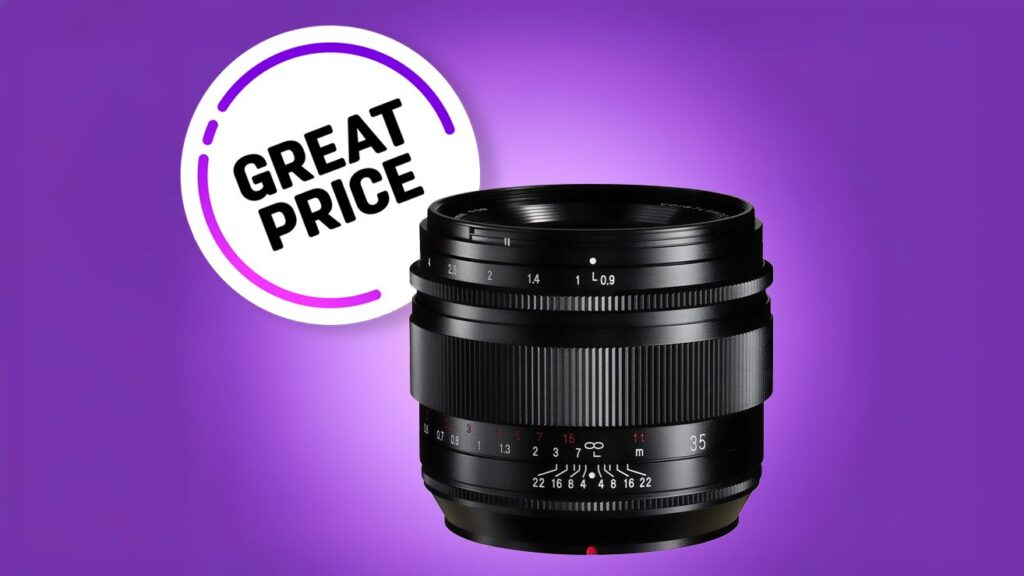
Table of Contents
A Rare Aperture at a Rare Price
In the world of mirrorless photography, the race for faster apertures usually leads to massive, heavy pieces of glass that resemble small telescopes. However, Voigtlander has carved out a niche by producing high-performance manual optics that balance extreme light-gathering capabilities with a footprint that doesn’t overwhelm the camera body. For Fujifilm X-mount users, that balance is currently more affordable.
B&H has announced a significant price drop for the Voigtlander Nokton 35mm f/0.9, bringing the cost down to $1,199 from its standard MSRP of $1,499. A $300 discount on a lens of this caliber is uncommon, as Voigtlander typically maintains strict pricing on its specialized Nokton line.
The Physics of f/0.9
To put an f/0.9 aperture into perspective, it is nearly a full stop faster than the widely coveted f/1.2 primes found in high-end professional lineups. In practical terms, this means the lens can pull in significantly more light in near-dark environments without the photographer needing to crank the ISO to levels that introduce excessive noise. This makes it an outlier for street photographers who operate during the ‘blue hour’ or for indoor portraitists who prefer natural light over flashes.
Beyond the light-gathering, the primary draw here is the depth of field. At f/0.9, the plane of focus becomes razor-thin. While this presents a significant challenge for the photographer—requiring precise manual focus—it results in a creamy, ethereal bokeh that separates the subject from the background with a level of intensity that autofocus lenses often struggle to replicate.
Manual Control in a Digital Era
The Nokton 35mm is an unapologetically manual tool. There is no autofocus motor here; instead, users rely on a tactile, damped focus ring. While this might seem like a step backward to those used to the snap-to-focus speed of modern mirrorless systems, it encourages a more deliberate, slow-burn approach to composition. When paired with Fujifilm’s focus peaking or manual magnification tools, the lens becomes a precision instrument for those who want total creative agency over their framing.
Despite its manual nature, Voigtlander hasn’t ignored the modern ecosystem. The lens is fully compatible with Fujifilm’s in-body image stabilization (IBIS) and communicates EXIF data to the camera. This ensures that while the focus is manual, the metadata—such as the aperture setting—is preserved in the image file, a small but vital detail for photographers who perform extensive post-processing work.
Form Factor and Build
One of the most impressive feats of the Nokton 35mm is its physical footprint. Weighing in at 492g and measuring just 64mm in length, it avoids the bulk typically associated with ultra-fast primes. The construction is primarily all-metal, giving it a dense, professional feel that suggests it can survive the rigors of daily street use.
The optical formula includes aspherical elements designed to combat the spherical aberration that often plagues wide-open apertures. While most lenses lose significant sharpness at their widest setting, the Nokton manages to maintain a usable center sharpness at f/0.9, though stopping down to f/1.4 or f/2.0 reveals the lens’s true resolving power.
For those building a lean kit around a Fujifilm X-T5 or X-Pro3, this lens fills the gap between a standard 35mm and a specialized portrait lens, offering a versatile focal length that behaves like a high-end art tool.


