Home / What Makes the Venice Biennale 2026 So Important in Contemporary Art?
What Makes the Venice Biennale 2026 So Important in Contemporary Art?
Saran K | May 25, 2026 | 12 min read
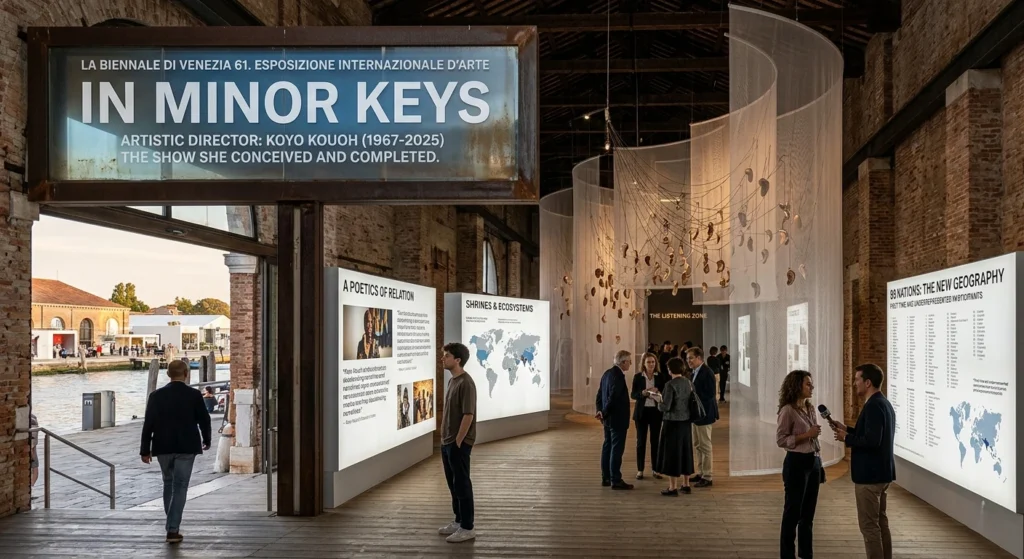
Table of Contents
The Venice Biennale 2026 is more than just a Venice art exhibition; it is a cultural watershed. The 61st International Art Exhibition, titled In Minor Keys, opened on May 9, 2026, and runs through November 22 across the historic Giardini and Arsenale venues in Venice, Italy. For anyone tracking modern art trends and global art events, this edition stands apart from all others.
This year’s Biennale carries the posthumous vision of Cameroonian-Swiss curator Koyo Kouoh, the first African woman ever appointed to lead the exhibition, who passed away unexpectedly in May 2025. Her team honored her meticulously planned curatorial project, bringing together 111 artists from five continents for an experience that is equal parts art exhibition and act of remembrance. Beyond the art, the 2026 edition has been engulfed in geopolitical controversy — jury resignations, protests, and international political pressure, making it one of the most closely watched Biennale highlights in the event’s 130-year history.
Whether you are an art world insider or a curious global traveler, here is everything you need to know about why the Venice Biennale 2026 matters so deeply to contemporary art and culture.
What Happened?
The 61st Venice Biennale officially opened to the public on May 9, 2026, with preview days held May 6–8. The main curatorial exhibition, In Minor Keys, was conceived by Koyo Kouoh after her appointment in late 2024 and completed posthumously by her dedicated team following her death in May 2025.
The exhibition spans two primary venues, the Giardini della Biennale and the Arsenale — alongside additional venues scattered across Venice. It features 111 artists, including solo practitioners, duos, collectives, and organizations, selected for what Kouoh described as a “kinship of research and practice.” The theme draws on metaphors of jazz improvisation, Caribbean poetics, and the idea of the Creole garden as a space of quiet resistance and healing.
Alongside the main show, 99 national pavilions are participating, including seven countries making their Biennale debut for the first time: Guinea, Equatorial Guinea, Nauru, Qatar, Sierra Leone, Somalia, and Vietnam. In total, 31 collateral events are taking place at various locations across the city, making the entire island of Venice a living, breathing art installation from May through November 2026.
Timeline of Key Events:
- October 2024 — Koyo Kouoh accepts the invitation to curate the 61st Biennale
- May 2025 — Koyo Kouoh passes away unexpectedly, aged 58
- May 27, 2025 — The Biennale Foundation announces it will honor her vision and proceed with In Minor Keys
- April 22, 2026 — The five-member International Jury announces it will not award prizes to countries whose leaders face ICC war crimes charges
- April 30, 2026 — The entire jury resigns ahead of the opening
- May 4, 2026 — Biennale organizers announce two new Visitors’ Lion awards, replacing the traditional jury prizes
- May 6–8, 2026 — Press preview days
- May 9, 2026 — Public opening
- November 22, 2026 — Closing date
Why Is This Trending?
The Venice Biennale 2026 has captured global attention for reasons that go well beyond the art itself. It sits at the intersection of culture, geopolitics, grief, and identity — making it a lightning rod for conversations happening everywhere from social media to diplomatic corridors.
The unexpected death of Koyo Kouoh sent shockwaves through the global art world. As the first African woman ever to curate the Biennale, her appointment had been celebrated as a historic milestone. Her passing before the opening transformed the event into a tribute as much as an exhibition, prompting widespread reflection on representation, legacy, and what it means to honor a visionary’s unfinished work.
Then came the political firestorm. Russia’s return to the Biennale for the first time since 2022, following its invasion of Ukraine, provoked immediate backlash. More than 200 participating artists, curators, and workers signed open letters demanding that both the Russian and Israeli pavilions be excluded. The European Commission threatened to withdraw up to 2 million euros in EU subsidies over Russia’s readmission. Italy’s Culture Minister Alessandro Giuli publicly refused to attend the preview events in protest. When the five-member jury resigned en masse, the global art press erupted.
On social media, #VeniceBiennale2026 and #InMinorKeys trended across Instagram and X (formerly Twitter), with artists, critics, and audiences debating the role of political neutrality in cultural institutions, the ethics of awarding prizes in wartime, and whether art exhibitions can or should be spaces of political refuge. Discussions about contemporary artists and their responsibilities to geopolitical realities have rarely felt so urgent.
Background and History
The Venice Biennale is the oldest and most prestigious recurring international art exhibition in the world, founded in 1895 under the patronage of the King of Italy. Held every two years, it was originally conceived as a celebration of contemporary European art and gradually expanded to become a truly global platform. The national pavilion system where countries curate independent exhibitions competing for top prizes was established in the early twentieth century and has grown to include nearly 100 nations.
Over its history, the Biennale has served as a barometer for art world values, often reflecting the political tensions of its era. During the Cold War, it became a site of ideological competition. In recent decades, it has prioritized expanding representation beyond the Western canon: the 2024 edition, Foreigners Everywhere curated by Adriano Pedrosa, centered voices from the Global South, queer artists, and the self-taught.
Koyo Kouoh was a natural continuation of this trajectory. Born in Cameroon in 1967 and raised in Zurich, she was the founder of the Raw Material Company in Dakar and had contributed to documenta 12 and 13. Her previous exhibitions — including Still (the) Barbarians (Ireland Biennial, 2016) and Dig Where You Stand (Carnegie International, 2018) — were celebrated for their incisive exploration of colonial residues, diaspora, and healing through collective memory. Her appointment to Venice was hailed across the art world as both overdue and inspired.
Russia’s complicated history with the Biennale is also relevant context. Since the 2022 invasion of Ukraine, Russia’s pavilion had been shuttered, with artists withdrawing in protest. The Foundation’s decision to readmit Russia in 2026, citing its policy that “any country recognized by the Italian Republic may request to participate” — reopened a wound the art world had not fully processed.
Key Facts and Important Details
- Exhibition title: In Minor Keys by Koyo Kouoh (completed posthumously by her team)
- Edition: 61st International Art Exhibition of La Biennale di Venezia
- Dates: May 9 – November 22, 2026 (preview: May 6–8)
- Venues: Giardini della Biennale, Arsenale, and 20+ additional venues across Venice
- Number of artists: 111 participants across five continents
- National pavilions: 99 countries participating, including 7 first-time debuts
- Collateral events: 31 officially admitted events across Venice
- Curator: Koyo Kouoh (1967–2025), first African woman to hold the role
- Jury: Five members; resigned April 30, 2026. Original jury: Solange Farkas (chair), Zoe Butt, Elvira Dyangani Ose, Marta Kuzma, Giovanna Zapperi
- Prizes: Traditional Golden Lion jury prizes replaced by two Visitors’ Lion awards, voted on by ticketholders who visited both main venues
- Golden Lion for Lifetime Achievement: Not awarded this year, as Kouoh was unable to finalize selections before her passing
- EU funding cut: The European Commission withdrew approximately 2 million euros over Russia’s participation
- Russia’s pavilion: Remained closed to the general public, open only during press preview days
- Carbon footprint: The 2026 edition has achieved carbon neutrality certification, powered exclusively by renewable energy with active material recycling
- Best visiting period: May to September; midweek days recommended for a less crowded experience
Public and Industry Reactions
The response to the Venice Biennale 2026 has been deeply polarized, cutting across political, cultural, and artistic lines.
From the art world
The jury’s resignation was met with a mix of support and condemnation. Curator Solange Farkas and her colleagues framed their decision as a principled stand, stating they would not consider “countries whose leaders are currently charged with crimes against humanity by the International Criminal Court.” Many artists and cultural workers applauded the decision, with over 200 participants signing open letters in solidarity. Others argued that excluding countries from cultural exchange sets a dangerous precedent that undermines art’s role as a universal language.
From governments
The Israeli Foreign Ministry publicly denounced the jury’s stance as “a contamination of the art world,” while Italy’s Culture Minister Alessandro Giuli sided strongly with Israel, personally calling the Israeli pavilion’s artist, Belu-Simion Fainaru, to express solidarity. Giuli simultaneously opposed Russia’s readmission, calling for documentation to verify compliance with EU sanctions. The European Commission’s threat to pull 2 million euros in funding underscored how deeply the funding structures of major cultural institutions are entangled with geopolitics.
From critics
The art press gave In Minor Keys itself a generally warm, if measured, reception. Writing in The Art Newspaper, critics described the exhibition as a rare sensory experience built on contemplation and slowness — a deliberate counter-programming to the noise surrounding the event. Artsy called it an invitation to “slow down and pay attention.” The Guardian’s Eddy Frankel, while acknowledging the surrounding chaos, noted that some exhibits still deserved a visit.
From audiences
Visitor response has been enthusiastic, with particular interest in standout pavilions such as Morocco’s debut at the Arsenale, where artist Amina Agueznay’s sweeping installation Asǝṭṭa (an Amazigh term for ritual weaving and the loom) brought together the work of 166 Moroccan artisans over six months; Germany’s Henrike Naumann presenting The Home Front; and Taiwan’s Li Yi-Fan exploring the relationship between humanity and technology at the Palazzo delle Prigioni.
What Happens Next?
The Venice Biennale 2026 will continue through November 22, meaning months of exhibitions, events, and public programming remain ahead.
The Visitors’ Lion awards — the replacement for the traditional jury prizes, will be decided by public vote. Every ticketholder who visits both the Giardini and the Arsenale venues is eligible to cast one vote for the best artist and the best national pavilion. The ceremony will take place on November 22, the Biennale’s closing day. This marks a historic shift: for the first time, the Biennale’s top prizes will be determined by the public rather than an appointed jury, raising questions about whether this model could become permanent.
The question of Russia will likely continue to generate debate. As EU political pressure mounts and the Russia-Ukraine war continues with no clear resolution, the Biennale Foundation may face difficult decisions about future editions. Whether Russia’s participation in 2028 will once again be permitted or whether the Foundation will revise its participation policy, will be watched closely.
Koyo Kouoh’s legacy is already being cemented. Her vision for In Minor Keys — centered on healing, sensory experience, and quiet resistance, resonates powerfully in a moment of global crisis. Discussions about establishing a permanent prize or curatorial fellowship in her name are reportedly underway within the art world.
For art lovers planning a visit, the Biennale recommends attending between May and September for the best experience, with midweek visits preferred to avoid weekend crowds. Extended opening hours on Fridays and Saturdays are available at the Arsenale during peak season.
Conclusion
The Venice Biennale 2026 is, without question, one of the most extraordinary editions in the event’s 130-year history, extraordinary in its grief, its beauty, its controversy, and its ambition. In Minor Keys stands as a moving artistic testament from a visionary curator who never got to see her work fully realized, brought to life by a team determined to honor every detail of her vision.
At the same time, the Biennale’s geopolitical entanglements — jury resignations, protests, EU funding threats, and questions about the role of cultural institutions in wartime, reflect the pressures that global art events are navigating in an increasingly fractured world. The Biennale’s response, replacing elite jury prizes with a public vote open to all visitors, is itself a statement: that art belongs to the people who experience it.
From the 111 artists assembled across the Giardini and Arsenale to the seven countries participating for the very first time, the Venice Biennale 2026 is a reminder of why contemporary art remains essential — not as escapism, but as a mirror, a refuge, and a space for humanity to reckon with itself.
The exhibition runs through November 22, 2026. There is still time to see it.
FAQs
Why is the Venice Biennale 2026 important?
The 2026 edition is significant for multiple reasons: it is the posthumous realization of the first-ever African woman curator’s vision, it features 99 national pavilions including seven first-time participants, and it has become a flashpoint for debates about geopolitics and cultural neutrality at the highest levels of the art world. It is also widely regarded as one of the most thoughtfully curated editions in recent years, with its emphasis on sensory depth and slower, more deliberate engagement with contemporary artists and their work.
What does “In Minor Keys” mean?
In Minor Keys is the curatorial title conceived by Koyo Kouoh. It draws on the metaphor of jazz improvisation — tuning into quieter, subtler frequencies rather than grand, dominant notes. The exhibition invites visitors to slow down, pay closer attention, and engage with art that works through subtraction, emotion, and the senses rather than spectacle. Kouoh described it as “an invitation to reconnect with emotions and the senses” amid a world of accumulating crises.
Where can people visit the Venice Biennale 2026?
The main exhibition runs across two primary venues: the Giardini della Biennale and the Arsenale di Venezia. Additional collateral events are spread across more than 20 locations throughout the city, including palazzos, museums, and public spaces. The official website is labiennale.org.
Who is Koyo Kouoh?
Koyo Kouoh (1967–2025) was a Cameroonian-born, Zurich-raised curator, the founder of the Raw Material Company in Dakar, and a contributor to documenta 12 and 13. She was appointed as the artistic director of the 61st Venice Biennale in late 2024, becoming the first African woman to hold this role. She passed away unexpectedly in May 2025, aged 58, before the Biennale opened.
Why did the jury resign?
The five-member International Jury resigned on April 30, 2026, days before the Biennale opened to the public. Their resignation followed a statement announcing they would not award prizes to countries whose leaders are currently under International Criminal Court arrest warrants for crimes against humanity — specifically Russia and Israel, both of which are participating in 2026. The jury’s resignation was accepted by the Biennale Foundation, which subsequently introduced two public Visitors’ Lion awards in place of the traditional prizes.
When did the Venice Biennale was founded?
The Venice Biennale was founded in 1895, making it the world’s oldest international art biennial. The 2026 edition is its 61st iteration.
Is the Venice Biennale free?
No. The Venice Biennale requires a paid ticket for the main exhibition venues (Giardini and Arsenale). Many collateral events at other venues throughout Venice are free or separately ticketed. For full ticketing information, visit labiennale.org.