Thunder’s Defensive Rotation Neutrals Wembanyama in Game 5 Victory
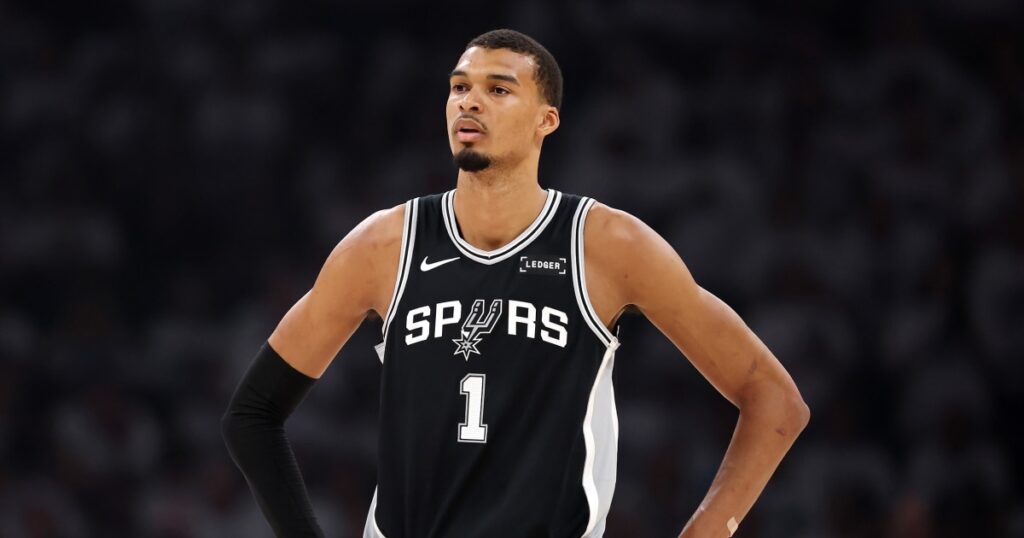
Table of Contents
The Mathematical Formula for San Antonio’s Struggle
For the San Antonio Spurs, the Western Conference Finals have devolved into a predictable, almost binary equation: when Victor Wembanyama dominates the floor, the Spurs win; when he is neutralized, they lose. On Tuesday night in Oklahoma City, the Thunder solved for X, handing the Spurs a 127-114 defeat and taking a commanding 3-2 lead in the series.
Wembanyama’s night was characterized by a frustrating lack of rhythm. He finished with 20 points—his lowest output of the series—and a shooting line that highlighted the Thunder’s defensive success. While a perfect 12-for-12 trip to the charity stripe kept his scoring respectable, he struggled immensely from the field, shooting just 4-for-15. More telling was his perimeter performance, where he missed all five of his three-point attempts.
The struggle began early. A look at the halftime splits reveals a pattern that has defined the series. In San Antonio’s two victories, Wembanyama entered the locker room shooting 7-for-15 and 6-for-11. Conversely, in the three losses, including Tuesday’s blowout, he hovered around a meager 2-for-5 average in the first half. By the time the Spurs attempted to mount a comeback, the game had already shifted toward Oklahoma City’s tempo.
A War of Attrition: OKC’s Defensive Versatility
The Thunder did not rely on a single defender to stop the 7-foot-4 French phenom. Instead, they employed a high-frequency rotation of bodies and looks, designed to keep Wembanyama from finding any consistent mechanical flow. Oklahoma City cycled through Isaiah Hartenstein, Chet Holmgren, Jaylin Williams, and Alex Caruso, alternating between physical grit and agile length.
This “committee approach” effectively disrupted Wembanyama’s timing. By switching between different archetypes of defenders, the Thunder forced him into uncomfortable positions and contested his primary scoring zones with varying levels of pressure. Jared McCain, the Thunder guard, noted that the strategy was a conscious team effort. “We talked about it. We made adjustments to it,” McCain said, acknowledging that the Thunder viewed Wembanyama’s rhythm as the catalyst for the entire Spurs offense.
The psychological toll was evident. Barely two minutes into the third quarter, with the Thunder holding an 18-point lead, Wembanyama delivered an impassioned speech to his teammates during a timeout. The spark provided a brief window of hope; the Spurs clawed back to within eight points later in the period. However, the momentum proved fleeting. San Antonio entered the fourth quarter trailing by 10 and suffered a catastrophic drought, scoring only two points in the opening four minutes of the final frame.
The Aggression Gap
Spurs coach Mitch Johnson didn’t mince words during the postgame press conference in Oklahoma City. “He’s got to take more than 15 shots, even with the free throws,” Johnson remarked. “He’s going to have to score more than 20 points, for sure. OKC did a good job. We’ve got to do a better job.”
The critique centers on a lack of aggression. While Wembanyama is often praised for his high basketball IQ and willingness to make the “right play,” in a series of this magnitude, the Thunder have bet on his hesitation. Stephon Castle, the Spurs guard, echoed this sentiment, suggesting that Wembanyama’s aggression is the key to unlocking the rest of the roster. “He’s our best player. We need him to be aggressive,” Castle said. “I feel like him being aggressive opens up shots for other guys.”
As the series shifts back to San Antonio for Game 6 on Thursday night, the Spurs face a tactical crossroads. They have two days to figure out how to counter a defensive scheme that has successfully turned one of the most unique talents in NBA history into a secondary scoring threat. For the Thunder, the blueprint is already written: keep the rotation fluid, disrupt the rhythm, and keep Wembanyama off balance.