The Trillion-Dollar Gamble: Can Starship Finally Scale SpaceX’s Galactic Ambitions?
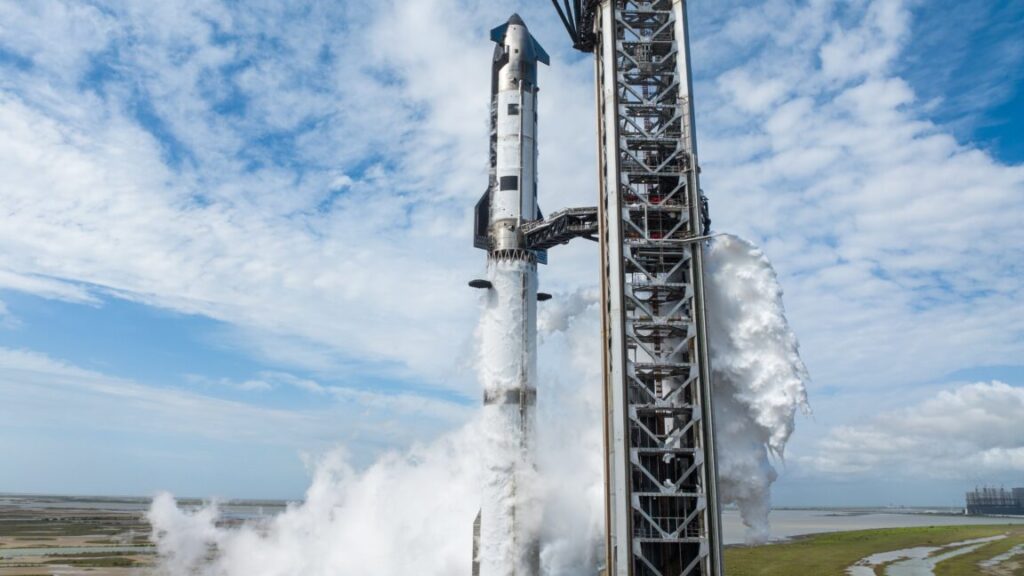
Table of Contents
Beyond the Rocket Company
It is becoming increasingly easy to forget that SpaceX is, at its core, a rocket company. Over the last year, the firm’s strategic moves have looked less like aerospace engineering and more like a diversified technology conglomerate. From a $17 billion spectrum deal with EchoStar to bolster Starlink, to the ambitious plan of launching one million orbital data centers, the company is aggressively pivoting toward the digital infrastructure of the future.
These maneuvers, coupled with a high-profile merger with xAI and a foray into semiconductor manufacturing, have pushed SpaceX’s internal valuation toward a staggering $1.5 to $2 trillion. Wall Street is currently enamored with the company’s potential as an AI and telecommunications powerhouse, yet this financial euphoria rests on a precarious foundation: a single, massive launch vehicle that has yet to prove it can reliably operate at scale.
The Starship Bottleneck
Enter Starship. While the Falcon 9 has secured SpaceX’s dominance in the current launch market, Starship is the prerequisite for everything else. Whether it is the deployment of next-generation Starlink satellites or the colonization of Mars, the entire roadmap depends on this fully reusable system. To date, however, the record has been volatile.
The investment is immense. Estimates suggest SpaceX has poured $15 billion into the program over the last decade, funding the sprawling Starbase facility in South Texas and expanding infrastructure in Florida. This investment manifests in the Raptor engines. Jacob McKenzie, Vice President for the Raptor program, recently noted that the company built 600 engines for the V2 program alone. For context, NASA typically spends billions to procure just a handful of comparable expendable engines, highlighting the sheer industrial scale SpaceX is attempting to maintain despite the rocket’s uneven flight history.
A Cycle of Breakthroughs and Blowups
The path to orbital reliability has been non-linear. In late 2024, the program seemed to hit a stride. SpaceX successfully demonstrated the ‘catch’ of the Super Heavy first stage and achieved a controlled splashdown of the upper stage after re-lighting its Raptor engines in vacuum. At the time, Starbase general manager Kathy Lueders suggested a target of 25 missions per year for 2025.
That optimism was short-lived. The first half of 2025 proved disastrous. Three consecutive flights ended in the loss of control during ascent, resulting in debris showers and high-profile failures. The nadir arrived on May 27, when both the upper stage and the Super Heavy booster failed to make a safe return, effectively resetting the clock on the program’s momentum.
The Transition to V3
SpaceX has since pivoted its focus toward the V3 iteration of the vehicle. This latest version aims to incorporate the hard-won data from the V2 failures, featuring a revised design intended to increase payload capacity and reliability. However, the transition has not been seamless. In November, a V3 booster exploded during a routine pressure test, a stark reminder that the physics of rapid reuse remain unforgiving.
The company has spent the last seven months in a period of forced reflection and reconstruction. Efforts have shifted toward building a second, more rugged launch tower at Starbase to support a higher launch cadence. While a V3 booster successfully passed a pressure test in early February, the gap in flight data is glaring.
As SpaceX prepares to return to the skies, the stakes have shifted. Starship is no longer just an engineering experiment; it is the primary asset backing a trillion-dollar valuation. If the V3 can finally move from ‘test mode’ to ‘operational mode,’ SpaceX may justify its astronomical price tag. If not, the company risks being a satellite operator waiting for a ride that never arrives.