The Rise of ‘Ghost Journals’: How AI is Fabricating Academic Papers Under Real Professors’ Names
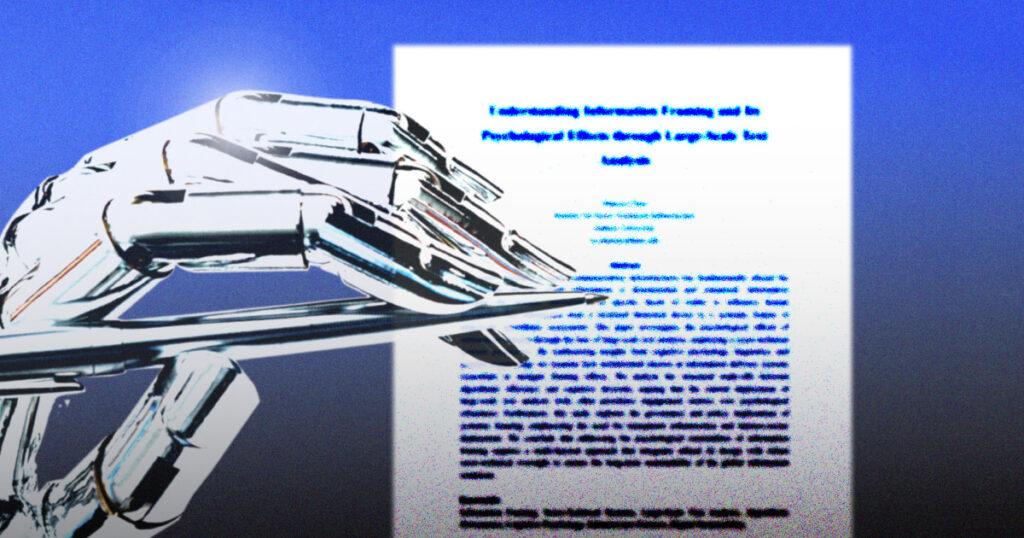
Table of Contents
A New Frontier in Academic Fraud
The scientific record is being quietly compromised by a sophisticated new breed of predatory publishing. It isn’t just the usual “pay-to-play” journals that skip peer review for a fee; these are essentially “ghost journals”—entities that exist solely to populate the internet with AI-generated research papers credited to legitimate, unsuspecting professors.
Unlike traditional academic misconduct, where a researcher might fudge data to get published, this is a top-down fabrication. Generative AI is being used to synthesize entire papers, complete with plausible-sounding methodology and fabricated citations, and then attributed to established experts in the field to lend the work an air of unearned authority.
The Mechanics of a Digital Heist
The process typically begins with the scraping of professional profiles from university directories and LinkedIn. By identifying a professor’s specific area of expertise—for example, molecular biology or behavioral economics—bad actors use Large Language Models (LLMs) to mimic the author’s tone and technical lexicon. The result is a paper that looks, at a glance, like a standard academic contribution.
These papers are then hosted on websites designed to look like legitimate scholarly repositories or journals. To the casual observer or an automated search bot, the paper appears to be a valid piece of research from a respected institution. However, for the professors involved, the discovery is often a shock. Many only find these papers when a colleague mentions a “new study” they’ve written, or when the paper begins appearing in AI-driven search summaries.
Why This Matters Beyond the Resume
The danger here is not just a matter of reputation management for academics. We are entering an era where AI models are being trained on the web’s existing data. If the internet becomes flooded with fabricated “scientific” papers, future AI models will be trained on falsehoods—a feedback loop that could lead to systemic errors in medicine, engineering, and public policy.
When an AI generates a fake paper and then another AI summarizes that paper for a user, the original human expert is completely bypassed. This creates a “hallucination pipeline” where misinformation is laundered through the prestige of academic formatting. For a medical student or a policy maker relying on rapid AI summaries, a fake paper attributed to a real Harvard or Stanford professor carries a weight of trust that is nearly impossible to verify without manually checking the university’s official faculty publication list.
The Failure of Traditional Peer Review
This trend exposes a critical vulnerability in the current academic publishing model. While peer review is intended to be the gold standard, the sheer volume of AI-generated content is overwhelming the system. Predatory journals are bypassing peer review entirely, but they are also creating “paper mills” that can churn out hundreds of these fake credited works per week.
University administrators and academic publishers are now scrambling to implement digital signatures and verified ORCID iDs (Open Researcher and Contributor IDs) to ensure that only the actual authors can claim credit for a work. However, as LLMs become better at mimicking the nuances of specialized academic writing, the line between a legitimate discovery and a statistically probable fabrication is blurring.
The immediate fallout is a growing atmosphere of skepticism. Professors are now finding themselves in the absurd position of having to “disavow” work they never wrote, essentially fighting a ghost in the machine that is using their own professional identity as a mask for synthetic misinformation.