The Rise of ‘Empathy Bait’: How AI Scammers Use Digital Blackface to Move Shein Inventory
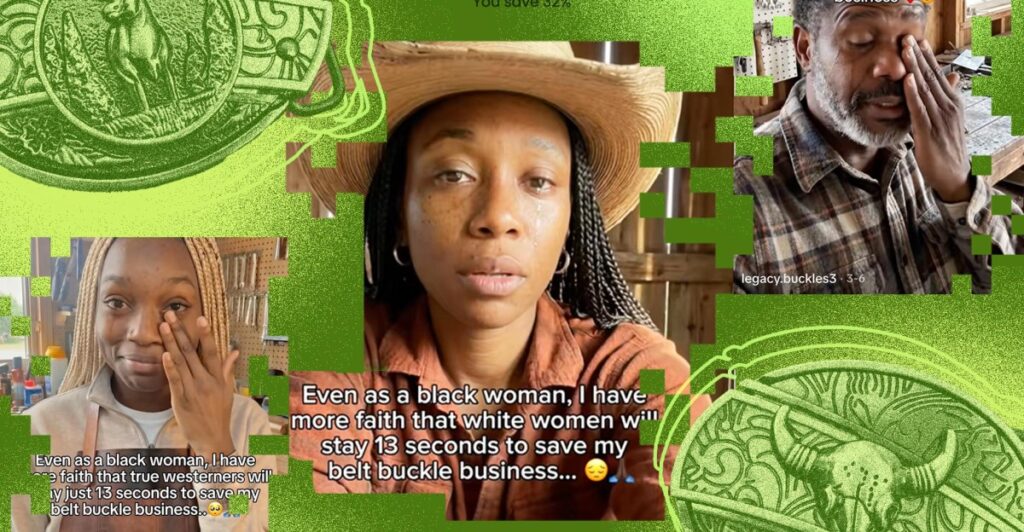
Table of Contents
The Architecture of a Digital Lie
Aliyah appears as a light-skinned Black woman in country-western attire, staring into a TikTok camera with tears streaming down her face. Her plea is urgent: she claims to be a struggling entrepreneur selling handmade metal belt buckles, urging viewers to stay on the video for just 13 seconds to help her business survive. To thousands of viewers, it looks like a grassroots success story in the making. In reality, Aliyah does not exist.
Aliyah is a sophisticated AI-generated avatar, part of a growing wave of “empathy bait” scams designed to manipulate viewers’ social consciousness and desire for solidarity. These personas are used to front dropshipping operations that sell mass-produced items—often sourced from fast-fashion giants like Shein—under the guise of independent, marginalized craftsmanship. The same sunflower-patterned belt buckles Aliyah claims to hand-forge are available on Shein for a fraction of the $40 price point these scammers demand.
Decoding the Synthetic Persona
While the visual quality of generative AI video has improved, the deception often falls apart upon closer technical inspection. In Aliyah’s videos, the audio is characterized by a robotic, flattened cadence that fails to align with the raw emotion of her crying face. Visual artifacts are common: in one sequence, she is shown sewing leather in a manner that defies actual tailoring logic; in another, a tear disappears instantly from her cheek in a way that defies physics.
The scale of this operation suggests a coordinated effort to exploit short-form video algorithms. Many of these accounts, such as “Aliyahsbuckles,” utilize identical backgrounds, lighting, and props, simply swapping the AI avatar to test which demographic profile yields the highest conversion rate. This isn’t just about selling a product; it is about weaponizing identity to bypass the natural skepticism users have toward traditional ads.
The Mechanics of ‘Empathy Bait’
Jeremy Carrasco, a researcher of AI-generated media and director of Riddance.ai, describes this trend as a predatory optimization of niche communities. According to Carrasco, these actors identify popular dropship items and then pair them with a persona likely to evoke a protective or supportive response from specific audiences. He estimates his team identifies up to 100 such accounts daily, noting that many are designed to mimic African American vernacular in their automated comment responses to further the illusion of authenticity.
The tactic is proving devastatingly effective. Aliyah’s primary video has garnered 6.5 million views and nearly 30,000 comments. The danger lies in the psychological trigger of solidarity. India Cater-Campbell, a Black business owner in Seattle, admitted she was nearly lured into a purchase because she wanted to support another Black businesswoman. “I felt solidarity as I am trying to start a business myself,” she noted, highlighting how these scams specifically target the communal impulse to uplift marginalized entrepreneurs.
Digital Blackface and the Economic Cost
This trend represents a modern evolution of “digital blackface,” a term used by researchers like Cienna Davis of the University of Pennsylvania to describe the use of Black cultural expressions and identities by non-Black individuals for social or economic gain. By synthesizing a Black identity, scammers can appropriate the trust and emotional labor associated with the Black community to sell low-quality goods.
The reach of these scams extends into high-profile circles. Recently, Gizelle Bryant of The Real Housewives of Potomac revealed on her podcast Reasonably Shady that she was tricked by a video featuring an AI-generated Black boy who claimed he was being bullied for crocheting. Bryant, along with other celebrities like Viola Davis, engaged with the content, proving that even those with significant digital literacy are susceptible to high-fidelity AI manipulation.
As generative video models continue to evolve, the gap between a real human and a synthetic avatar is closing. With platforms like TikTok and Instagram struggling to label AI content effectively, the burden of verification is shifting to the user, who is often scrolling through a feed optimized for mindless consumption rather than critical analysis.


