The Psychology of Survival: How Four Men Escaped a Flooded Laotian Labyrinth
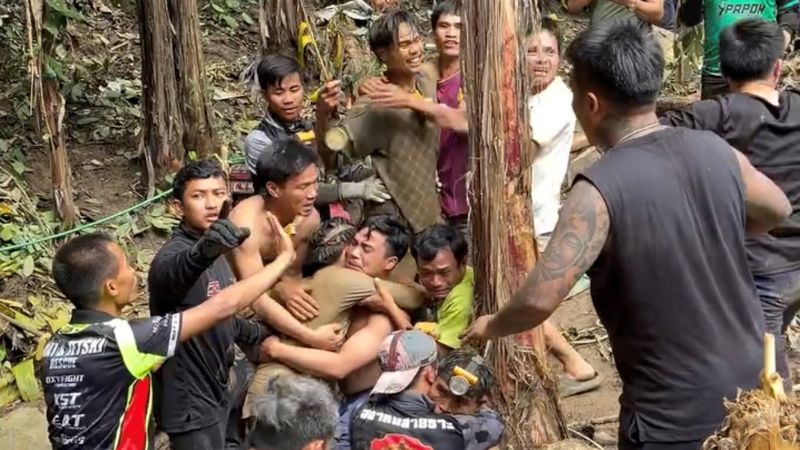
Table of Contents
A Descent Driven by Desperation
In the remote limestone foothills of Xaisomboun province, Laos, the lure of gold often outweighs the inherent risks of the terrain. For Mee Singfamalai, a 23-year-old barber, and four companions, a speculative venture into a subterranean cave system turned into an 11-day battle for survival when the humid Laotian summer unleashed a deluge of heavy rains, flash-flooding the passages behind them.
The incident highlights a growing trend of informal mining in Laos’ river basin regions. In areas where formal employment is scarce and regulatory enforcement is minimal, villagers often risk their lives in unmapped cave systems. For this group, the goal was simple financial gain; the result was a harrowing entrapment in a dark, waterlogged labyrinth.
The Mechanics of an Unassisted Escape
While a multinational team of cave diving experts—including specialists from the Metta Tham Rescue Kalasin unit—had managed to extract one member of the group using advanced diving gear, four others remained trapped. The rescue operation involved deploying high-capacity pumps to lower water levels and heavy machinery to carve access roads through the mud-slicked jungle. However, the survivors did not wait for a coordinated extraction.
When the water finally began to recede, the remaining four men made a tactical decision to attempt an escape on their own. They navigated approximately 260 meters (850 feet) of treacherous tunnels—a distance roughly equivalent to the height of a 78-story building. The transit was not a simple walk; it was a grueling sequence of diving through submerged sections and crawling through apertures barely larger than a human body.
Survival Under Extreme Stress
The conditions inside the cave were hostile. Without blankets or food, the men survived on water alone, huddling together for warmth to combat the subterranean chill. Mee Singfamalai, recovering at Long Tieng Hospital, described the psychological toll of the isolation.
“I was afraid because we were there alone,” Mee told reporters. “We slept hugging each other. It helped a lot.”
This behavior—social bonding as a survival mechanism—was critical in maintaining the group’s morale. The mental fortitude required to crawl through oxygen-depleted, narrow passages while physically exhausted suggests a powerful drive fueled by the desire to return to their families. Another survivor, Lam, explicitly linked their resilience to their socioeconomic reality, stating in a social media post that the “terror of poverty” was what pushed them to fight so hard for survival.
The Ongoing Search and Technical Challenges
Despite the successful emergence of the four men, the mission in Xaisomboun is far from over. Two additional villagers, believed to have entered the system before Mee’s group, remain missing. The rescue operation is now utilizing a map provided by the survivors, which has revealed the existence of a secondary chamber—a potential air pocket located another 100 meters deeper into the network.
The technical difficulty of this search is compounded by the volatile weather. Rescue divers, some of whom possess experience from the high-profile 2018 Tham Luang cave rescue in Thailand, are re-entering the system to probe these deeper recesses. The search is a race against time and the elements, as continued rainfall threatens to re-flood the very passages the survivors recently escaped.
For those who made it out, the experience has left a permanent mark. Mee, now on a restricted diet of soft foods like congee as he recovers from the physical trauma, was definitive about his future relationship with the region’s geology. “Never,” he said when asked if he would return. “You would have to send me to death if you want to force me in.”