The Modular Viewfinder Gap: Why Canon’s EOS R Line Needs the M6 Mark II’s Best Trick
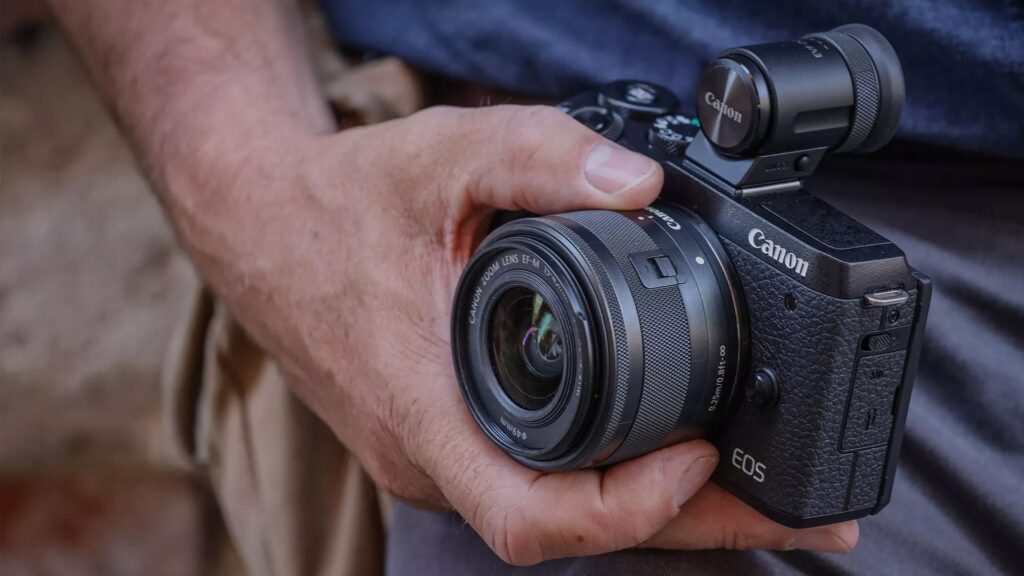
Table of Contents
The Vanishing Act of the Versatile Compact
When Canon officially wound down the EOS M system in 2023, the industry viewed it as a necessary consolidation. The company needed to steer users toward the RF mount to unify its mirrorless ecosystem. However, in the transition from the M-series to the R-series, a specific piece of functional ingenuity was left behind: the detachable electronic viewfinder (EVF).
The Canon M6 Mark II stood as the pinnacle of that discontinued line, packing a 32.5MP APS-C sensor and impressive 14fps burst speeds into a chassis that defied a rigid category. It wasn’t just a compact camera; it was a modular one. By utilizing the EVF-DC2—a slide-on electronic viewfinder that clipped into the hot shoe—the M6 Mark II could transform from a pocketable ‘street’ camera into a stable composition tool for stills photography in seconds.
The Ergonomic Compromise of the R-Series
Current entry-level offerings in the EOS R lineup, such as the Canon EOS R50, follow a diverging design philosophy. These cameras are increasingly optimized for the ‘vlogger’ demographic, prioritizing tilt-screens and streamlined bodies. While the R50 includes a built-in EVF, the broader trend across the industry—seen in the Sony ZV-E10 II and the Nikon Z30—is the complete removal of the viewfinder to shave off millimeters of height.
This design choice creates a binary problem for the user. You either carry a bulky camera with a permanent hump for the EVF, or you carry a sleek, screen-only device that becomes nearly impossible to use in direct sunlight or for precise framing. The M6 Mark II solved this by making the viewfinder an accessory rather than a permanent architectural feature.
Leveraging the Multi-Function Shoe
The technical argument for bringing back a modular EVF is stronger now than it was during the EOS M era. Canon’s modern RF cameras utilize the Multi-Function Shoe, which provides a more robust electronic interface than the traditional hot shoe. This allows for faster data transmission and more reliable power delivery.
Integrating a modern version of the EVF-DC2 into the R-system would not require a ground-up redesign of the camera bodies. Instead, it would be a peripheral play. An updated, high-resolution modular finder could slide into the Multi-Function Shoe of an R50 or a future ‘R-Lite’ model, providing the stability of a third point of contact for the photographer without forcing the camera to be permanently oversized.
Market Pressure and the Hybrid Demand
There is a growing segment of ‘hybrid’ creators who find themselves trapped between two worlds. They need the portability of a compact for B-roll and vlogging, but they still require the intentionality of a viewfinder for high-quality stills. By eschewing modularity, Canon is forcing users to choose between the ultra-compact (but limited) and the professional (but bulky).
The M6 Mark II proved that there is a market for ‘expandable’ ergonomics. As the line between cinema-style vlogging and traditional photography continues to blur, the ability to snap on a viewfinder only when the lighting conditions demand it is no longer a niche request—it is a logical evolution of the compact mirrorless form factor.


