The Last-Mile Lifeline: How Modified Tricycles are Slashing Maternal Mortality in Rural Ghana
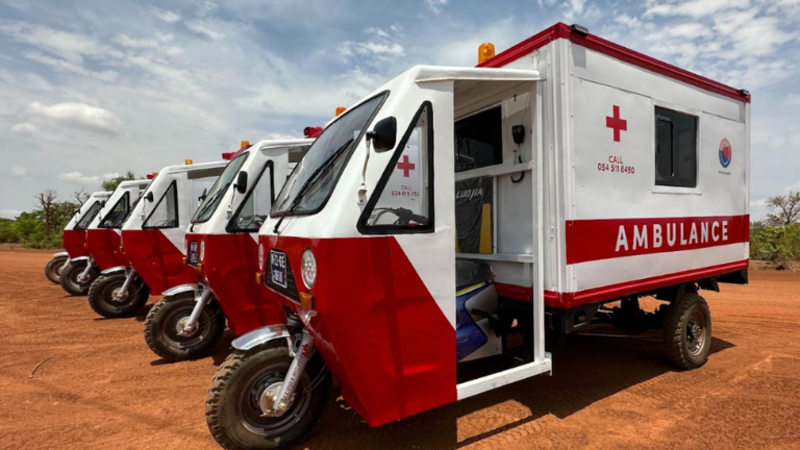
Table of Contents
The Gap in the Grid
In the remote farming communities of Northern Ghana, the distance between a manageable medical complication and a fatal hemorrhage is often measured in kilometers of unpaved, rutted roads. For women like Billeh Rosemount, a 24-year-old from Du West, the lack of reliable transport isn’t just an inconvenience—it’s a systemic risk. During a complicated miscarriage in October 2024, Rosemount found herself bleeding uncontrollably, with a local midwife unable to stabilize her. In these regions, a conventional ambulance is a rarity; if one is available, the transit time to a secondary health facility can take hours, often rendering the trip pointless.
Rosemount’s survival depended on a piece of targeted engineering: a motorcycle-powered tricycle ambulance. Designed to navigate the narrow, rough terrain where standard vehicles frequently bog down or simply cannot fit, these low-cost vehicles are filling a critical void in Ghana’s healthcare infrastructure.
Engineering for the ‘Last Mile’
The vehicles are the brainchild of Moving Health, a nonprofit that originated as an MIT project in 2016. Founded by CEO Emily Young and a team of mechanical engineering students, the organization shifted to permanent operations in Ghana in 2019. Their approach is a study in appropriate technology—creating a tool that is technically sufficient for the task without being so complex or expensive that it becomes unsustainable.
At approximately $7,000 per unit, these ambulances cost roughly one-tenth of a traditional emergency vehicle. However, they are not merely motorized carts. Each unit is outfitted as a mobile stabilization ward, featuring:
- A full-length patient stretcher.
- An onboard oxygen concentrator.
- Emergency birthing kits and basic life support equipment.
- Dedicated seating for a midwife or community health worker and a family member.
The integration of a dedicated seat for medical staff was a specific design pivot based on feedback from local professionals like Midwife Cynthia, ensuring that laboring women receive active clinical care during the journey, rather than just transport.
The Data of Delivery
The scale of the problem in Ghana is stark. While maternal mortality is declining, 2023 figures show 234 deaths per 100,000 live births—a rate roughly 14 times higher than in the United States. According to the World Health Organization, Sub-Saharan Africa accounted for approximately 70% of global maternal deaths in 2023. The common thread in these fatalities is often the “three delays”: delay in seeking care, delay in reaching a facility, and delay in receiving adequate treatment.
Moving Health focuses on the second delay. By deploying 31 ambulances across five districts in the Upper West Region, the nonprofit reports a 64% decrease in transport time from rural communities to hospitals. This efficiency gain has extended the reach of emergency care to over 230,000 people.
Infrastructure vs. Innovation
The rise of tricycle ambulances highlights a glaring gap in national infrastructure. In 2020, reports indicated that only 55 traditional ambulances served the entire Ghanaian population. While the National Ambulance Service has expanded to 356 vehicles as of 2024, that remains a staggering ratio for a population of roughly 35 million people.
For Moving Health, the goal isn’t to replace the national fleet but to augment it. “Sometimes the biggest barrier to surviving a medical emergency isn’t the lack of hospitals,” says Emily Young, “it’s being able to get there in time.” By training local drivers and community health workers to manage emergency dispatches, the nonprofit is creating a decentralized, rapid-response network that operates independently of the bottlenecks affecting larger state-run services.