The Invisible Border War: Why a 2027 Regulatory Summit in Shanghai is the New Space Race
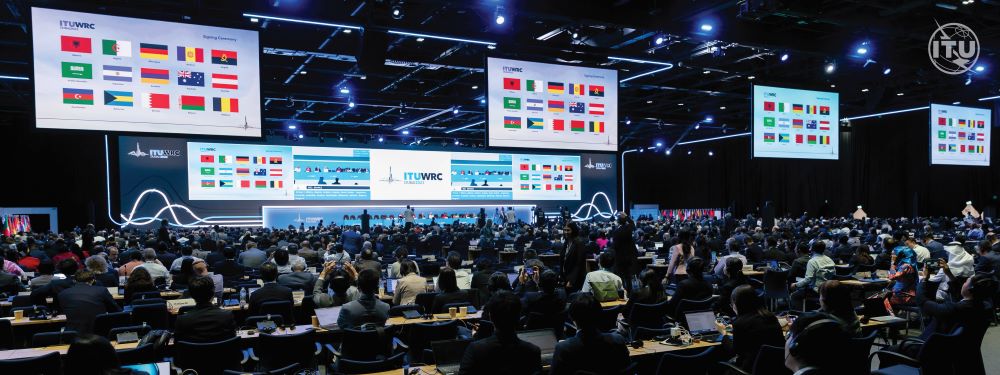
Table of Contents
The Fight for the Orbital Airwaves
While the public focuses on the spectacle of rocket launches and lunar landings, a far more consequential battle for the future of the space economy is being fought in the dry, bureaucratic corridors of regulatory filings. For those tracking the geopolitical tension between Washington and Beijing, the real frontline isn’t a launchpad in Florida or Xichang—it is the 2027 World Radiocommunication Conference (WRC-27) in Shanghai.
The stakes became clear in December when China filed for an additional 200,000 satellites. The move is a transparent signal of intent: Beijing isn’t just participating in the satellite era; it is attempting to architect it. By rapidly scaling national champions like the Guowang and Qianfan constellations, China is challenging the current U.S. hegemony in Low Earth Orbit (LEO).
Currently, the U.S. holds a significant lead, primarily driven by SpaceX’s Starlink, which boasts over 10,000 active satellites. With Amazon’s Project Kuiper and AST SpaceMobile also accelerating their deployments, the U.S. has the hardware advantage. However, hardware is useless without the legal right to transmit. That is where the International Telecommunication Union (ITU) comes in.
The Shanghai Summit: A Strategic Choke Point
WRC-27 is not a typical administrative gathering. Approximately 80% of its agenda is dedicated to space and satellite issues. The decisions made here will dictate who can broadcast, on what frequencies, and under what restrictions. If the U.S. fails to coordinate a unified diplomatic and technical front, it risks having the rules of the road written by adversaries.
One of the most contentious points is the rise of “direct-to-device” spectrum. The ability for a satellite to connect directly to a standard smartphone—bypassing traditional ground stations—is the next frontier of connectivity. The FCC has already established a framework for “supplemental coverage from space,” positioning the U.S. as the first mover. The goal at WRC-27 will be to convince the rest of the world to adopt this American model, ensuring that U.S. tech remains the global standard for bridging the digital divide.
The “Unauthorized Services” Threat
Perhaps the most alarming agenda item concerns so-called “unauthorized” services. Championed by authoritarian regimes, including Iran, there is a push to force non-geostationary orbit (NGSO) systems to kill their signals over countries that have not explicitly authorized their operation.
If adopted, this would effectively extend national firewalls into orbit. It would allow regimes to censor the internet from space, potentially kneecapping the ability of U.S. constellations to provide uncensored information or emergency connectivity to oppressed populations. It is a regulatory attempt to bring the restrictive nature of terrestrial internet to the vacuum of space.
The Technical Tug-of-War: Power and Lunar Limits
Beyond censorship, the conference will tackle the physics of interference. For two decades, the industry has relied on Electronic Power Flux Density (EPFD) limits to prevent LEO satellites from interfering with the massive geostationary (GEO) satellites parked higher up. These rules are antiquated.
The FCC recently pivoted toward a more flexible approach, focusing on actual interference rather than arbitrary power caps. This move enables more efficient spectrum use, but it requires international buy-in. Because the ITU is currently producing studies on these levels for the 2027 summit, the window for the U.S. to influence those technical benchmarks is closing.
Simultaneously, the conference will allocate frequencies for lunar communications. This is not just about science; it is about infrastructure. As the U.S.-led Artemis program competes with China’s lunar ambitions, the party that secures the primary spectrum for moon-to-earth communication will hold the keys to the next great territorial expansion.
A Call for Diplomatic Mobilization
The distance to 2027 may seem vast, but in the world of international treaty-making, the clock is already ticking. To maintain its lead, the U.S. cannot rely solely on the brilliance of its engineers. It requires a coordinated diplomatic offensive.
Industry experts argue that the State Department and FCC must move beyond reactive policy. This would involve hosting an international spectrum summit to align allies and “middle-ground” states before the Shanghai conference begins. In the space race, the most powerful weapon isn’t a bigger rocket—it’s the rulebook.