The Ghost in the Machine: Revisiting the ‘Lost’ C++ Optimization that Could Speed Up Modern Data Structures
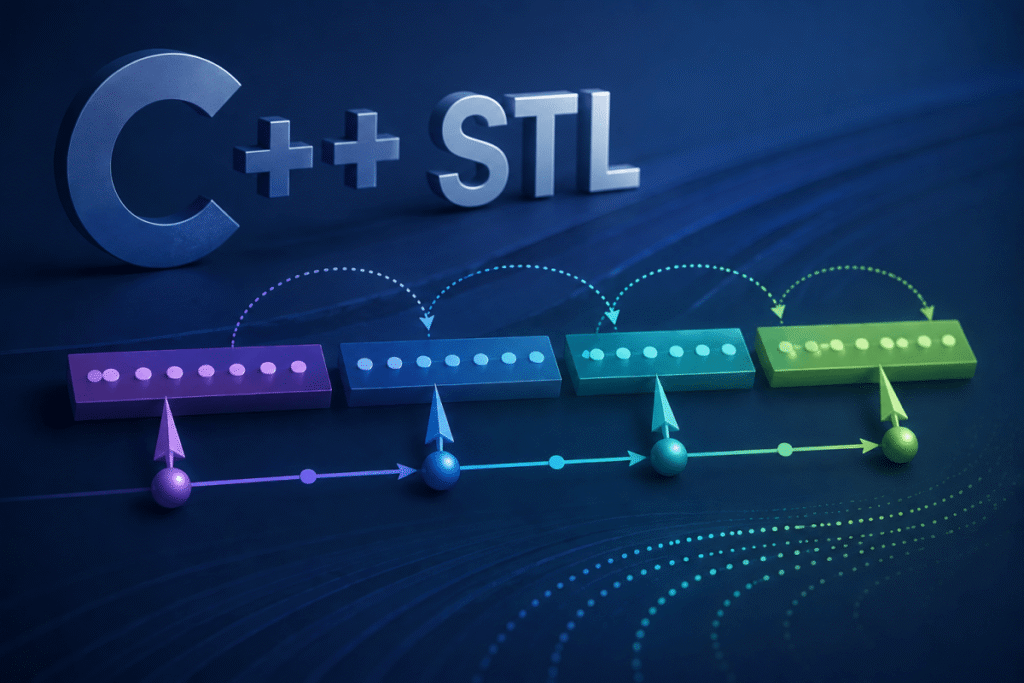
Table of Contents
The Hidden Cost of Abstraction
In the world of high-performance computing, the C++ Standard Template Library (STL) is often cited as the gold standard for generic programming. Its founding principle, championed by Alexander Stepanov, was simple but ambitious: abstraction should have near-zero overhead. The goal was to ensure that a generic algorithm, when compiled, would be as efficient as a hand-written version tailored for a specific data structure.
However, decades later, a lingering inefficiency persists in how C++ handles certain containers. The culprit is the “abstraction penalty” found in standard iterators, particularly when dealing with segmented data structures like std::deque. While the STL provides a flat view of data, the underlying reality is often fragmented, creating a performance gap that has haunted developers since the early 2000s.
The Austern Proposal
In 2000, Matt Austern published a seminal paper titled Segmented Iterators and Hierarchical Algorithms. Austern argued that by treating every data structure as a uniform range of elements, the STL was ignoring a critical architectural detail: segmentation.
Consider std::deque, which is internally a sequence of fixed-size arrays. Every time a programmer calls ++it on a deque iterator, the system must implicitly check if the pointer has reached the end of the current block. This constant checking is a micro-bottleneck that prevents compilers from utilizing auto-vectorization—the process where a compiler optimizes a loop to perform the same operation on multiple data elements simultaneously.
Austern’s solution was to introduce a two-level iterator structure. Instead of a flat range, a segmented iterator would explicitly expose the boundaries of each contiguous block. This allows an algorithm to operate on each chunk with maximum efficiency—perhaps using a tight inner loop or memset—and only handle the transition between segments at a higher level of the logic.
Recursive Segmentation and the Hierarchical Approach
The brilliance of the segmented iterator approach is that it is recursive. While a deque represents a simple one-level segmentation, more complex structures like a vector<vector<vector<T>> would require a nested decomposition. In this model, the local iterator produced at the outer level is itself a segment iterator for the next level down, continuing until the code reaches a truly flat, non-segmentable range.
Despite the technical merit, these ideas never made it into the C++ standard. Instead, they survived in the periphery, implemented within specialized libraries such as boost::container::deque. By using a segmented_iterator_traits class template, developers can manually implement hierarchical algorithms that dispatch to a two-level loop: an outer loop for segments and an inner loop for the high-performance local range.
Benchmarking the Reality
Recent testing of these experimental segmented algorithms reveals a stark contrast in performance. When executing algorithms like fill across different compilers, the results typically diverge based on three modes: the standard flat iterator, the segmented iterator, and a hand-optimized version.
The data suggests that when the compiler cannot guarantee vectorization because of unpredictable block boundaries, the standard iterator lags. By contrast, the segmented approach allows the compiler to see a fixed-size range, triggering the very optimizations that std::deque usually suppresses. This is particularly evident when using loop unrolling hints, such as #pragma unroll(4), which further amplify the speed gains of the segmented approach.
However, the transition isn’t seamless. Implementing this for more complex operations, such as std::merge—which manages multiple input and output ranges—introduces significant complexity. Algorithms that require simultaneous forward and backward traversal, like std::reverse, further complicate the implementation of a hierarchical model.
While the C++ standard has moved forward with concepts and ranges, the core tension between a simplified API and raw hardware efficiency remains. The ghost of Austern’s segmented iterators serves as a reminder that the path to “zero overhead” is rarely a straight line.


