The Geometry of the Grid: How Manhattanhenge Became a Digital Spectacle
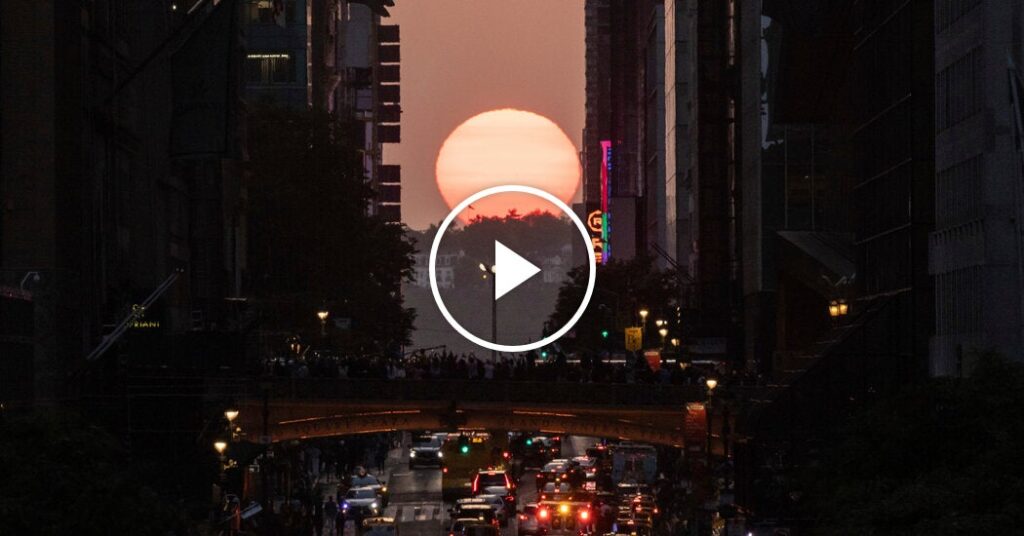
Table of Contents
The Precise Intersection of Steel and Solar
For a few fleeting moments on a few specific days in May and July, the chaotic sprawl of New York City transforms into a giant, accidental solar observatory. This phenomenon, colloquially known as Manhattanhenge, occurs when the setting sun aligns perfectly with the east-west orientation of the Manhattan street grid, casting long, dramatic shadows and bathing the concrete canyons in a singular, blinding golden light.
While the event is often framed as a quirky tourist attraction, it is actually a result of the Commissioners’ Plan of 1811. This blueprint established the rigid rectangular grid of streets and avenues that defines the island. Because the grid is not perfectly aligned with the cardinal directions of true east and west, the sun only hits this precise angle twice a year. For those standing on the right street at the right second, the city’s skyscrapers act as a massive aperture, focusing the sunset into a narrow, intense corridor of light.
The scene on the ground during the first day of the event is typically one of organized chaos. Thousands of New Yorkers and visitors flood the streets, not just to witness the light, but to capture it. What was once a momentary observation has evolved into a high-stakes exercise in mobile photography and real-time digital sharing.
The Algorithm of the Golden Hour
The modern experience of Manhattanhenge is inseparable from the technology used to document it. In the last decade, the event has shifted from a niche curiosity to a viral social media milestone. The timing is now managed not by glancing at a watch, but through precise astronomical apps and GPS-synced timers that tell photographers exactly when the alignment will peak.
The proliferation of computational photography—specifically the HDR (High Dynamic Range) capabilities of the latest iPhone and Pixel devices—has changed how the event is consumed. Capturing a sunset between two massive skyscrapers is a nightmare of contrast; the sky is often blown out while the street level remains in deep shadow. Modern sensors now allow users to balance these extremes in real-time, creating the hyper-saturated, ‘golden’ imagery that dominates Instagram and TikTok feeds during the event.
This digital amplification creates a feedback loop. As a photo of a perfectly aligned street goes viral, more people flock to that specific coordinate, turning a quiet residential block into a crowded gallery of tripods and smartphones. The event has effectively become a ‘destination’ for the digital creator economy, where the value of the experience is measured by its shareability.
Urbanism as an Accidental Clock
There is a deeper technical fascination in how Manhattanhenge serves as a reminder of the physical world in an increasingly virtual age. It is one of the few times a year when the sheer scale of the city’s architecture is humbled by a planetary movement. The alignment demonstrates the intersection of 19th-century urban planning and celestial mechanics.
Interestingly, the phenomenon isn’t unique to New York, though the scale of the Manhattan grid makes it the most famous example. Similar ‘henge’ events occur in other gridded cities, but the density of New York’s high-rises creates a unique visual compression that doesn’t exist elsewhere. It turns the city into a literal instrument for measuring the sun’s path across the ecliptic.
As the sun finally dips below the horizon and the golden light fades into the blue hour, the crowds disperse, leaving behind a city that returns to its usual rhythmic noise. But for a brief window, the technology of the grid and the physics of the solar system aligned to create a moment of unplanned, architectural symmetry.


