The Efficiency Trap: Why AI-Driven Layoffs May Be a Long-Term Strategic Blunder
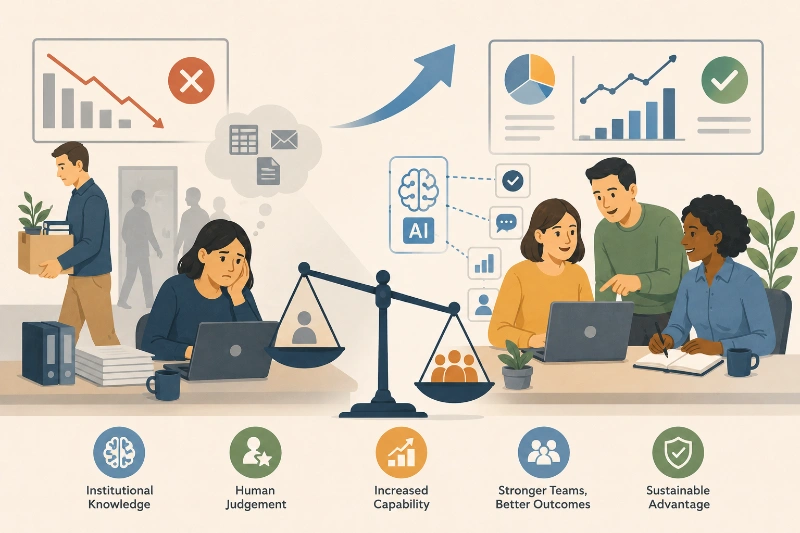
Table of Contents
The Spreadsheet Illusion
In corporate boardrooms across the globe, a specific version of AI adoption is currently winning the argument. It is a version that looks impeccable on a balance sheet: fewer salaries, reduced payroll overhead, and a steady—or even increased—output of deliverables. Clad in the language of “digital transformation” and “operational efficiency,” this strategy treats generative AI as a direct replacement for human labor.
However, a growing chorus of industry strategists and operators suggests that this approach is a dangerous gamble. By viewing AI solely as a tool for headcount reduction, organizations are inadvertently purging their most valuable asset: institutional knowledge.
The Cost of Invisible Knowledge
The fundamental flaw in the “replace-and-reduce” model is the assumption that the value of a role lies in its output. When a company cuts a position because an AI can now generate the weekly report, draft the client emails, or handle the data entry, it assumes the task was the value. In reality, the output is often the least valuable part of a senior employee’s contribution.
The true value is the context. It is the understanding of why a specific client reacts poorly to certain phrasing, the knowledge of where an edge case in a legacy system usually breaks, and the intuitive grasp of how a business actually operates beneath the formal process documents. This institutional memory is not easily codified; it is built through years of trial, error, and relationship management.
When that knowledge walks out the door during a wave of AI-driven layoffs, it creates a vacuum that no Large Language Model can fill. An AI can mimic the style of a report, but it cannot replicate the lived experience of the person who knows which data points in that report are actually meaningful to the CEO.
Scaling Capability Over Cutting Costs
A divergent strategy is emerging among firms that view AI not as a replacement, but as a force multiplier. Rather than asking how many people they can remove from a workflow, these organizations are asking how much more their existing teams can achieve when stripped of low-value friction.
The shift is subtle but profound. Instead of replacing a marketing team, a company might use AI to allow a three-person team to manage ten campaigns with the same level of precision they previously applied to one. Instead of cutting analysts, they enable those analysts to automate the three-day data-gathering phase of a project, redirecting that reclaimed time toward high-level interpretation and strategic pivot-planning.
In this model, the human remains the central equation; AI simply increases the speed at which that equation runs. This creates a compounding advantage. Experienced teams, augmented by AI, make better decisions faster than a skeleton crew attempting to prompt a machine without deep domain expertise.
The Judgement Gap
The efficacy of any AI system is tethered to the quality of the judgment guiding it. A prompt written by someone who understands the nuanced operational constraints of a product will produce a result that is categorically superior to one written by a generalist or a replacement hire working from a brief.
Context is not a “soft skill”—it is a hard competitive advantage. When organizations prioritize short-term cost-cutting over the retention of experienced staff, they often find that their AI tools underperform because there is no one left who knows how to steer them toward the right answer.
A New Operating Model
For the modern enterprise, the goal of AI integration should be the removal of “low-skill work” from “high-skill people.” Administration, formatting, and basic drafting are the friction points that prevent experts from operating at their peak. By automating these burdens, companies can redirect their human capital toward relationship management and complex problem solving.
The gap between these two philosophies—AI as a cost-cutter versus AI as a capability-expander—is beginning to widen. While the former may show immediate gains in quarterly earnings, the latter is building a more durable, scalable, and intelligent infrastructure. The companies that treat their people as the essential steering mechanism for AI are the ones likely to dominate the next era of digital business.


