The Digital-Analog Divide: Why the ‘Split-Desk’ Setup is Replacing the Traditional Tech Station
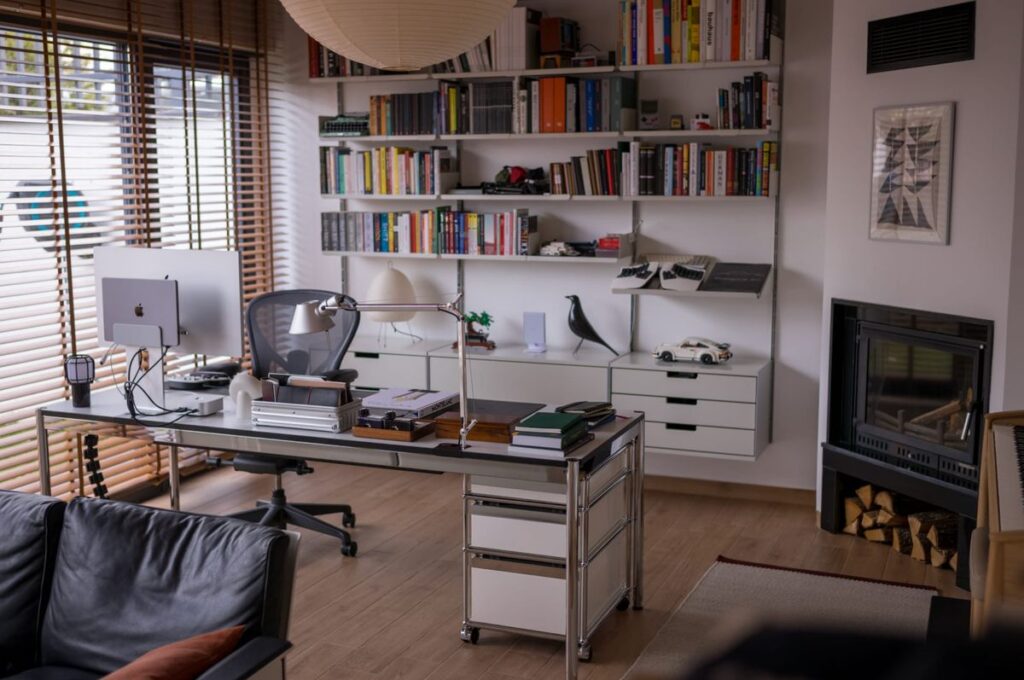
Table of Contents
For decades, the standard home office configuration has remained largely unchanged: a desk pushed flush against a wall, a monitor acting as the focal point, and the user staring directly into a partition. It is a layout optimized for the machine, not the human. However, a growing movement among designers and power users is challenging this paradigm, shifting toward a ‘room-facing’ orientation and a conceptual split between digital and analog zones.
Breaking the Wall: The Psychology of Room Orientation
The traditional wall-facing desk creates a sensory vacuum. By rotating the workspace to face the interior of the room, users are introducing a sense of depth and spatial awareness that is often missing in modern remote work environments. This shift isn’t merely aesthetic; it mirrors layouts found in professional archives and historical exhibitions, where the desk acts as a command center rather than a cubicle.
Positioning the desk so the user can see the door and the rest of the living space reduces the feeling of isolation and provides a psychological sense of security. When the field of vision opens up, the transition between ‘work mode’ and ‘home mode’ becomes less jarring, allowing the office to integrate into the home’s architecture rather than occupying a dead-end corner.
The Digital-Analog Split
The most significant evolution in modern workspace design is the move away from the ‘tech-only’ surface. In many traditional setups, the computer dominates the entire desk. Even tasks that require deep thinking, sketching, or planning are performed in the shadow of a monitor, meaning the keyboard must be shoved aside to make room for a notebook. This creates a friction point where the digital tool competes for attention during analog tasks.
The solution is a bifurcated workspace—a single, large surface divided into two distinct functional zones. A primary example of this is the use of expansive modular furniture, such as the USM Haller system, which provides the necessary real estate (often 200cm or more) to sustain two separate workflows side-by-side.
The Digital Zone: Precision and Minimalism
The digital side is reserved exclusively for high-output technical work. This area typically houses the core compute stack: a Studio Display, a Mac, and specialized peripherals like the Elora Halcyon split keyboard. The guiding principle here is extreme minimalism. If a tool is not used daily for coding, writing, or communication, it is evicted from this zone.
By stripping away non-essential items, the digital zone becomes a cognitive trigger. Sliding the chair into this position signals to the brain that it is time for execution and focused technical output.
The Analog Zone: The Creativity Hub
Conversely, the analog side is a screen-free sanctuary. This area is designed for journaling, project outlining, and tactile creativity. Unlike the digital side, this zone does not need to be minimalist; it needs to be inviting. It is a space where a sketchbook can remain open for days or where LEGO sets and drawing materials can coexist without the pressure of a ticking cursor.
This separation prevents the ‘attention residue’ that occurs when a user tries to brainstorm a new idea while staring at a browser tab full of notifications. The physical act of moving the chair a few feet to the left serves as a mental reset, shifting the user from a state of consumption and reaction to one of reflection and creation.
Balancing Minimalism and Utility
There is a prevailing belief in tech circles that a clean desk is a productive desk. However, there is a tipping point where extreme minimalism begins to stifle creativity. A sterile environment can feel clinical, removing the visual cues and tactile inspirations that drive innovative thinking.
The hybrid approach—minimalism for the digital side and functional maximalism for the analog side—offers a sustainable compromise. It acknowledges that while we need precision to code, we need a bit of curated chaos to imagine. For those spending ten hours a day at a desk, this structural boundary is becoming less about interior design and more about mental health and cognitive efficiency.