The Death of the Wall-Facing Desk: Why Hybrid ‘Analog-Digital’ Workspaces are Making a Comeback
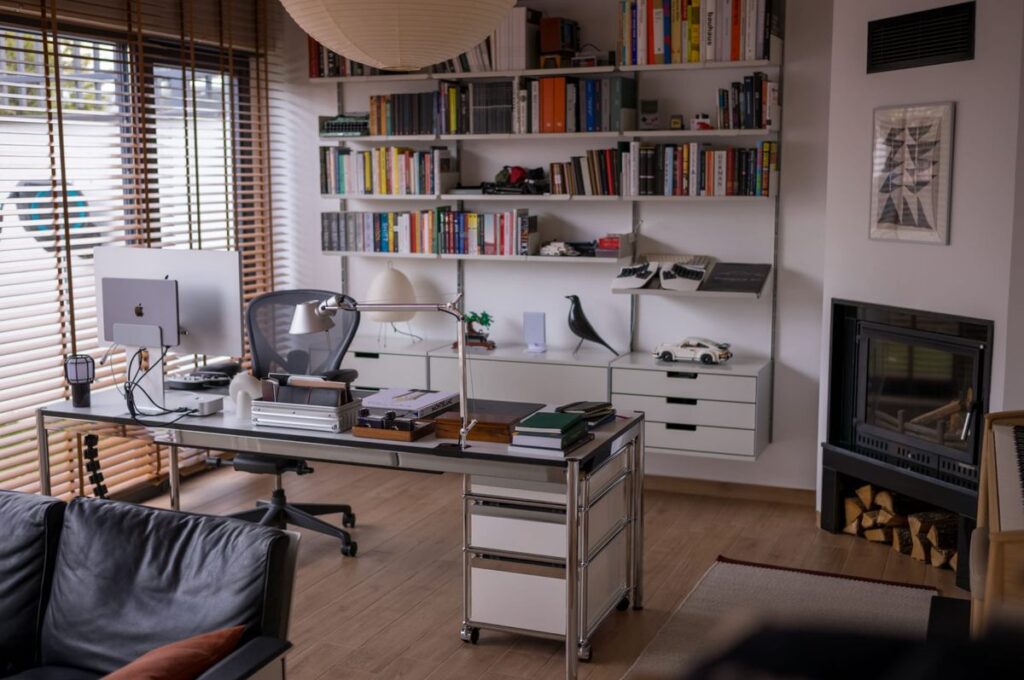
Table of Contents
The Psychology of the Wall
For decades, the standard home office layout has followed a predictable pattern: a desk pushed flush against a wall, a chair facing a flat surface, and a monitor serving as the primary focal point. It is a layout born of necessity and space-saving, but it often creates a psychological tunnel. When your field of vision ends at a white wall, the environment becomes static, contributing to a sense of confinement that can stifle long-term creativity.
A shift in this paradigm is gaining traction among designers and power users who are reimagining the ‘command center.’ By rotating the desk to face the room—a layout common in executive offices and gallery exhibitions—the user gains a sense of depth and environmental awareness. Placing the back to the wall and the eyes toward the door doesn’t just change the aesthetics; it fundamentally alters the energy of the room, making the workspace feel more open and less like a cubicle.
Breaking the Digital Monopoly
Beyond the physical orientation of the furniture, a more significant trend is emerging in how we allocate surface area. The traditional ‘tech-only’ desk, crowded with peripherals, cables, and screens, creates a mental state where every task is filtered through a digital lens. When your keyboard is the center of your universe, even a simple brainstorming session or a quick note becomes a digital event.
The solution being adopted by a growing number of creative professionals is the Split-Surface Layout. Rather than maintaining two separate pieces of furniture, the goal is to utilize a single, expansive surface—such as a 200cm USM Haller system—divided into two distinct zones: the Digital Side and the Analog Side.
The Digital Zone: Pure Utility
The digital side of the hybrid desk is reserved for high-output technical work. This area is intentionally minimalist, often featuring a high-resolution display like the Apple Studio Display, a Mac, and a specialized input device—such as a custom Elora Halcyon split keyboard—to maximize ergonomics. By stripping away everything that isn’t essential to the immediate task, the digital zone minimizes cognitive load. If a tool isn’t used daily, it is evicted from this zone, ensuring that the space remains a place of execution rather than a hoard of gadgets.
The Analog Zone: The Creative Sanctuary
Adjacent to the tech hub lies the analog side. This is a screen-free sanctuary dedicated to tactile engagement: journaling, sketching, project planning, or reading. Unlike the digital side, the analog zone is allowed to be ‘messy.’ It is a functional space where a notebook can stay open for days or a LEGO project can evolve over a week without the pressure of being cleared away.
This division creates a physical and mental boundary. Moving the office chair just a few feet to the left signals to the brain that the ‘execution phase’ is over and the ‘thinking phase’ has begun. It effectively decouples the act of planning from the act of typing, preventing the computer from dominating every waking hour of the workday.
The Balance of Minimalism and Function
There is a prevailing belief in the tech community that extreme minimalism is the peak of productivity. However, the rigid adherence to a ‘clean’ desk can actually kill the spontaneous passion required for innovation. The hybrid approach suggests that the ideal workspace is actually a blend of minimalism and maximalism: a sterile, efficient zone for digital output and a rich, tactile zone for creative exploration.
This evolution in workspace design reflects a broader trend in the post-pandemic era. As the lines between home and office blur, the priority is shifting from simply ‘having a place to work’ to creating an environment that supports various cognitive modes—from deep work and coding to collaborative play and analog reflection.