The Connectivity Play: Why Jensen Huang Just Put a Trillion-Dollar Target on Marvell
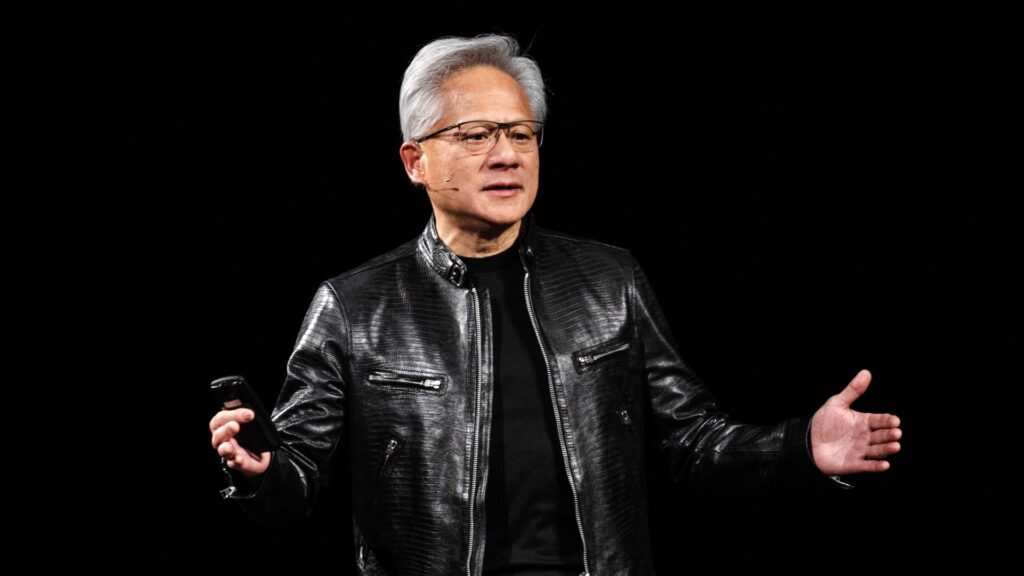
Table of Contents
The ‘Connectivity’ Catalyst
Wall Street has spent the last two years obsessing over the GPU, but Nvidia CEO Jensen Huang just shifted the spotlight toward the plumbing that makes those GPUs useful. During a high-profile appearance at Computex in Taipei, Huang explicitly named Marvell Technology as the next potential trillion-dollar company, sparking an immediate 20% surge in the semiconductor firm’s share price.
The endorsement wasn’t just a casual compliment; it was a technical validation of the ‘disaggregated’ data center. In a joint session with Marvell CEO Matthew Murphy, Huang explained that as AI models scale, the bottleneck is no longer just raw compute power, but the speed at which data moves between thousands of interconnected chips. When a computing problem is broken down and distributed across an entire data center, the network becomes the computer.
“That’s the reason why Matt’s doing so well. That’s the reason why Marvell is so essential,” Huang told the audience, emphasizing that the total aggregation of compute, memory, and bandwidth is only possible through the high-performance connectivity layers Marvell specializes in.
Moving Beyond the GPU Hype
For the broader market, this represents a pivotal shift in how investors view the AI trade. While Nvidia provides the ‘brains’ (the H100s and B200s), Marvell provides the ‘nervous system.’ The company’s portfolio of optical interconnects, Ethernet switches, and custom ASIC (Application-Specific Integrated Circuit) designs are what allow a cluster of GPUs to function as a single, massive supercomputer rather than a collection of isolated processors.
Marvell’s financial trajectory already suggests this momentum. In its most recent quarterly reporting, the company beat analyst estimates with $2.4 billion in revenue, driven largely by a surge in data center demand. However, the long-term bull case rests on the transition to more efficient data transmission. Nvidia has already signaled its commitment here, investing $2 billion into Marvell and pouring billions more into photonics—the science of using light rather than electricity to move data.
The Photonics Pivot
The industry is reaching a physical limit with copper-based electrical signaling, which suffers from heat and latency issues at AI scales. Photonics offers a path forward, promising significantly lower power consumption and higher bandwidth. By backing Marvell and other photonics ventures, Nvidia is effectively hedging against the looming ‘power wall’ that threatens the sustainability of massive AI clusters.
The Competitive Landscape
Marvell isn’t the only player in this space, but Huang’s endorsement gives it a distinct edge in the Nvidia ecosystem. The company’s ability to design custom silicon for cloud giants—who are increasingly looking to build their own AI chips to reduce reliance on Nvidia—creates a unique dual-stream revenue model. Marvell wins whether the world buys more Nvidia GPUs or whether hyperscalers like Google and Amazon build their own proprietary hardware.
As data centers evolve from simple server farms into distributed computing fabrics, the value of the interconnect is beginning to rival the value of the processor itself. If Huang’s prediction holds, Marvell’s ascent to a trillion-dollar valuation won’t be based on a single ‘killer app,’ but on the fact that no AI cluster can function without its networking backbone.


