The Concrete and Chaos of Recovery: What SpaceX’s AMOS-6 Disaster Tells Us About Blue Origin’s New Glenn Setback
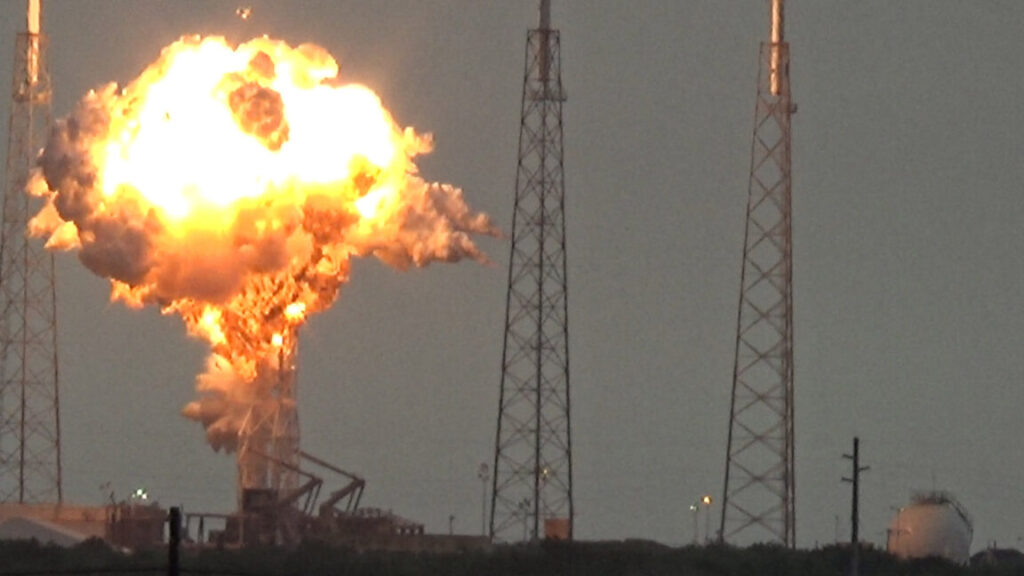
Table of Contents
A Familiar Kind of Catastrophe
For those who spent the autumn of 2016 in the wetlands of Cape Canaveral, the footage of Blue Origin’s New Glenn vehicle exploding during a static fire test felt like a haunting case of déjà vu. In September 2016, John Muratore, then a NASA engineer serving as launch director for SpaceX, watched a Falcon 9 rocket disintegrate during a pre-launch test. The resulting fireball didn’t just destroy the AMOS-6 satellite; it effectively erased the launch site.
Now, Blue Origin finds itself in a strikingly similar predicament. The company’s heavy-lift ambitions for the New Glenn program—critical to NASA’s lunar goals—have hit a physical wall. While the immediate cause of the explosion remains under wraps, the visible wreckage suggests a disaster that transcends a simple engine failure. With launch towers toppled and concrete shattered, the company is facing a recovery process that is as much about civil engineering as it is about rocket science.
The Forensic slog
Hans Koenigsmann, the former SpaceX VP of build and flight reliability who led the AMOS-6 investigation, notes that the hardest part of these failures isn’t the explosion, but the search for the ‘why.’ Following the Falcon 9 disaster, Koenigsmann’s team spent weeks scouring the Florida scrub for fragments of the booster, operating on the principle that the debris thrown the furthest likely originated from the most energetic part of the blast.
For Blue Origin, the priority will be a transparent autopsy of the hardware. While industry speculation points toward an anomaly in one of the seven BE-4 engines, Koenigsmann warns that every anomaly is unique. The challenge for Blue Origin is that they cannot simply move on to a new pad; they must first determine if the failure was a fluke of manufacturing or a fundamental design flaw that could recur on the next vehicle.
Beyond the Fireball: The Infrastructure Nightmare
While the media often focuses on the rocket, the real crisis for Blue Origin is the ground. Launch pads are not merely slabs of concrete; they are some of the most complex pieces of industrial infrastructure on Earth. The New Glenn failure saw at least one massive launch tower collapse and significant damage to the foundation.
Trip Harriss, who managed Falcon 9 fleet operations during the AMOS-6 era, emphasizes that the ‘brawn’ of the site—the steel and concrete—is only the first layer of the problem. The true nightmare is the ‘nervous system’ of the pad: the miles of bespoke electrical wiring and the intricate plumbing used to feed propellant and pressurized gases into the vehicle.
“I’m worried about the tubing,” Harriss noted, reflecting on how these systems are often hand-installed and highly specialized. When a fireball sweeps across a pad, it doesn’t just knock things over; it melts the very conduits that allow the rocket to function. Replacing these elements requires a level of precision and manual labor that cannot be rushed by simply adding more manpower.
The Timeline of Recovery
The precedent set by SpaceX suggests a grueling timeline. Despite the urgency, SpaceX was not permitted to begin reconstruction at Space Launch Complex-40 until January 2017—four months after the blast. This delay was mandated by the need for a grid-by-grid forensic examination of the debris field and extensive environmental remediation.
To maintain a flight cadence, SpaceX pivoted, utilizing an existing pad at Vandenberg Air Force Base in California to return to flight by January 2017. Blue Origin, however, does not have the luxury of a redundant, flight-ready heavy-lift pad. They are tethered to the site they just broke.
The path forward for New Glenn now involves a dual-track struggle: identifying the failure within the BE-4 propulsion system while simultaneously rebuilding a shattered industrial complex from the ground up. For Blue Origin, the road back to the launch window will be measured not in weeks, but in the slow curing of concrete and the painstaking replacement of thousands of feet of fried cabling.