The $25k Gamble: Slate Auto is Betting on ‘Anti-Luxury’ to Save the EV Market
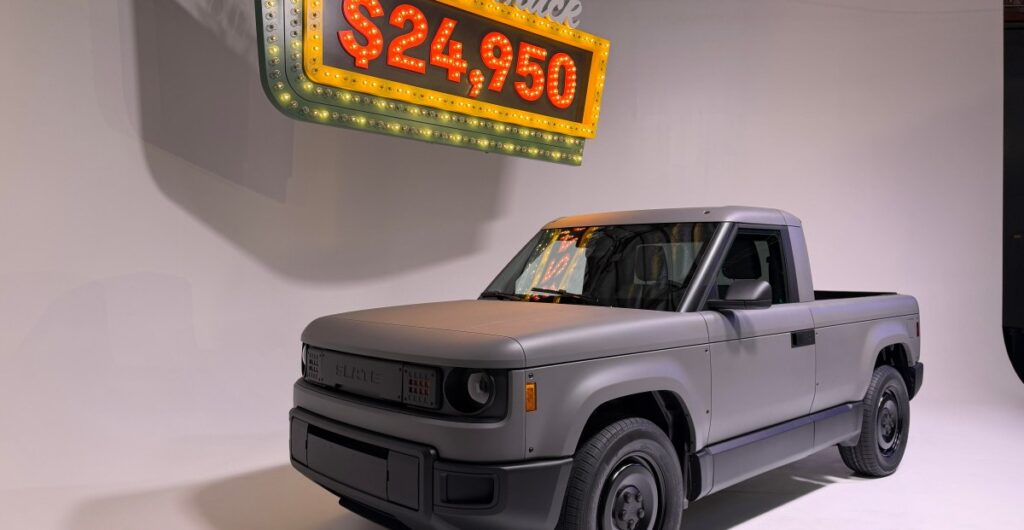
Table of Contents
A Direct Attack on ‘Trimflation’
For the last decade, the automotive industry has been locked in an arms race of additive luxury. Screens have grown from simple dashboards to monolithic tablets; basic utility has been replaced by ‘lifestyle’ packages. This trend, often dubbed ‘trimflation,’ has pushed the average price of a new vehicle to nearly $50,000, leaving a massive void where the entry-level compact truck once lived.
Slate Auto is attempting to fill that void with a premise that feels almost heretical in the current EV landscape: a truck that is intentionally basic. Launched with a starting price of $24,950, the Slate Truck isn’t just the cheapest electric pickup on the market—it’s a calculated experiment in how much technology a modern driver is willing to sacrifice for a monthly payment they can actually afford.
The Cost of Affordability
Driving the Slate in Southern California, the first thing you notice is what isn’t there. There is no infotainment system. No center touchscreen. No factory-installed speakers or stereo. In their place is a simple, sturdy dash mount for a smartphone, effectively outsourcing the entire UI/UX to the device already in your pocket.
The commitment to minimalism extends to the hardware. Windows are operated by manual hand cranks, and the driver-assistance suite—the cornerstone of Tesla and Rivian’s marketing—is entirely absent. You are the sole operator of this vehicle. Yet, despite the austerity, the truck doesn’t feel like a toy or a prototype. It handles with a surprising level of normalcy, proving that while screens are a luxury, a well-tuned powertrain and chassis are the actual requirements for a viable vehicle.
Reviving the Utilitarian Spirit
In the 1990s, the Toyota Pickup and the early Ford Ranger were the gold standard for tradespeople and first-time buyers. They were tools, not status symbols. Slate is attempting to revive this dead segment. By pricing the vehicle significantly below the Ford Maverick (which starts around $30,000) and even the Chevrolet Bolt EV, Slate is targeting a demographic that has been priced out of the new car market entirely.
To avoid the ‘budget’ stigma, Slate has adopted a modular ecosystem. The base vehicle is a blank canvas. The company offers over 200 accessories—everything from roof racks to interior lighting—with 80% of them costing under $500. This allows owners to build a custom rig without the upfront cost of a high-trim factory package. Most notably, for roughly $5,000, the two-seat pickup can be converted into a five-seat SUV, a versatility that allows the vehicle to evolve with the owner’s life.
The Infrastructure of Ownership
Slate isn’t just changing the product; they are changing the delivery. By utilizing a direct-to-consumer model with fixed pricing, they’ve stripped away the dealer negotiation process. To maintain the low cost of ownership, they’ve launched ‘Slate U,’ a series of video tutorials encouraging DIY installations of wraps and trim pieces. For those less inclined to wrench, a network of 3,000 RepairPal-affiliated shops provides professional installation.
Crucially, Slate hasn’t cut corners where it matters. The truck retains air conditioning, power locks, and a backup camera—essential safety and comfort features. Furthermore, the powertrain and battery are backed by a 10-year or 110,000-mile warranty, signaling that the company is confident in the longevity of its hardware despite the lack of software bells and whistles.
Whether the American public will embrace a truck with manual windows in 2026 remains to be seen. However, with Deloitte’s 2026 Global Automotive Consumer Study highlighting that price and quality remain the top drivers for buyers, Slate’s bet on utility over luxury may be the most rational move in the EV sector in years.