Spotify Introduces Podcast Clipping to Combat the ‘Long-Form’ Fatigue
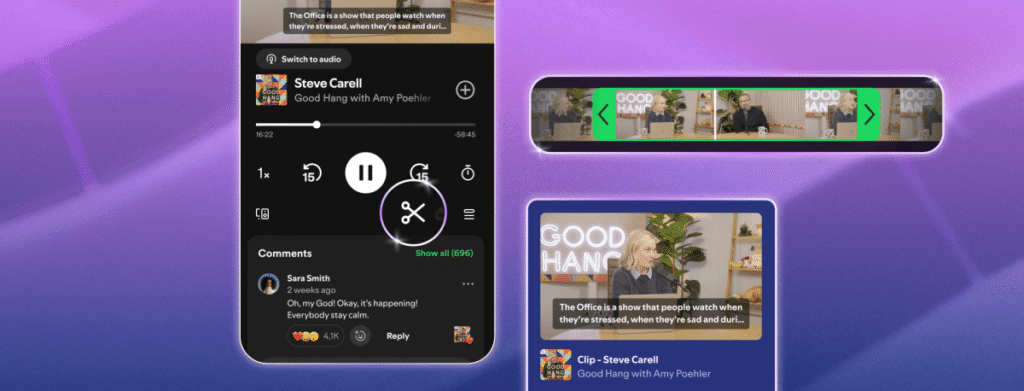
Table of Contents
The friction of the long-form share
For years, the primary way to share a specific insight from a three-hour podcast has been the “timestamp shoutout.” Users would post a link to a full episode on X or Threads, accompanied by a manual note like “Check out the part at 1:22:14 where they discuss the new LLM architecture.” It is a clunky, high-friction process that requires the recipient to open an app, scrub through a timeline, and hope the context is clear.
Spotify is attempting to eliminate this friction with the global rollout of its new “clips” feature. Available to both free and Premium mobile users, the tool introduces a scissors icon directly into the “Now Playing” view. This allows listeners to isolate a specific segment of audio, trim the start and end points, and preview the snippet before exporting it to social media or messaging apps.
Slicing through the CEO podcast circuit
The timing of this feature is not accidental. There has been a noticeable shift in how the tech industry handles public relations. From Sam Altman to Jensen Huang, executives are increasingly bypassing traditional journalist-led press conferences in favor of long-form podcast appearances. These environments allow leaders to control the narrative and provide expansive explanations, but they also create a massive amount of “dark data”—hours of audio where critical news is buried in the middle of a rambling conversation.
By allowing users to create a discrete, shareable clip, Spotify is essentially crowdsourcing the highlighting of news. Instead of waiting for a journalist to transcribe a key quote, the community can now instantly distill a 120-minute interview into a 30-second “aha!” moment. This transforms the podcast from a linear listening experience into a searchable, modular asset.
From Chapters to curated libraries
This move builds on the momentum of Spotify’s “Chapters” feature launched earlier this year. According to internal data, users are saving and adding these longer pre-defined segments to playlists over 2 million times per month. However, Chapters are curated by the creator; clipping puts that power back into the hands of the listener.
Crucially, these clips aren’t just for ephemeral social sharing. Saved clips are stored within the user’s Spotify Library, meaning listeners can build their own curated archives of insights. This effectively turns a podcast into a personal knowledge base, where a user can save a specific technical explanation from one show and a market prediction from another, all in one place.
How the clipping workflow operates
The process is designed to be unobtrusive. When a user taps the scissors icon, they enter a trimming interface. Once the audio is sliced and previewed, the sharing menu expands to offer several options: a direct link to the full episode, a specific chapter, a timestamp, or the newly created audio clip itself. This multi-tiered approach ensures that while the clip provides the immediate hook, the path back to the full-length source remains seamless.
The marketing flywheel for creators
For podcast producers, the feature functions as a built-in marketing engine. The industry has long relied on “audiograms”—static images with moving waveforms—to promote episodes on Instagram and TikTok. These usually require third-party software and manual editing.
By integrating this directly into the consumption platform, Spotify is lowering the barrier for organic promotion. When a listener shares a high-impact clip, they aren’t just sharing a thought; they are providing a direct, frictionless gateway for new listeners to discover the rest of the episode. This creates a viral loop that benefits the creator’s growth metrics while satisfying the user’s desire for rapid information exchange.
The feature is currently rolling out globally on mobile devices, with Spotify indicating that availability will expand to more shows as the infrastructure scales.