Shuttle Era Veterans Tom Akers and Joe Tanner Inducted into US Astronaut Hall of Fame
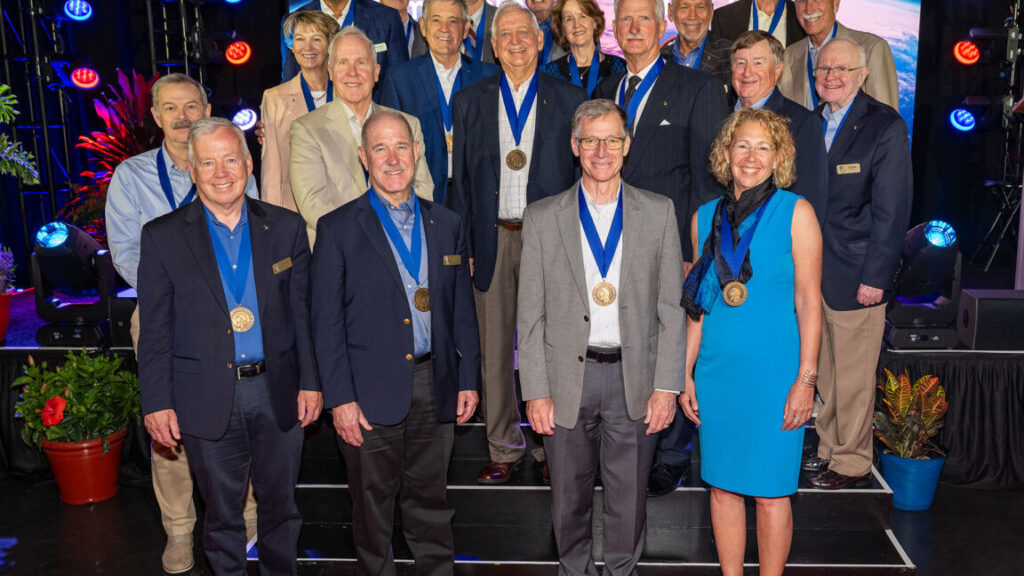
Table of Contents
A Shared Legacy in the Orbit of Atlantis
For Tom Akers and Joe Tanner, the road to the US Astronaut Hall of Fame was a long game of timing and tenacity. On May 16, the two space shuttle-era veterans were officially inducted together, marking a full-circle moment for two men whose careers were intertwined long before they ever reached the stratosphere.
The ceremony took place under the shadow of the retired space shuttle Atlantis at the Kennedy Space Center Visitor Complex—a fitting backdrop, given that both men flew aboard the legendary orbiter during their careers. While their induction marks a joint achievement, their entry into NASA’s elite ranks followed very different paths. In 1984, Tanner arrived at the Johnson Space Center (JSC) as an instructor pilot and applied for the next astronaut candidate class. He didn’t make the cut in 1987, but Akers did.
“Tom came in with the class of 1987, which, interestingly enough, I interviewed for. He made it, and I didn’t,” Tanner recalled. Akers, leaning into the long-standing camaraderie between the two, joked during a joint interview with collectSPACE.com that he had been “leading the way ever since,” questioning why NASA had taken so long to finally pick Tanner, who eventually became an astronaut in 1992.
The Mechanics of the Void: From Hubble to the ISS
Beyond the friendly rivalry, the induction recognizes two of the most skilled “spacewalkers” of the shuttle era. Extravehicular activity (EVA) is often the most dangerous and technically demanding part of a mission, and both Akers and Tanner specialized in the high-stakes environment of orbital repair.
Akers is perhaps best remembered for a historic anomaly on May 16, 1992—the same date as the induction ceremony. During the STS-49 mission aboard Endeavour, Akers became part of the only three-person spacewalk in history. The crew was tasked with capturing a malfunctioning Intelsat VI communications satellite, but the standard capture bar failed. In a rare tactical shift, ground controllers and the crew coordinated a three-person EVA to secure the satellite by hand.
“All of our spacewalks are designed really for two people; the system really isn’t made where it’s easy for three people,” Akers explained. “That was a unique situation… With the teamwork and great ground team support, it worked slick.”
While Akers navigated the chaos of the Intelsat capture, Tanner became a critical asset in the assembly and maintenance of NASA’s most complex structures. Both men worked on the Hubble Space Telescope (HST), a task that required extreme manual dexterity to handle delicate optical instruments. However, Tanner also played a pivotal role in building the backbone truss and solar array wings of the International Space Station (ISS).
Tanner noted a distinct difference between the two types of missions: Hubble work was a game of precision and “manual dexterity,” whereas ISS construction was a feat of physical endurance, requiring the movement of massive, heavy objects across long distances in microgravity.
A Final Salute to the Shuttle Era
The induction ceremony, led by news correspondent John Zarella, served as a reunion for the shuttle community. Curt Brown, board chairman of the Astronaut Scholarship Foundation and a fellow astronaut, emphasized that the careers of Akers and Tanner embody the “excellence, leadership, and service” that defined the US space program’s golden age.
The event featured a guard of honor including fellow inductees Brian Duffy and Chris Ferguson—the latter having served as the pilot on Tanner’s final mission, STS-115. The ceremony concluded with the unveiling of etched-glass portraits and mission patch displays, which now join 111 other plaques in the Heroes & Legends attraction.
In total, Akers logged nearly 30 hours of EVA across 34 days in space. Tanner’s tally was even higher, with 46.5 hours of spacewalks over 43 days. As the industry shifts toward commercial spaceflight and the Artemis lunar missions, the induction of Akers and Tanner serves as a reminder of the grueling, manual labor required to build the infrastructure of modern astronomy.