Sennheiser Momentum 5 Wireless: A Quiet Powerhouse in a Familiar Frame
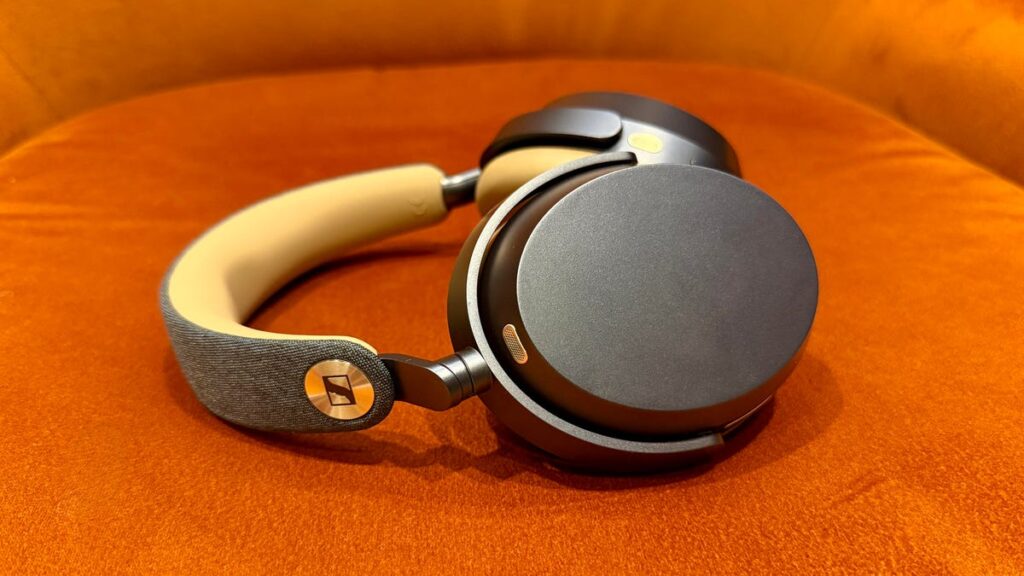
Table of Contents
The ANC Gap Finally Closes
For years, Sennheiser has occupied a specific niche in the premium wireless market: the choice for those who prioritize sonic fidelity over the ‘silence at all costs’ approach of Bose and Sony. While the Momentum 4 Wireless was praised for its sound, it often felt a step behind in the arms race of Active Noise Cancellation (ANC). The arrival of the Momentum 5 Wireless suggests that Sennheiser has finally decided to close that gap.
At first glance, the Momentum 5 looks like a mirror image of its predecessor. Sennheiser has opted for the same chassis, meaning the distinct, vintage aesthetic of the original Momentum line remains a distant memory in favor of a modern, plastic-heavy design. Weighing in at 290 grams, they are slightly heavier than the Sony WH-1000XM6, but the comfort remains high thanks to well-implemented cushioning and replaceable earpads.
The real story, however, is happening inside the earcups. Sennheiser has doubled the microphone count, moving from four mics in the Momentum 4 to eight in the Momentum 5. This hardware bump translates to a tangible improvement in ANC performance. While it may not quite reach the ‘vacuum-like’ isolation of the Bose QuietComfort Ultra or the AirPods Max 2, it has evolved from a mediocre experience to a genuinely competitive one. Mid and high frequencies still occasionally bleed through, but the low-end drone of airplane cabins or office HVAC systems is handled with far more authority than before.
Refining the Ecosystem
Beyond the noise cancellation, Sennheiser has introduced a few quality-of-life improvements that signal a more mature product cycle. The most notable is the addition of spatial audio with head tracking, a feature that has become mandatory for any flagship attempting to compete in the current market. Battery life remains a standout, claiming up to 57 hours on a single charge—a figure that puts the competition to shame.
Perhaps the most appreciated change for long-term owners is the user-replaceable battery. In an era of planned obsolescence, providing a path to extend the life of the hardware is a move that aligns well with the brand’s premium positioning. Additionally, the redesigned carrying case is slimmer and more ergonomic, featuring a carved-out section that doubles as a handle, making it far less cumbersome than the bulky cases found on the higher-end HDB 630 model.
The Audiophile Trade-off
Sennheiser continues to offer a tiered approach to its high-end audio. The Momentum 5 is designed for the general consumer, but those seeking a more rigorous technical experience can opt for the HDB 630. The latter utilizes upgraded drivers and a BTD 700 wireless USB-C dongle, which supports “lossless” Bluetooth streaming up to 24-bit/96kHz via aptX Adaptive. This is a critical distinction for users on Windows or Mac who find standard Bluetooth codecs too restrictive.
For the average user, the Momentum 5’s touch controls remain intuitive, with swipes for volume and track skipping that feel responsive. Interestingly, Sennheiser has tweaked the power logic; unlike the Momentum 4, which powered on automatically upon leaving the case, the Momentum 5 now requires a manual press of the power button. This prevents the headphones from accidentally pairing with a device while still tucked away in a bag.
Priced at $400, the Momentum 5 represents a $50 increase over the launch price of the previous generation. While the hardware remains familiar, the internal upgrades to ANC and the addition of a replaceable battery justify the premium. It is a refined, calculated update that cements Sennheiser’s place as the primary alternative for those who want a ‘musical’ headphone that can actually handle the noise of a commute.


