Samsung Floods Indian Market with 72 New TV Models, Betting Big on Micro LED and Neo QLED
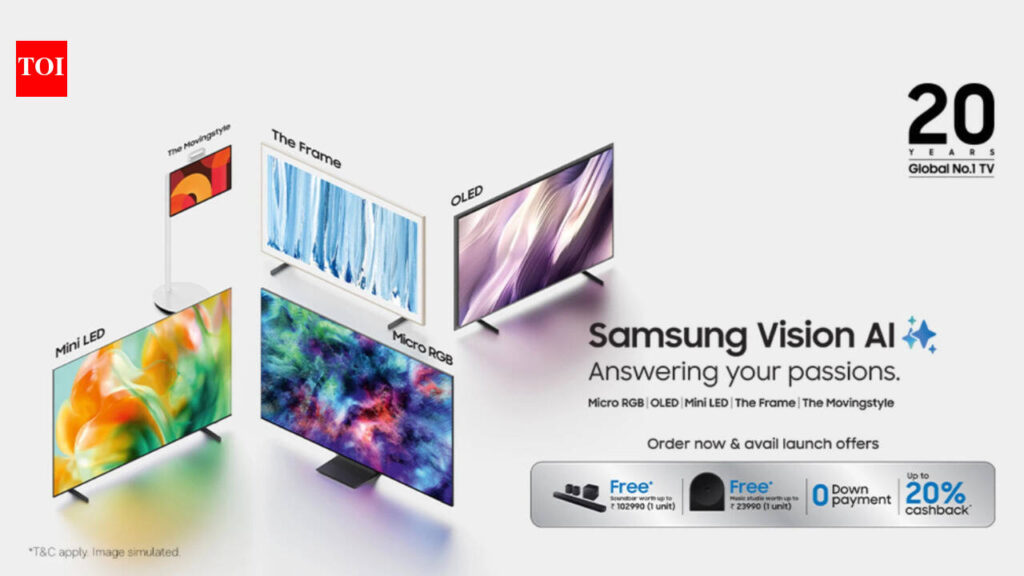
Table of Contents
A Massive Push for Premium Panels
Samsung has unveiled its 2026 television portfolio for the Indian market, an aggressive expansion that sees the company launching 72 distinct models across its display categories. The sheer volume of the rollout signals Samsung’s intent to saturate every price bracket in India, from entry-level 4K screens to the ultra-premium Micro LED territory that remains a niche for the global elite.
While the quantity is striking, the real story lies in the diversification of panel technology. For the first time in India, Samsung is pushing Micro LED more aggressively, attempting to bridge the gap between its high-end QD-OLED and the high-brightness Neo QLED series. Micro LED, which uses microscopic LEDs that emit their own light without the need for a backlight or organic material, is being positioned as the ‘holy grail’ of displays—offering the perfect blacks of OLED without the long-term risk of burn-in.
The Battle of Brightness: Neo QLED vs. OLED
The bulk of the 72-model lineup consists of Neo QLED and Mini LED variants. Samsung continues to refine its Quantum Mini LED technology, utilizing smaller, denser LEDs to provide tighter backlight control and higher peak brightness. This is particularly relevant for the Indian consumer base, where living rooms often feature significant ambient light, making the high-nit output of Neo QLED more practical than the more muted tones of traditional OLEDs.
Parallel to this, the 2026 OLED range is seeing a shift toward larger screen sizes. Samsung is leaning heavily into its QD-OLED (Quantum Dot OLED) hybrid tech, which aims to deliver a wider color volume than standard WOLED panels. Industry analysts suggest that Samsung is leveraging this hybrid approach to maintain a competitive edge over LG’s dominant OLED footprint in the region.
Software Integration and the AI Upscaling Play
Beyond the hardware, the 2026 lineup is built around an updated Tizen OS, which now integrates deeper AI-driven picture processing. Samsung is claiming a significant leap in its ‘AI Upscaling’ capabilities, utilizing neural networks to bring legacy 1080p and 720p content up to a perceived 4K quality. In a market like India, where a vast amount of content is still consumed via set-top boxes and cable TV, this feature is a critical selling point.
The ecosystem play is also evident. These TVs are designed to act as the central hub for Samsung’s SmartThings integration, allowing users to manage home automation directly from the remote or through voice commands. This move transforms the TV from a passive viewing screen into a home management terminal, a trend that has seen rapid adoption across Asian markets.
Market Positioning and Logistics
Deploying 72 models is a logistical gamble. By offering such a wide array of screen sizes and spec configurations, Samsung is attempting to prevent ‘feature gaps’ that competitors like Xiaomi or TCL often exploit with aggressive mid-range pricing. However, the challenge remains in the pricing strategy. While the Mini LED and OLED models target the upper-middle class, the entry-level 4K models will have to fight a brutal price war with Chinese OEMs.
Samsung has not yet released the full price list for every SKU, but early indications suggest a tiered approach that prioritizes the ‘premiumization’ of the Indian living room. The Micro LED units, in particular, are expected to carry price tags that keep them out of reach for most, serving more as brand halo products than volume drivers.


