Russian Drone Strike in Galati Highlights Critical Gaps in NATO’s Eastern Border Air Defenses
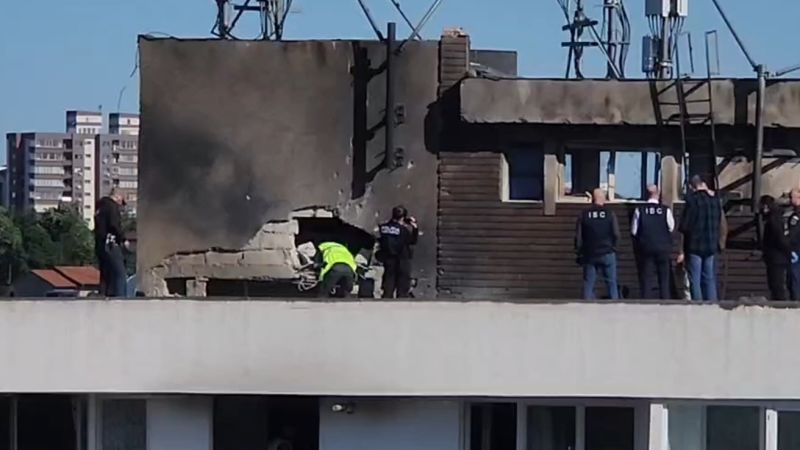
Table of Contents
A Failure of Detection in Galati
In the early hours of Friday, a Russian-origin drone breached Romanian airspace and struck an apartment building in the city of Galati, wounding two people and leaving a charred roof as a visceral reminder of the war in Ukraine’s proximity. While the physical damage was limited to a single residential block, the operational failure is more significant. According to Colonel Cristian Popovici of the Romanian defense ministry, the drone was detected at 1:54 a.m. but vanished from radar as it approached the eastern sector of the city.
This “radar blackout” is a recurring technical challenge for NATO’s eastern flank. Low-altitude, slow-moving UAVs—often referred to as “dark targets”—are notoriously difficult for traditional long-range air defense systems to track. By the time the Romanian military deployed two F-16s, the aircraft were effectively hunting a needle in a haystack. The military’s admission that there was “no opportunity” to intercept the drone suggests a critical latency gap between detection and engagement in the border regions.
The Geography of Provocation
The strike did not occur in a vacuum. Galati is strategically positioned on the Danube, directly across from Izmail, Ukraine. Izmail serves as the largest Ukrainian port on the river and has become a primary target for Russian forces attempting to throttle Ukraine’s grain exports and logistics. Reports confirm that the attack on Galati happened almost simultaneously with a Russian drone swarm targeting the Izmail port area.
This pattern suggests a dangerous trend: Russian drones are either intentionally crossing borders as a form of “gray zone” provocation or, more likely, the sheer volume of munitions being fired at Ukrainian border targets is causing lethal drift into NATO territory. This marks the 28th time Russian drones have breached Romanian airspace since the conflict began, transforming the border from a line of demarcation into a volatile zone of operational spillover.
The Tech Gap: Why F-16s Aren’t Enough
The deployment of F-16s in response to a single drone highlights a mismatch in capability. High-performance fighter jets are designed for air superiority, not for intercepting small, cheap, one-way attack drones. Romanian Foreign Affairs Minister Oana-Silvia Toiu has explicitly requested that the EU and NATO accelerate the transfer of specific anti-drone capabilities—likely referring to short-range air defense (SHORAD) systems and electronic warfare (EW) jamming arrays.
To effectively secure the border, Romania requires a denser layer of low-altitude sensors and autonomous interceptors (such as “drone-hunter” drones) that can operate independently of traditional radar, which can be spoofed or bypassed by flying at extreme low altitudes.
Diplomatic Escalation and the ‘Persona Non Grata’
The political response has been swift and severe. Romanian President Nicușor Dan has declared a Russian consul in Constanța persona non grata and ordered the closure of the consulate, a rare and aggressive diplomatic move. Simultaneously, European Commission President Ursula von der Leyen stated that Russia has “crossed yet another line,” signaling a shift toward more stringent sanctions.
Despite the condemnation from US Ambassador to NATO Matthew Whitaker, who vowed to defend “every inch of NATO territory,” the incident exposes a fragile reality: Article 5—the collective defense clause—is difficult to trigger over a stray drone. Russia continues to test these boundaries, utilizing UAVs to probe NATO’s reaction times and technical vulnerabilities without escalating to a full-scale kinetic war.
As Bucharest pushes for an upgraded electronic shield, the Galati strike serves as a warning that the technological frontier of the Ukraine war is no longer confined to Ukrainian soil.


