Roscosmos Turns to Corporate Sponsors as Sanctions Hollow Out Russian Space Program
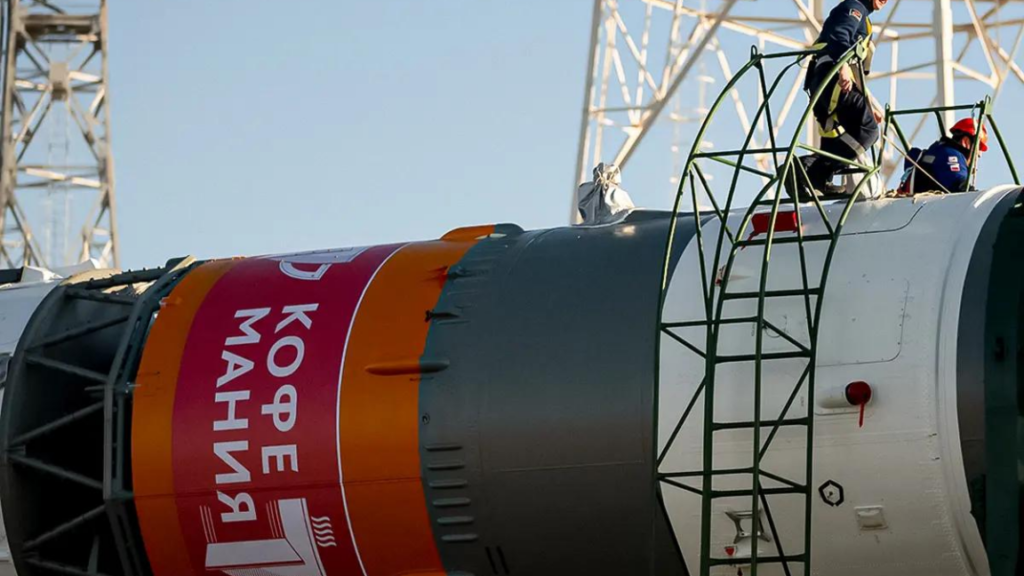
Table of Contents
A New Revenue Stream in Low Earth Orbit
For decades, the image of a Russian rocket was one of state prestige and Cold War engineering. Now, those boosters are increasingly serving as orbiting billboards. In a move that signals the growing financial desperation of its aerospace sector, Russia has officially integrated corporate advertising into its national space policy.
Since the start of 2026, Roscosmos, the state-owned space corporation, has begun plastering its launch vehicles with logos for domestic brands. Recent reports from the Russian business newspaper Vedomosti indicate that six major advertisements have already been deployed. The client list reads less like a futuristic aerospace consortium and more like a local business directory, featuring the PSB Bank, the Kofemaniya restaurant chain, the Russian Media Group, and the Russian Olympic Committee.
While the idea of space advertising isn’t entirely new—Pepsi famously paid $5 million in the 1990s for a stunt aboard the Mir space station, and Pizza Hut once appeared on a Proton vehicle—those were opportunistic, one-off deals. This current shift is structural. Last fall, Vladimir Putin approved federal law amendments that explicitly grant Roscosmos the right to sell advertising space on both state and federally owned space objects. The stated goal is to attract private investment and “reduce the burden on the state budget.”
The Cost of Isolation
The pivot to corporate sponsorship is a direct symptom of a crippled economy and an isolated space agency. Following the 2022 invasion of Ukraine, the European Space Agency and various commercial satellite operators abandoned the Soyuz and Proton launch systems in favor of Western alternatives. Estimates suggest that sanctions have cost Roscosmos roughly $2.5 billion in lost revenue.
The broader economic context is equally grim. Swedish Foreign Minister Maria Malmer Stenergard recently noted that Russia’s economy has likely contracted over the last five years, with sanctions costing the nation an estimated $450 billion. To put the scale of the decline in perspective, Stenergard observed that Russia’s current economic output is now smaller than that of the state of Texas.
With defense spending hitting a post-Soviet record of approximately 7 percent of government expenditure, the space program is fighting for scraps. While the new advertising revenue is unlikely to fill the multi-billion dollar hole left by international partners—analysts suggest these deals may only bring in a few million dollars annually—it represents a pragmatic, if humbling, attempt to keep the lights on.
A Program in Retreat
The financial strain is manifesting in the operational reality of Russia’s orbital missions. In a move to conserve limited hardware, Roscosmos recently extended the duration of human spaceflight missions to the International Space Station (ISS) from six months to eight. By keeping crews in orbit longer, the agency can reduce the total number of Soyuz spacecraft required for rotation.
The decline in launch frequency is perhaps the most telling metric of all. In both 2024 and 2025, Russia’s total annual launches dropped to just 17. Excluding the anomaly of the 2020 pandemic year, this is the lowest volume of launches the country has seen since 1961—the year Yuri Gagarin became the first human in space. During the peak of the Soviet era in the 1980s, the program routinely pushed 100 orbital rockets per year.
As the gap between the current capabilities of Roscosmos and the rapid ascent of private entities like SpaceX grows, the Russian space program finds itself in an unfamiliar position: no longer the global vanguard of exploration, but a state utility searching for a corporate sponsor.