POCO Pad C1 Hits Global Markets: A Pragmatic Budget Tablet for the HyperOS Ecosystem
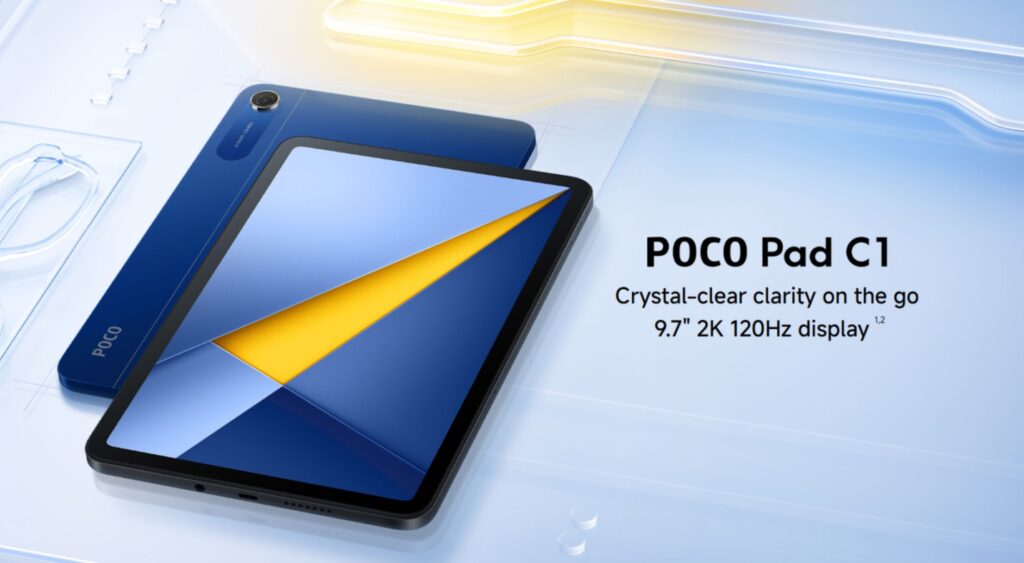
Table of Contents
Filling the Gap in the Budget Slate Market
Xiaomi has officially expanded its POCO portfolio with the global debut of the POCO Pad C1. While the tech world remains obsessed with the high-end foldable and OLED wars, the C1 represents a strategic pivot toward the ‘utilitarian’ segment—users who need a reliable medium for streaming, reading, and light productivity without the $500+ price tag of a flagship iPad or Galaxy Tab.
The POCO Pad C1 isn’t trying to compete with the M-series benchmarks. Instead, it positions itself as a dedicated companion device. With a slim 7.4mm metal chassis and a weight of 406 grams, the hardware is surprisingly lean for a device of its size, suggesting a focus on portability and handheld comfort during long browsing sessions.
Display Priorities Over Raw Power
The standout feature is undoubtedly the screen. POCO has opted for a 9.7-inch IPS panel with a 2K resolution, which is a refreshing move in a budget category often plagued by muddy 1080p displays. The inclusion of a 120Hz refresh rate ensures that UI navigation within HyperOS 3.0 remains fluid, avoiding the stutter typical of entry-level tablets.
Brightness levels are competent, peaking at 500 nits for indoor use and reaching 600 nits for outdoor visibility. While these aren’t the blinding peaks found in HDR10+ displays, they are more than sufficient for a tablet primarily intended for home or office environments. Furthermore, the TUV Rheinland certification for low blue light and flicker reduction indicates a clear intent to market this as a reading and study tool for students.
The Silicon Trade-off: Snapdragon 6s 4G Gen 2
Under the hood, the POCO Pad C1 utilizes the Qualcomm Snapdragon 6s 4G Gen 2. By sticking to a 4G chipset, POCO has managed to keep the cost down while maintaining stable connectivity. When paired with 6GB of RAM and 128GB of internal storage, the device is well-equipped for everyday multitasking—think PDF annotation, Chrome tabs, and Netflix streaming—but it will struggle with heavy gaming or intensive video editing.
To address the storage bottleneck, Xiaomi included a microSD slot supporting expansion up to 2TB. This is a critical addition for users who intend to use the tablet as a local media library for movies and offline documents.
Software and the AI Integration
Running on HyperOS 3.0, the C1 benefits from Xiaomi’s latest push toward ecosystem synergy. Interestingly, POCO is integrating several AI-driven features into this budget slab, including ‘Circle to Search’ and Google Gemini integration. This suggests that Xiaomi is prioritizing software-level intelligence to make up for the modest hardware specs, allowing users to interact with information more intuitively than through traditional folder-and-app navigation.
Battery Life and Connectivity
Powering the device is a 7,600 mAh battery. While 18W charging is slow by modern smartphone standards—likely resulting in a multi-hour wait for a full charge—the efficiency of the Snapdragon 6s chip allows for impressive longevity. Xiaomi claims up to 15 hours of continuous video playback, which aligns with the device’s identity as a consumption-first machine.
The inclusion of a 3.5mm headphone jack is a welcome, if predictable, touch for the budget segment, providing an alternative for users who aren’t yet fully committed to TWS earbuds. Audio is handled by dual speakers, designed to provide a wider soundstage for media consumption.
While regional pricing is still being finalized across different markets, industry expectations place the POCO Pad C1 well below the $300 mark, making it a competitive alternative for those who find the entry-level Android tablet market too fragmented or underpowered.


