POCO Pad C1 Debuts as a Low-Cost 4G Tablet Aiming for the Student Market
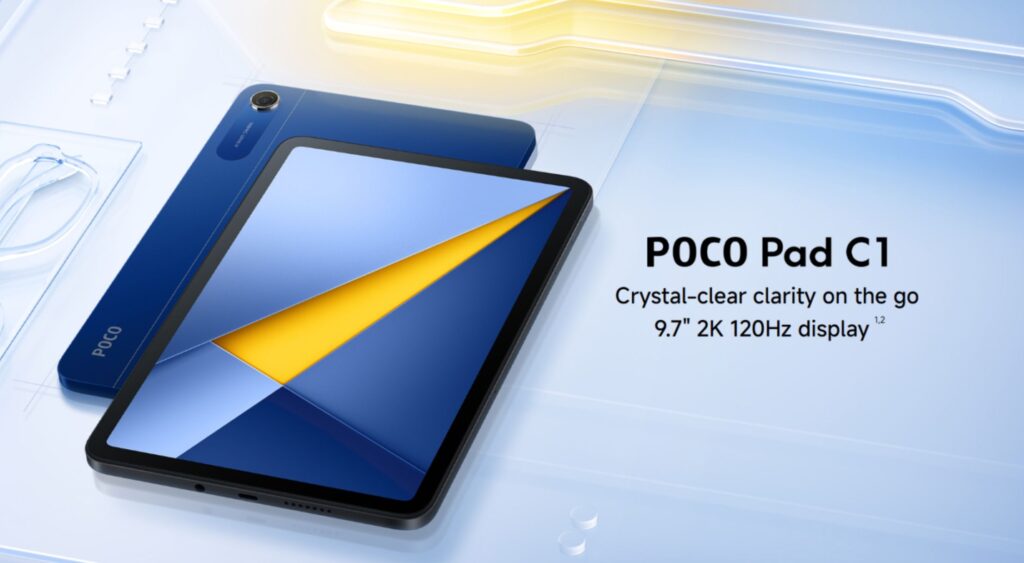
Table of Contents
Xiaomi’s Budget Play in the Tablet Space
Xiaomi is continuing its aggressive push into the affordable tablet segment with the official global launch of the POCO Pad C1. Positioned as an entry-level device, the C1 isn’t trying to compete with the high-end productivity of an iPad Pro or the raw power of the Samsung Galaxy Tab S series. Instead, it targets a very specific demographic: students and casual users who need a larger screen for media consumption and light multitasking without breaking the $300 barrier.
The device makes its debut on Xiaomi’s official portals, appearing in Blue and Grey finishes. At first glance, the hardware feels surprisingly premium for its price point, featuring a slim metal chassis that keeps the thickness down to 7.4 mm. Weighing in at 406 grams, it avoids the bulkiness that often plagues budget tablets, making it a viable companion for commuting or carrying in a backpack.
The Display: A Rare Win for Budget Slates
The most compelling aspect of the POCO Pad C1 is undoubtedly the screen. While many budget tablets stick to 60Hz or basic 1080p panels, POCO has equipped the C1 with a 9.7-inch IPS display boasting a 2K resolution. More importantly, the 120Hz refresh rate ensures that UI animations and scrolling through web pages feel fluid—a feature typically reserved for mid-to-high-range devices.
Brightness is another area where the C1 punches above its weight. With a peak brightness of 500 nits (scaling up to 600 nits for outdoor visibility), it should remain legible in bright environments, though it won’t match the HDR peaks of OLED panels. To appeal to those spending long hours on digital textbooks or streaming, Xiaomi has included TUV Rheinland certification for low blue light and flicker reduction, targeting eye fatigue.
Performance and the 4G Trade-off
Under the hood, the POCO Pad C1 is powered by the Qualcomm Snapdragon 6s 4G Gen 2 chipset. It is important to note that this is a 4G-only device. In an era where 5G is the standard for new mid-range hardware, the choice of a 4G chip helps keep the cost down while still providing standalone connectivity for users who don’t want to rely on Wi-Fi hotspots.
The device comes standard with 6 GB of RAM and 128 GB of internal storage. While this is sufficient for basic app usage, power users may find the storage limiting. Fortunately, POCO has retained the microSD card slot, supporting expansions up to 2 TB, which is essential for those intending to store large libraries of offline videos or PDF archives.
Software and AI Integration
The C1 ships with HyperOS 3.0, Xiaomi’s increasingly unified operating system designed to bridge the gap between smartphones and tablets. Interestingly, POCO is leaning into the AI trend even at this price point. The tablet includes support for Google’s Gemini and the “Circle to Search” functionality, bringing a layer of modern AI productivity to a device that is otherwise focused on basic utility.
Battery Life and Connectivity
Battery longevity is a critical metric for a device intended for media consumption. The POCO Pad C1 houses a 7,600 mAh cell. While the 18W charging speed is modest by modern standards—meaning a full charge will take a few hours—the efficiency of the Snapdragon 6s chip allows for roughly 15 hours of continuous video playback. For the average user, this translates to nearly two days of light use before needing a wall outlet.
In a move that will please audiophiles and budget-conscious buyers alike, POCO has kept the 3.5 mm headphone jack. Combined with the dual-speaker setup, the C1 is clearly optimized as a portable cinema for those who prefer wired audio over the latency of budget Bluetooth buds.
While exact regional pricing is still being finalized for various markets, industry indicators suggest the POCO Pad C1 will launch well under the $300 mark, making it a formidable competitor in the budget Android ecosystem.


