Nvidia’s SCADA Architecture: Solving the AI Data Bottleneck with 2.9PB PCIe 6.0 Storage
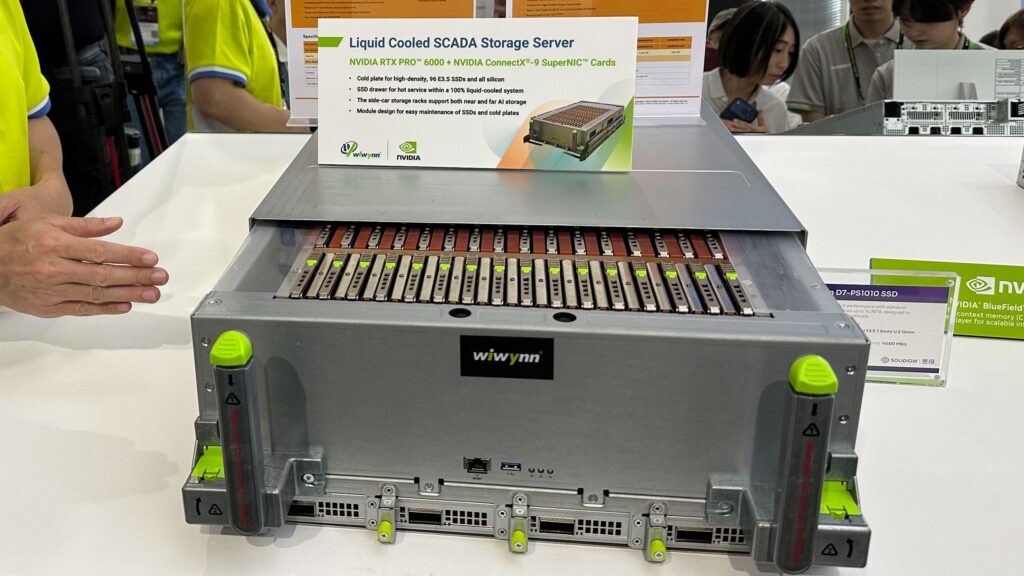
Table of Contents
The Invisible Wall in AI Scaling: The I/O Bottleneck
For years, the conversation around Artificial Intelligence has centered almost exclusively on compute—the raw TFLOPS of a GPU or the parameter count of a Large Language Model (LLM). However, as we move into 2026, the industry is hitting a physical wall: the I/O bottleneck. While GPUs can process data at blistering speeds, the path from the storage drive to the GPU memory has remained a congested highway, often gated by the CPU.
At Computex 2026, Wiwynn provided a glimpse into the solution with the debut of one of the first Nvidia SCADA (SCaled Accelerated Data Access) servers. This isn’t just a faster storage box; it is a fundamental architectural shift. By allowing GPUs to initiate and control storage I/O operations directly, SCADA removes the CPU from the critical path, effectively treating massive arrays of flash storage as an extension of the GPU’s own memory pool.
- Architectural Shift: SCADA enables GPUs to control storage I/O directly, bypassing the CPU bottleneck that typically slows down AI training and inference.
- Extreme Density: The Wiwynn implementation supports up to 96 liquid-cooled E3.S SSDs, reaching capacities of 2.949 PB.
- PCIe 6.0 Integration: Utilizing PCIe 6.x switches and ConnectX-9 SuperNICs, the system achieves massive random read speeds of 528 million 4K IOPS.
- Target Workloads: Specifically designed for RAG (Retrieval-Augmented Generation), vector searches, and KV-cache retrieval where random access latency is critical.
Understanding SCADA: A New Paradigm for Data Access
To understand why Nvidia SCADA matters, one must first understand the failure of the traditional CPU-centric model. In a standard server, if a GPU needs data from an NVMe drive, the CPU must manage the request, handle the interrupts, and oversee the transfer. Even with GPUDirect Storage (GDS), which creates a direct DMA (Direct Memory Access) path, the CPU still owns the “control plane.” In the context of thousands of concurrent GPU threads requesting tiny blocks of data, the CPU becomes a traffic cop who can’t keep up with the volume of cars.
SCADA flips this logic. It transforms the GPU from a passive recipient of data into an active manager of the storage layer. In this ecosystem, the GPUs—specifically the RTX Pro 6000 Blackwell cards in the Wiwynn build—act as sophisticated storage processors. They initiate the transactions and manage the data path, allowing the system to handle the “fine-grained random access” required by modern AI workloads.
The Technical Core: Hardware Specifications
The Wiwynn SCADA server is a beast of engineering, designed to fit within an Nvidia MGX rack-compliant 6RU chassis. The hardware stack is a curated selection of the fastest available components in the 2026 ecosystem:
- Processing Power: Powered by the Nvidia Vera CPU, providing the necessary system orchestration.
- Acceleration: Four RTX Pro 6000 Blackwell GPUs, which handle the storage logic and I/O orchestration.
- Connectivity: Four ConnectX-9 SuperNIC cards and four PCIe 6.x switches (sourced from partners like Broadcom), ensuring that the bandwidth between the storage and the compute nodes is virtually seamless.
- Storage Medium: Up to 96 E3.S SSDs. When populated with Micron 9650 Pro 30.72 TB drives, the total raw capacity hits 2.949 Petabytes.
Why This Matters: The RAG and Vector Search Revolution
Not all AI data movements are created equal. AI training often involves massive, sequential reads—streaming a huge dataset into memory. This is relatively easy to optimize. However, AI Inference, particularly Retrieval-Augmented Generation (RAG) and vector database queries, is a different animal. These workloads rely on random access—grabbing tiny blocks of data (often smaller than 4KB) from disparate locations across a multi-petabyte dataset.
When a user asks a RAG-enabled AI a specific question about a corporate document, the system must perform a vector search to find the most relevant “chunks” of information. If the storage system has high latency or if the CPU is bottlenecked, the “Time to First Token” (TTFT) increases, making the AI feel sluggish. By leveraging PCIe 6.0 and GPU-driven I/O, SCADA reduces this latency to near-negligible levels, enabling real-time interaction with massive knowledge bases.
The Thermal Challenge: Liquid Cooling Everything
Pushing 2.9 petabytes of data through a PCIe 6.0 pipe generates an immense amount of heat. Conventional air cooling is insufficient for 96 high-performance SSDs packed into a 6RU chassis. To maintain peak performance and prevent thermal throttling—which would devastate the IOPS consistency—Wiwynn has implemented a comprehensive liquid cooling loop.
The system utilizes six separate cold plate modules that inject coolant directly to the SSDs. This ensures that as the drives hit their 528 million 4K IOPS peak, they remain at a stable temperature, preserving the lifespan of the 3D NAND and ensuring that read/write speeds don’t dip during sustained heavy loads. This brings the total system power consumption to approximately 9 kW, a figure that reflects the sheer density of the Blackwell and Vera architecture.
Defining the Storage Hierarchy: Where SCADA Fits
Nvidia describes SCADA as part of its “Storage Next” vision. To understand its place, we have to look at the data center storage tiers:
| Tier | Storage Type | Characteristics | Role in AI |
|---|---|---|---|
| Tier 1 | HBM / GPU Memory | Ultra-fast, very low capacity | Active model weights/activations |
| Tier 2 | Local NVMe / CXL | Fast, medium capacity | Hot cache for immediate data |
| Tier 3.5 (SCADA) | Accelerated Flash | High-speed, PB-scale, GPU-managed | RAG, Vector Search, KV-Cache |
| Tier 4 | Remote HDD / Object Storage | Slower, massive capacity | Cold archives, raw training sets |
By inserting a “Tier 3.5,” Nvidia is effectively bridging the gap between local high-speed cache and slow remote storage. SCADA acts as a high-speed feeder, prepping and delivering data to the primary compute servers via ConnectX-9 cards at a rate that mimics the speed of local memory.
Practical Implications for the Enterprise
For the average consumer, this is academic. But for the enterprises running LLMs at scale—companies like Perplexity, OpenAI, or massive financial institutions—the implications are profound. The ability to store nearly 3PB of instantly accessible, GPU-managed data means that context windows can grow larger and the “knowledge” of the AI can be updated in real-time without the need to constantly re-train the model.
However, the cost of entry is steep. While Wiwynn hasn’t released official pricing, the combination of Blackwell GPUs, Vera CPUs, and 96 high-capacity PCIe 6.0 SSDs puts this system in the six-figure range per unit. This is infrastructure for the 1% of the 1%—the vanguard of the AI industrial revolution.
The Broader Ecosystem Impact
The emergence of SCADA also signals a shift for component manufacturers. Broadcom and Micron are already integrated into this ecosystem. The demand for E3.S form factors and PCIe 6.0 controllers will likely accelerate as other server OEMs follow Wiwynn’s lead. We are seeing a transition where the “server” is no longer a general-purpose computer, but a specialized appliance designed for a single task: moving data to a GPU as fast as physics allows.
Frequently Asked Questions
What is Nvidia SCADA?
Nvidia SCADA (SCaled Accelerated Data Access) is a storage architecture that allows GPUs to directly initiate and control storage I/O operations. By bypassing the CPU, it removes the primary bottleneck in AI data retrieval, particularly for random-access workloads like vector searches and RAG.
How does SCADA differ from GPUDirect Storage?
While GPUDirect Storage (GDS) creates a fast data path between the SSD and the GPU, the CPU still manages the “control plane” (the requests and commands). SCADA moves the control plane to the GPU itself, allowing the GPU to manage the storage transactions entirely.
What is the capacity of the Wiwynn SCADA server?
The Wiwynn implementation supports up to 96 liquid-cooled E3.S SSDs. When equipped with 30.72 TB Micron 9650 Pro drives, it provides a total capacity of 2.949 Petabytes (PB).
What is the impact of PCIe 6.0 in this system?
PCIe 6.0 doubles the bandwidth of PCIe 5.0, allowing the SCADA server to achieve an aggregated random read speed of 528 million 4K IOPS. This is critical for the thousands of parallel threads an AI model uses to retrieve data.
What are the power requirements for a SCADA server?
Due to the high-performance Blackwell GPUs and the massive SSD array, a Wiwynn SCADA server has a maximum power consumption of approximately 9 kW and requires full liquid cooling to operate efficiently.
Which AI workloads benefit most from SCADA?
Workloads involving Retrieval-Augmented Generation (RAG), vector database queries, graph analytics, and KV-cache retrieval benefit most because they rely on high-parallelism, random-access data patterns.